Across the endless Sahara Desert, where dunes rise like frozen waves and the horizon seems to dissolve into heat and light, caravans have always moved carefully. Every journey is a negotiation, with distance, with thirst, and with forces that cannot always be seen.
Among these vast routes once traveled a caravan of merchants and guides, moving slowly between scattered oases. They carried goods of value, spices, salt, cloth, but more importantly, they carried trust. Because in the desert, trust is often more valuable than water.
Don’t stop yet! See our complete East African folktales collection
It was during one such journey that they encountered her.
The Woman Who Walked With the Wind
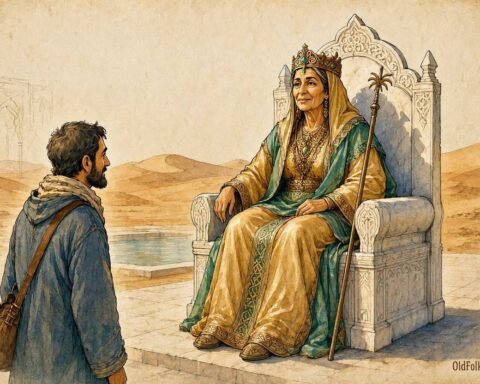
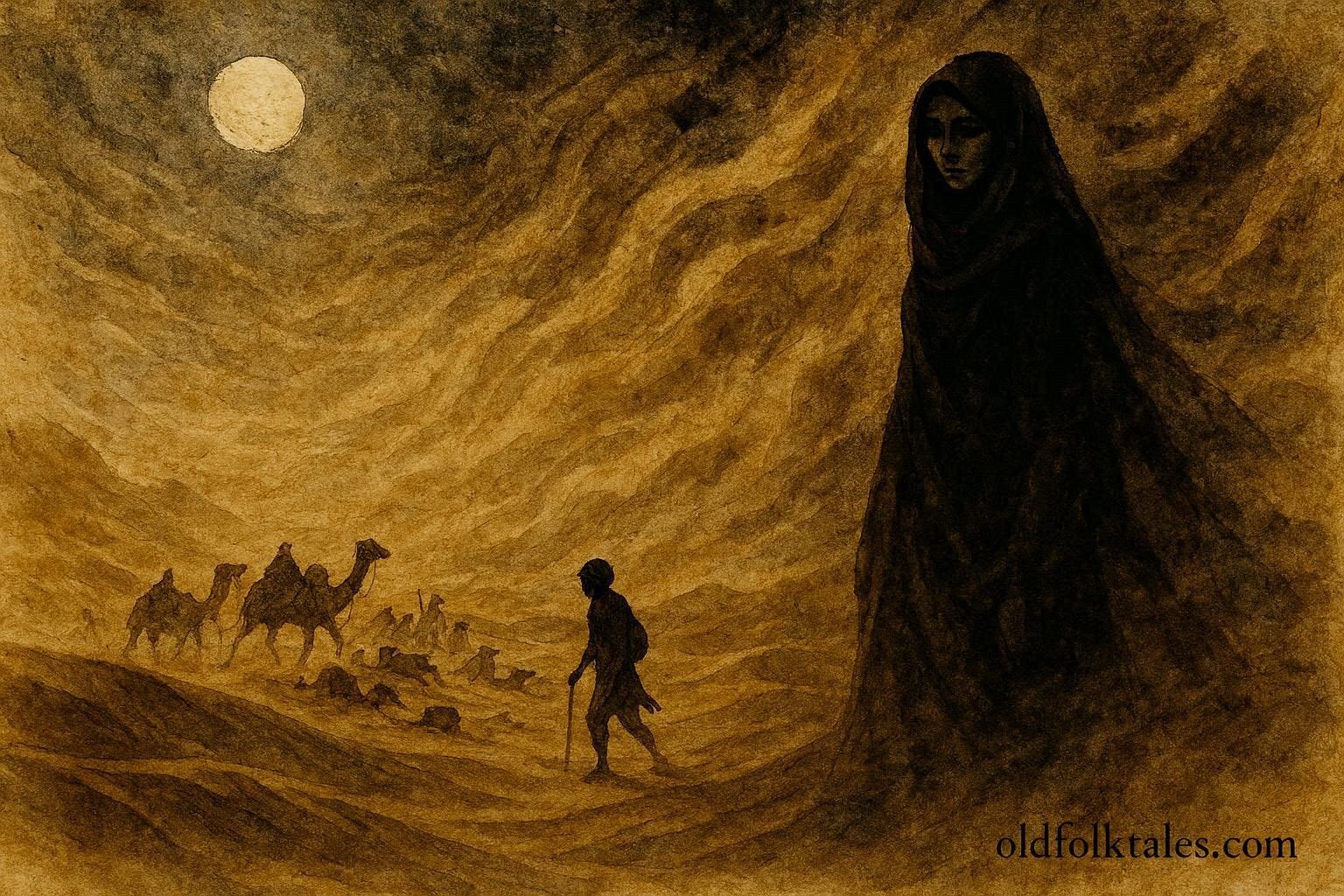
She appeared at the edge of the dunes just after dawn, where the air still held the cool breath of night.
At first, the caravan thought she was a mirage.
A lone woman standing where no village existed, her garments moving gently though no wind should have been blowing.
But as they approached, they realized she was real.
She stood calmly, her gaze steady, as though she had been waiting for them rather than appearing by chance.
The wind shifted around her.
Not violently.
Not randomly.
But deliberately.
The caravan leader raised a hand, signaling the group to stop.
“Who are you?” he called out.
The woman did not answer immediately.
Instead, she looked toward the horizon, where the dunes rolled endlessly into silence.
“I am where the wind remembers,” she said softly.
The words unsettled some of the travelers.
Others dismissed them.
The desert is full of strange speech, they told themselves.
Still, something about her presence could not be ignored.
An Offer in the Desert
The caravan leader stepped forward.
“We are bound for trade routes beyond the dunes,” he said. “We cannot delay.”
The woman turned her gaze toward him.
“I do not ask you to delay,” she replied.
“Then what do you ask?” he said.
The wind stirred slightly.
“I offer passage,” she said. “Safe passage through the shifting sands.”
The caravan exchanged uncertain glances.
Safe passage in the Sahara was no small promise.
“And in return?” the leader asked cautiously.
The woman’s expression did not change.
“Respect,” she said simply.
The word lingered in the air.
Not payment.
Not tribute.
Respect.
Some among the caravan felt uneasy.
But others saw opportunity.
The Leader’s Betrayal
That night, as the caravan rested under a sky filled with stars sharp enough to cut through darkness, the leader spoke privately with a few trusted men.
“This woman is useful,” he said. “If she can guide us through the desert, we will reach markets before others. We will gain advantage.”
One of the men hesitated.
“She asked for respect,” he reminded him.
The leader waved it off.
“Respect is not a thing you can measure,” he said. “We will give her what she wants in appearance.”
And so, they agreed.
But agreement without sincerity is another form of silence.
The Journey With the Wind
The next morning, the woman walked ahead of the caravan.
And the wind followed her.
It did not scatter them.
It guided them.
Sand shifted away from their path.
Heat softened at their passage.
The dunes seemed to open routes that were otherwise hidden.
The caravan moved with unusual ease.
Whispers spread quickly.
“She is a blessing,” some said.
“She is more than human,” others murmured.
But the leader said nothing.
He was already thinking of profit.
The Breaking of Trust
On the third day, they reached a narrow pass between two towering dunes.
It was a place where wind gathered and direction mattered most.
The woman stopped.
The wind around her changed.
“I will go no further,” she said.
The leader frowned.
“Why here?” he asked.
“This is where your journey must be guided with care,” she said.
He looked around.
The path ahead appeared safe.
He saw no danger.
Only delay.
And delay, in his mind, meant loss.
That night, he made his decision.
While the woman rested apart from the caravan, he altered the path.
He led the group away from her guidance.
Quietly.
Without informing her.
He believed he was choosing efficiency.
But he was choosing betrayal.
The Storm of the Sahara
At first, the desert seemed unchanged.
But by midday, the air grew heavy.
The wind shifted direction abruptly.
Then again.
Then violently.
The dunes began to move in ways that defied pattern.
The sky darkened, not with clouds, but with sand.
The caravan halted too late.
The storm arrived without warning.
It was not ordinary wind.
It was shaped.
Focused.
Intentional.
The woman stood at the edge of the storm, her figure barely visible through the swirling sand.
And she spoke.
“You chose without respect,” she said.
Her voice carried through the chaos.
The wind answered her.
And the desert obeyed.
The Scattering
The storm tore through the caravan.
Tents collapsed.
Animals broke free.
Goods were lost beneath shifting sand.
Men were separated by distance and blindness.
The desert, once guided, now became disoriented chaos.
And when it ended, there was no caravan left as one.
Only fragments.
Only silence.
Only scattered survival.
The Young Traveler Left Behind
Among those separated was a young traveler.
He was not a leader.
He was not among those who made decisions.
He had followed, as many did.
When the storm ended, he found himself alone.
The desert stretched in every direction.
No tracks remained.
No sound returned.
But he remembered something.
The woman.
And her words.
Respect.
The Search for Balance
He began to walk.
Not aimlessly.
But carefully.
He did not fight the desert.
He listened to it.
When wind shifted, he adjusted.
When dunes softened, he slowed.
When silence deepened, he waited.
Days passed.
Then more.
His supplies dwindled.
But something else grew within him.
Understanding.
The Return of the Wind Bride
On the seventh night, when the moon hung low and pale over the dunes, she appeared again.
Not suddenly.
Not dramatically.
But as if she had always been there.
The wind moved gently around her.
“You survived,” she said.
The young traveler lowered his head.
“I did not deserve to,” he replied.
She studied him.
“You were not the one who betrayed,” she said.
“But I was part of it,” he said quietly.
The wind shifted softly.
The Lesson of the Desert
The woman stepped closer.
“The desert does not punish without reason,” she said. “It responds to imbalance.”
The young traveler listened.
“My anger was not toward all,” she continued. “It was toward disregard.”
He nodded.
“I understand,” he said.
Silence followed.
Then he asked softly:
“Can balance return?”
The wind moved gently around them.
“It can,” she said. “But only through humility.”
Restoration
She raised her hand.
The wind calmed.
Not disappeared.
But softened.
Guided.
The young traveler felt the desert differently now, not as an enemy, but as a system of movement and respect.
She pointed toward a direction.
“Walk,” she said.
And he did.
What Became of the Caravan
The scattered members of the caravan eventually found their way back, or were found by others.
But the caravan itself never returned as it was.
The leader was never seen again.
And those who survived spoke less of trade after that.
They spoke instead of caution.
Of listening.
Of the woman who walked with wind.
Want to dive deeper? Read more North African folktales today
Moral Lesson
The desert, like nature itself, does not respond to greed or control, it responds to respect. Betrayal disrupts balance, but humility can restore it. Survival is not only about endurance, but about understanding one’s place within the world.
Knowledge Check
- What is the main lesson of “The Bride of the Wind and the Lost Caravan of the Sahara”?
The story teaches that respect for nature and others is essential, and betrayal of that balance leads to consequences. - Who is the Bride of the Wind in the folktale?
She is a mystical figure connected to the wind and desert forces, representing nature’s authority and balance. - Why did the caravan suffer the storm?
The caravan leader betrayed the woman’s trust and disregarded her guidance, disrupting the balance of respect. - How did the young traveler survive the desert?
He listened to the environment, acted with humility, and followed the principles of respect and patience. - What does the wind symbolize in the story?
The wind represents natural power, spiritual balance, and the consequences of human actions. - What cultural values are reflected in this Saharan Moroccan folktale?
The story emphasizes respect for nature, humility, communal responsibility, and moral accountability in desert life.
Source: African folktale, Morocco. Inspired by Saharan nomadic tales recorded in Stories of the Saharan Winds by Ibrahim al-Koni (1997).
Cultural Origin: Sahara Desert, Morocco