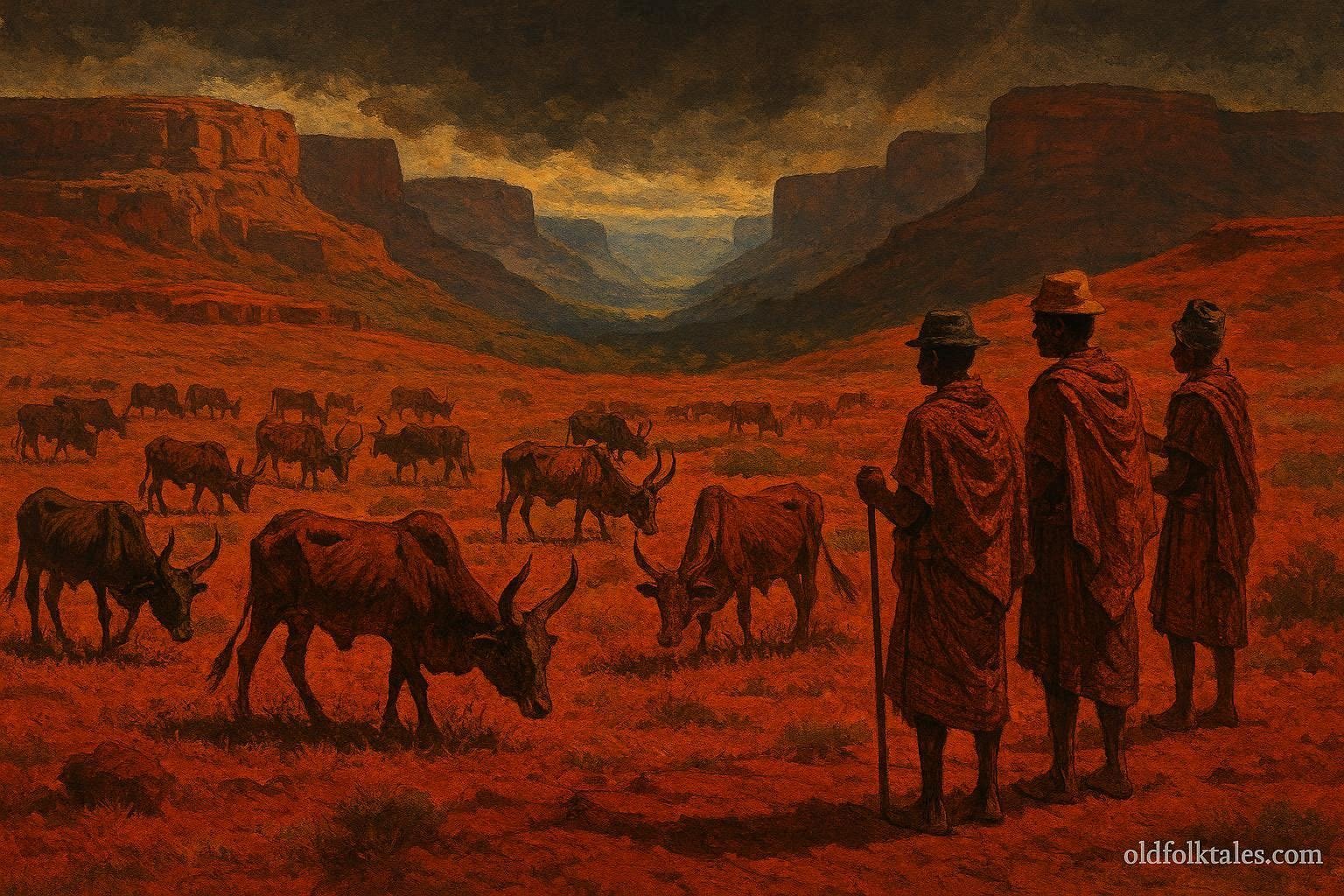
Across the vast southern plains of Madagascar stretched wide grasslands colored red beneath the dry sun and dusty winds. These lands belonged largely to the Bara people, pastoral communities whose lives revolved around cattle, ancestral honor, and survival within one of the island’s harshest environments.
Among the Bara, cattle were more than wealth.
They represented identity, leadership, spiritual connection, and social status. Families measured prosperity through the size and strength of their herds, while ceremonies, marriages, alliances, and even political authority often depended upon cattle ownership.
The most respected animals belonged to the royal herds.
These sacred cattle were believed to carry ancestral blessings connected directly to the stability of the land itself. Protected carefully across generations, they grazed upon the elevated grasslands known as the Red Plateau, an enormous stretch of high plains overlooking several villages and seasonal rivers.
If you enjoyed this story, explore our full West African folktales collection
According to tradition, as long as the royal cattle remained healthy, the kingdom would survive famine, conflict, and misfortune.
But if harm came to the sacred herd, disaster would follow.
For many years, the Red Plateau flourished.
Seasonal rains arrived reliably, rivers flowed through the valleys, and the royal herds expanded across the plains beneath the supervision of experienced cattle guardians.
Then the drought began.
At first, the changes seemed temporary.
The rainy season arrived late.
Grasslands dried earlier than expected.
Wells grew smaller.
But as months passed, conditions worsened dramatically across the southern territories. Rivers disappeared into cracked earth while dust storms spread across the plains under relentless heat.
Villagers struggled desperately to protect their livestock.
Families traveled farther each week searching for water and pasture. Hunger slowly spread as cattle weakened beneath the harsh conditions.
Fear grew strongest when strange events began affecting the royal herds.
Several sacred cattle vanished mysteriously from the Red Plateau without trace. At first, the guardians assumed thieves were responsible. Yet no tracks appeared around the grazing lands, and no neighboring communities reported stolen animals passing through their territories.
Then more cattle disappeared.
Panic spread quickly across the kingdom.
The royal herd was sacred.
Its disappearance threatened not only economic survival but the spiritual legitimacy of the leadership itself. Rumors spread among the villages that the ancestors had become angered or that ancient protections surrounding the plateau had been broken.
At the center of the crisis ruled Chief Andriabe, an aging leader respected for wisdom but increasingly weakened by the ongoing drought. Many people expected him to solve the mystery quickly before unrest spread further across the plains.
Yet despite sending trackers, hunters, and warriors across the region, no explanation emerged.
Some villagers accused rival communities of stealing the cattle secretly.
Others believed supernatural forces were involved.
One elderly diviner delivered a troubling warning during a gathering of chiefs.
“The plateau is rejecting dishonor,” she declared. “The ancestors protect what humans have neglected.”
Her words disturbed many elders because recent years had brought growing tension within the kingdom. Wealthy families increasingly fought over grazing territory while younger cattle owners ignored several old customs once respected carefully by previous generations.
Sacred ceremonies honoring the royal herd had also become less frequent.
Some feared the drought itself reflected imbalance between the people and ancestral law.
Meanwhile, divisions spread within the leadership council.
Several younger warriors demanded violent raids against neighboring territories they suspected of cattle theft. Others urged patience, fearing conflict would only worsen the suffering already affecting the plains.
Among the royal cattle guardians served a young herdsman named Mijoro.
Unlike many others, Mijoro spent most of his life upon the Red Plateau learning the behavior of the sacred herd and listening carefully to stories told by older cattle keepers. Quiet and observant, he noticed details many overlooked.
One evening while searching for missing animals near the edge of the plateau, Mijoro discovered something unusual.
Deep within a remote valley hidden beneath rocky cliffs, patches of green grass still survived despite the drought. Nearby flowed a narrow spring concealed between stones and thick vegetation untouched by most travelers.
And there, grazing peacefully beyond the valley, stood several of the missing royal cattle.
Mijoro stared in disbelief.
The animals had not been stolen.
They had wandered away from the drying plateau searching instinctively for surviving water and pasture hidden deep within the hills.
Excited by the discovery, Mijoro hurried back to inform Chief Andriabe and the royal council.
But instead of celebration, disagreement erupted immediately.
Several advisers insisted the information remain secret so only powerful families could access the hidden valley. Others argued the remaining pasture belonged solely to the sacred herds rather than ordinary villagers.
The crisis exposed dangerous greed spreading throughout the leadership.
Chief Andriabe listened silently before finally speaking.
“The cattle survived because they followed the land,” he said quietly. “But humans now threaten each other over what the ancestors intended for all.”
The old ruler realized the drought had revealed more than environmental hardship.
It exposed the weakening unity of the kingdom itself.
That night, the chief ordered a gathering across the Red Plateau despite exhaustion and fear spreading among the people.
Before the assembled villages, he announced the discovery publicly.
Then he made a decision surprising many wealthy cattle owners.
The hidden valley and spring would remain protected communal land shared carefully between families according to traditional laws rather than private ownership by elites.
Furthermore, sacred ceremonies honoring the royal cattle and ancestral responsibilities would be restored fully throughout the kingdom.
Some resisted angrily.
But most villagers supported the decision because survival now depended upon cooperation rather than rivalry.
Gradually, the kingdom adapted.
Communities worked together protecting water sources, rotating grazing lands carefully, and restoring neglected customs emphasizing unity between people, cattle, and the environment.
Months later, the rains finally returned to the southern plains.
Grasslands slowly recovered while the royal cattle once again grazed openly across the Red Plateau.
For generations afterward, the story of the Royal Cattle of the Red Plateau survived among the Bara as more than a legend about drought and missing animals.
It became a reminder that leadership requires fairness, responsibility, and respect for both ancestral law and collective survival.
Because according to old Bara belief, cattle may sustain a kingdom’s wealth —
but unity sustains the kingdom itself.
Looking for more? Explore the magic of East African folktales here
Moral Lesson
True leadership protects the survival and unity of the entire community rather than the interests of a powerful few.
Knowledge Check
- Why were cattle important to the Bara people?
Cattle represented wealth, identity, leadership, and spiritual connection. - What caused fear across the kingdom?
Sacred royal cattle disappeared during a severe drought. - Where were the missing cattle found?
They were discovered in a hidden valley with surviving water and grass. - Why did the discovery create conflict?
Some leaders wanted to control the hidden resources for themselves. - What decision did Chief Andriabe make?
He shared the valley’s resources fairly among the communities. - What lesson does the story teach?
Communities survive through fairness, cooperation, and responsible leadership.
Source
Madagascan pastoral folklore. Adapted from Bara cattle traditions documented in Malagasy pastoral ethnographic research and folklore archives.