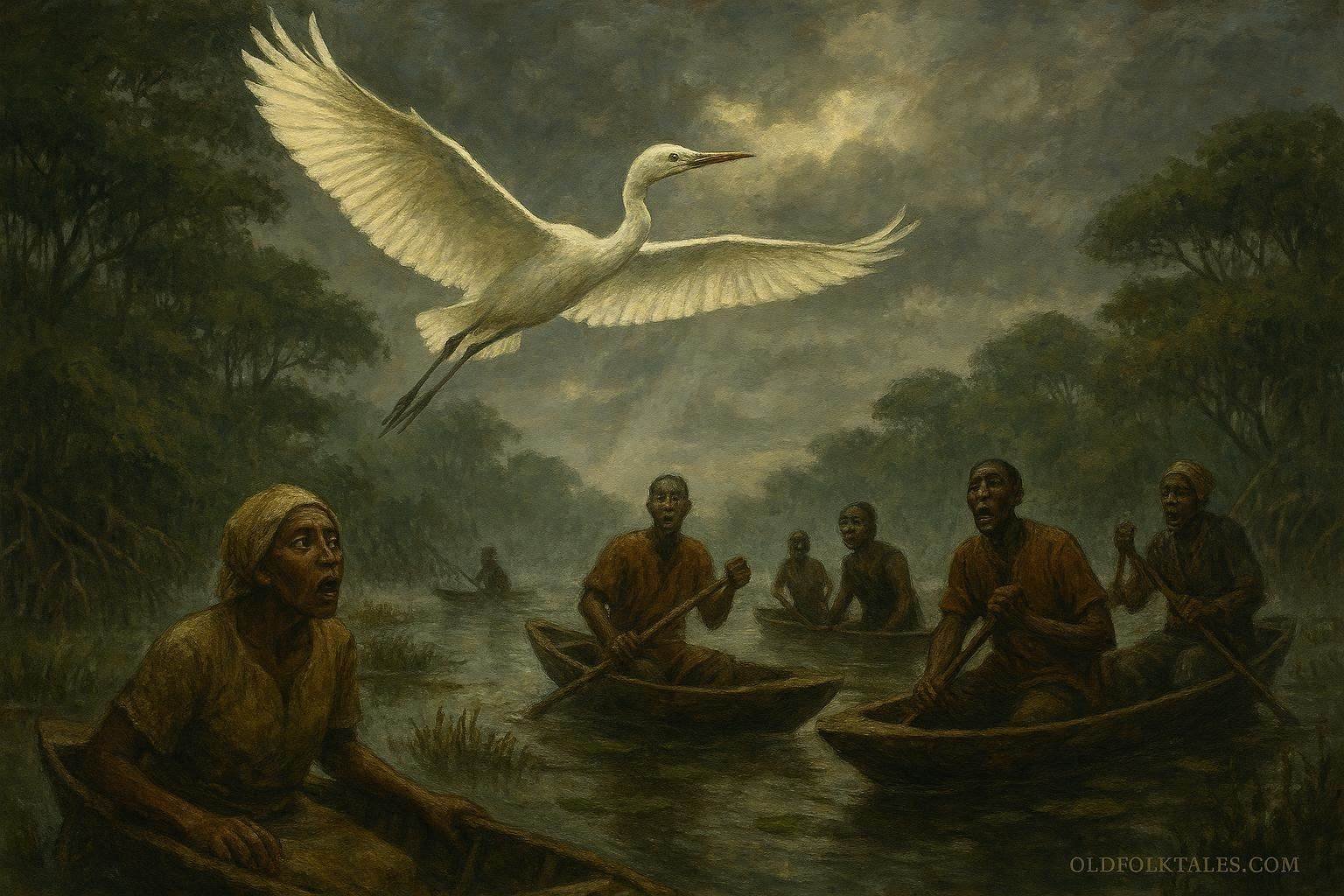
In the northern regions of Guinea-Bissau, beyond the crowded fishing villages and winding riverbanks, stretched the wide wetlands and marshes of Mansoa. Tall grasses moved endlessly with the wind, rivers twisted through muddy channels, and thick mangrove forests bordered waters filled with fish, crocodiles, and migrating birds.
For generations, the Papel people lived beside these wetlands, depending on the marshes for survival. Fishing, farming, and seasonal trade shaped village life, while elders carefully preserved stories explaining the spiritual balance between nature, ancestors, and humanity.
Among the Papel, birds were never seen as ordinary creatures.
Certain birds were believed to carry messages.
Others symbolized ancestral protection.
And one bird above all inspired both fear and respect throughout the Mansoa Marshes.
It was known simply as the White Bird.
According to oral tradition, the bird appeared only during moments when the future of the region was about to change. Sometimes its arrival came before floods, conflict, famine, or migration. At other times, it appeared before moments of renewal and prosperity.
Continue your journey: Read more East African folktales
No one knew exactly where it came from.
Some claimed it lived deep within forbidden wetlands untouched by humans.
Others believed it belonged to the ancestors themselves.
But every generation carried stories about those who saw the White Bird shortly before history changed forever.
Long ago, during a season remembered for strange weather and political uncertainty, a village named Canhabaque stood near the edge of the Mansoa Marshes. The village depended heavily on fishing and rice farming, and although life remained difficult, the people lived peacefully under the guidance of respected elders.
Among the villagers lived a young fisherman named Boro.
Boro was known for his curiosity and his habit of wandering deeper into the wetlands than most others dared. While many fishermen avoided isolated parts of the marshes believed to contain dangerous spirits or sacred territory, Boro often explored hidden waterways searching for larger fishing grounds.
The elders frequently warned him.
“The marsh remembers everything,” they would say.
“Those who travel carelessly may return carrying knowledge they were never meant to find.”
But Boro rarely feared such stories.
One year, however, unusual signs began spreading across the region.
The rainy season arrived late.
Fish moved strangely through the rivers.
Bird migrations shifted unexpectedly.
Even experienced elders admitted the marshes felt different.
Then one morning, while traveling alone through a narrow water passage surrounded by thick reeds, Boro noticed complete silence settling over the wetlands.
No insects.
No birdsong.
No movement in the grass.
Only stillness.
Suddenly, a large white bird descended from the mist and landed on a dead tree rising from the water ahead.
Boro froze immediately.
The bird was unlike anything he had ever seen.
Its feathers appeared almost silver beneath the morning light.
Its eyes reflected the water strangely.
And despite the distance between them, Boro felt as though the creature was watching him with human understanding.
For several moments, neither moved.
Then the bird spread its wings slowly and flew deeper into the marshes before disappearing completely into the fog.
Boro returned to the village shaken by what he had witnessed.
When he described the bird to the elders, fear spread immediately among them.
Several elderly women began whispering prayers.
Others demanded silence.
The oldest elder in the village, a man named Tcherno, listened carefully before speaking.
“The White Bird has returned,” he said quietly.
That evening, the village gathered while Tcherno explained the meaning behind the legend.
According to ancestral tradition, the White Bird appeared only before major turning points affecting the future of entire communities. Its arrival was neither good nor evil by itself.
It was a warning.
A sign that change was approaching.
The elders urged the village to remain united and observant in the coming weeks.
But many younger villagers dismissed the fears as superstition.
Some believed Boro simply saw a rare migrating bird.
Others argued the old legends belonged to earlier generations who feared the unknown.
Still, strange events continued.
A powerful storm struck unexpectedly days later, flooding parts of nearby farmland. Then traders arriving from distant regions carried troubling news of political tensions spreading between several neighboring territories.
Soon afterward, fishing yields began declining sharply across the marshes.
Food shortages slowly followed.
As conditions worsened, arguments increased between villages competing over shrinking resources. Several communities accused others of crossing traditional fishing boundaries illegally.
Fear and distrust spread rapidly throughout the region.
During this period, Boro became increasingly troubled by dreams.
Night after night, he saw the White Bird flying across dark waters while villages below struggled beneath storms and fire.
In the dreams, the bird always circled toward the northern marshes before vanishing into mist.
Finally, Boro shared the dreams with Tcherno.
The elder listened carefully before making an important decision.
He believed the dreams were guiding them toward safety.
According to old traditions, hidden higher ground existed deep within the northern wetlands where earlier generations once survived floods and conflict long before the present villages were established.
But the routes had been forgotten over time.
As tensions across the region worsened, Tcherno convinced several families to follow Boro into the marshes searching for the lost refuge.
Many villagers refused.
Some mocked the decision openly.
Others feared abandoning their homes.
But Boro trusted the signs.
Guided by memory, dreams, and instinct, the group traveled deeper into the wetlands than most had ever gone.
The journey proved exhausting.
Dense reeds blocked their movement.
Dangerous waters surrounded them.
And several times they nearly became lost entirely.
Then, one misty morning, the White Bird appeared again.
This time it flew slowly ahead of them, stopping repeatedly as though guiding their path.
The group followed carefully.
Hours later, they discovered elevated land hidden between thick mangrove forests and surrounded naturally by waterways difficult for outsiders to cross.
Ancient stone remains confirmed that earlier settlements once existed there generations before.
The refugees settled temporarily upon the hidden ground.
Only days later, devastating conflict spread through portions of the region as rival communities fought over resources and territory weakened by environmental hardship.
Flooding destroyed several lowland villages.
Trade collapsed temporarily.
And many families fled the marshes searching for safety.
Because of their early departure, Boro’s group survived the chaos largely unharmed.
Months later, when peace slowly returned, survivors from different villages reunited and rebuilt new settlements together upon safer ground.
The story of the White Bird spread across the region afterward, becoming one of the most respected legends among the Papel people.
Some believed the bird represented ancestral protection.
Others believed nature itself warned humanity before disaster arrived.
But all agreed on one truth.
Those who ignored the balance between the environment, community, and wisdom of earlier generations often failed to recognize danger until it was too late.
Even today, elders in Guinea-Bissau say unusual white birds appearing over the Mansoa Marshes should never be dismissed carelessly.
Because according to tradition, the marshes speak through signs long before history changes course.
Click here to discover more legendary tales from West Africa
Moral Lesson
Wisdom, unity, and respect for ancestral knowledge can help communities survive times of uncertainty and change.
Knowledge Check
- Where is the story set?
It is set in the Mansoa Marshes of Guinea-Bissau. - Who was Boro?
He was a young fisherman who explored deep areas of the wetlands. - What made the White Bird special?
Villagers believed it appeared before major changes or disasters. - What happened after the White Bird appeared?
Floods, conflict, and food shortages began affecting the region. - How did Boro help the villagers survive?
He guided families to hidden safe land within the marshes. - What lesson does the story teach?
Communities should respect wisdom, nature, and ancestral warnings.
Source
West African folklore. Adapted from Papel bird symbolism traditions preserved in Guinea-Bissauan oral narratives and ecological folklore studies.