In the southern regions of Guinea-Bissau, where rivers twisted through forests, wetlands, and rice fields before flowing toward the Atlantic Ocean, the people of Tombali lived closely connected to water.
The rivers fed farms.
They sustained fishing communities.
And they served as pathways linking villages scattered across the dense landscape.
Among the Balanta people, water was respected as more than a natural resource.
Rivers were believed to hold spiritual presence.
Certain waterways were connected to ancestral forces, protective spirits, and sacred traditions passed down through oral history. Elders taught that rivers carried memory, and those who approached them carelessly risked disturbing powers older than any village.
One particular legend from Tombali became famous throughout the region.
It was the story of the Sacred River Bride.
Fascinated by this tale? Discover more North African folktales
Long ago, during a terrible season of famine, southern Guinea-Bissau suffered through one of the harshest environmental crises remembered in Balanta oral tradition.
The rains arrived late.
Rice fields dried before harvest.
Fish became scarce within the rivers.
And hunger spread slowly across the region.
Entire villages struggled to survive.
Families traveled long distances searching for food while elders gathered constantly to discuss how the balance between humanity and nature had become disturbed.
Among the villages affected by the famine was a riverside settlement named Cacine.
The village depended heavily on farming and fishing, but both had nearly collapsed under the changing conditions.
As desperation grew, old spiritual leaders began revisiting ancient ceremonial traditions rarely practiced anymore.
According to ancestral belief, certain periods of severe hardship required sacred ceremonies to restore harmony between the living world and the river spirits believed to protect the land.
One of these ceremonies involved selecting a symbolic River Bride.
The role was not considered a sacrifice in the ordinary sense.
Rather, the chosen woman served as a spiritual representative carrying the prayers, grief, and hopes of the people during rituals performed beside sacred waters.
The River Bride symbolized purity, balance, and unity between humanity and nature.
During the famine, the elders agreed the ceremony must be performed again.
But choosing the River Bride proved difficult.
Many families feared the ancient traditions because stories surrounding earlier ceremonies often ended mysteriously.
Some claimed the rivers demanded deeper offerings during times of great suffering.
Others believed the chosen women simply disappeared into distant settlements afterward to live as spiritual servants connected to sacred waters.
No one knew the complete truth anymore.
After several weeks of discussion, the elders selected a young woman named Aminata.
Aminata was known throughout Cacine for her calm spirit and unusual connection to the river. Since childhood, she spent long hours near the water, often claiming she could sense changes in the river before storms or floods arrived.
Fishermen sometimes relied on her instincts before traveling.
Even elders admitted her presence seemed strangely tied to the rhythms of the river itself.
When informed of her selection, Aminata remained silent for a long time.
Her family reacted with fear.
Her mother begged the elders to reconsider.
But according to tradition, refusing the role after ancestral signs appeared could bring greater disaster upon the community.
Eventually, Aminata accepted.
Preparations for the ceremony began immediately.
Women gathered white cloth used during sacred rituals.
Fishermen cleaned ceremonial canoes.
And elders prepared offerings of rice, palm oil, river herbs, and carved wooden symbols representing ancestral protection.
Meanwhile, strange signs spread across the village.
Birds gathered unusually near the riverbanks.
The water level shifted unpredictably despite the drought.
And villagers reported hearing unfamiliar sounds at night rising from the river after midnight.
Fear mixed with hope throughout Cacine.
Some believed the ceremony would restore balance.
Others worried the famine had already angered the spirits beyond forgiveness.
On the morning of the ritual, the entire village gathered beside the sacred river before sunrise.
Mist drifted across the water.
Drums echoed softly through the trees.
And elders stood quietly beside decorated canoes waiting for the ceremony to begin.
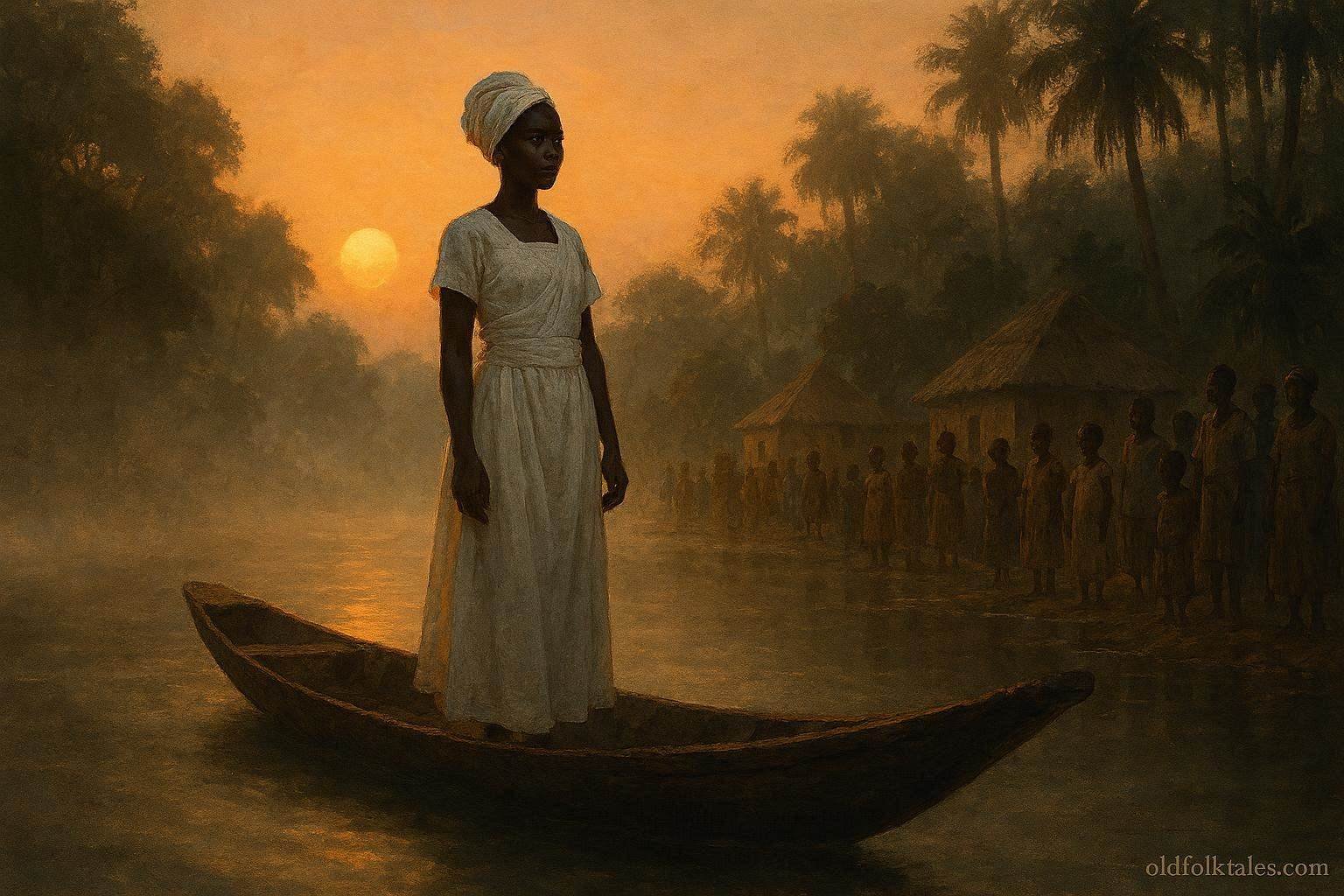
Aminata arrived wearing white ceremonial cloth decorated with cowrie shells and river beads passed down through earlier generations.
Though nervous, she walked calmly toward the water.
The spiritual leader of the ceremony raised his hands and spoke ancient prayers asking the river spirits to restore life to the land.
He asked for rain.
For fish.
For healing.
And for peace between humanity and the natural world.
Then Aminata stepped into the ceremonial canoe alone.
Tradition required the River Bride to travel briefly into the center of the sacred water while the village remained watching from shore.
The canoe drifted slowly through the morning mist.
At first, everything appeared peaceful.
The river remained calm.
The drums continued softly.
Then suddenly the wind changed.
The water began moving strangely around the canoe.
Several villagers gasped as thick fog spread rapidly across the river surface.
Within moments, Aminata and the canoe became almost completely hidden from view.
Panic spread along the riverbank.
Some fishermen prepared to launch rescue boats immediately.
But the elders ordered everyone to remain still.
According to tradition, interrupting the ceremony before its completion could bring greater disaster.
The village waited in silence.
Minutes passed.
Then longer.
Finally, the fog slowly lifted.
But the canoe was empty.
Aminata had vanished.
No signs of struggle appeared.
No overturned boat.
No movement within the water.
Only silence.
Shock spread across the village.
Some women cried openly.
Others fell to their knees praying.
Search parties spent days exploring the riverbanks and nearby waterways, but no trace of Aminata was ever discovered.
Soon afterward, however, unusual changes began affecting the region.
Heavy rains returned unexpectedly after months of drought.
The rivers filled again.
Fish populations recovered rapidly.
And abandoned rice fields slowly became fertile once more.
The famine gradually ended.
For many villagers, the timing could not be ignored.
Some believed Aminata had been taken by river spirits as a sacred protector of the waters.
Others believed she crossed permanently into the spiritual world during the ceremony itself.
A few argued she survived and chose never to return, becoming part of hidden spiritual communities connected to ancient traditions.
But no explanation was ever confirmed.
Over time, the story of the Sacred River Bride spread throughout southern Guinea-Bissau.
Future ceremonies honoring the river continued, though none ever repeated the exact ritual that ended with Aminata’s disappearance.
Among the Balanta people, her story became a symbol of mystery, sacrifice, and humanity’s fragile relationship with nature.
Even today, elders near parts of the Tombali rivers say that during heavy mist before sunrise, a lone canoe can sometimes be seen drifting silently across the water.
And inside sits a young woman dressed in white, watching the riverbanks before disappearing again into the fog.
Click here to discover more legendary tales from West Africa
Moral Lesson
Communities must respect nature, spiritual traditions, and the sacrifices made to preserve balance during times of hardship.
Knowledge Check
- Where is the story set?
It is set in the Tombali region of Guinea-Bissau. - Why was the River Bride ceremony performed?
The region was suffering from famine and environmental hardship. - Who was Aminata?
She was the young woman chosen to serve as the Sacred River Bride. - What happened during the ceremony?
Aminata vanished after drifting into thick fog on the river. - What changed after her disappearance?
Rain returned, rivers recovered, and the famine slowly ended. - What lesson does the story teach?
People should respect nature, spiritual balance, and ancestral traditions.
Source
West African folklore. Adapted from Balanta river traditions preserved in Tombali ritual folklore archives and ethnographic studies from Guinea-Bissau.