Towering above the city of Cape Town, Table Mountain has watched over the southern coast of Africa for centuries.
Its massive flat summit rises above the ocean like a silent guardian, visible from ships approaching the Cape long before the city itself comes into view.
For generations, travelers, sailors, traders, and local communities have attached stories to the mountain.
Some believe it protects the city.
Others believe it remembers everything that has happened beneath its shadow.
Among the oldest and most feared legends preserved in Cape Town oral tradition is the story of the Veiled Queen of Table Mountain.
If you enjoyed this story, explore our full West African folktales collection
According to the legend, a mysterious woman dressed entirely in white appears along the mountain paths and cliffs shortly before disaster strikes the city below.
Sometimes she is seen before violent storms.
Sometimes before shipwrecks along the coast.
And sometimes before periods of political unrest and tragedy.
No one knows who she truly is.
Some say she is the spirit of a forgotten royal woman from long before colonial settlement.
Others believe she is connected to the ocean itself, a guardian spirit warning the city when imbalance approaches.
Among both Cape Malay and Afrikaans storytelling traditions, the Veiled Queen became a symbol of warning that could never be ignored.
The most famous account of her appearance took place many years ago during a period of growing tension in Cape Town.
At the center of the story was a young newspaper writer named Daniel Jacobs.
Daniel lived near the Bo-Kaap district and worked for a small local publication documenting social events, trade developments, and political debates spreading across the city.
Cape Town during this period was restless.
Public anger was growing over political inequality, corruption, and rising violence between rival groups competing for influence and control.
Though daily life continued normally on the surface, many people quietly feared that the city stood on the edge of serious instability.
Daniel spent much of his time interviewing dockworkers, merchants, fishermen, and community leaders across the harbor districts.
Because of this, he often heard rumors before official reports appeared publicly.
One evening, after finishing an interview near the waterfront, Daniel noticed unusual weather moving across the mountain.
Heavy clouds gathered rapidly around the summit despite the sky being clear only hours earlier.
The famous “tablecloth” mist slowly began spilling over the edges of Table Mountain like rolling white smoke.
An elderly fisherman nearby crossed himself quietly and muttered something Daniel barely heard.
“The Queen walks tonight.”
Daniel laughed politely at first.
He had heard stories about the Veiled Queen growing up, but he considered them only folklore repeated to frighten children and entertain tourists.
Still, the old fisherman’s expression remained serious.
“She appears before the city suffers,” the fisherman warned.
That night, curiosity stayed with Daniel.
Unable to ignore the story completely, he decided to hike partway up the lower mountain paths early the next morning before sunrise, hoping perhaps to gather material for a newspaper article about local legends.
The air was cold and covered in mist when he began climbing.
The city below remained quiet beneath the early morning darkness while waves crashed faintly against the distant shoreline.
As Daniel moved higher along the rocky path, the fog thickened until visibility became difficult.
The mountain felt strangely silent.
No birds.
No wind.
Only the sound of his footsteps against stone.
Then he saw her.
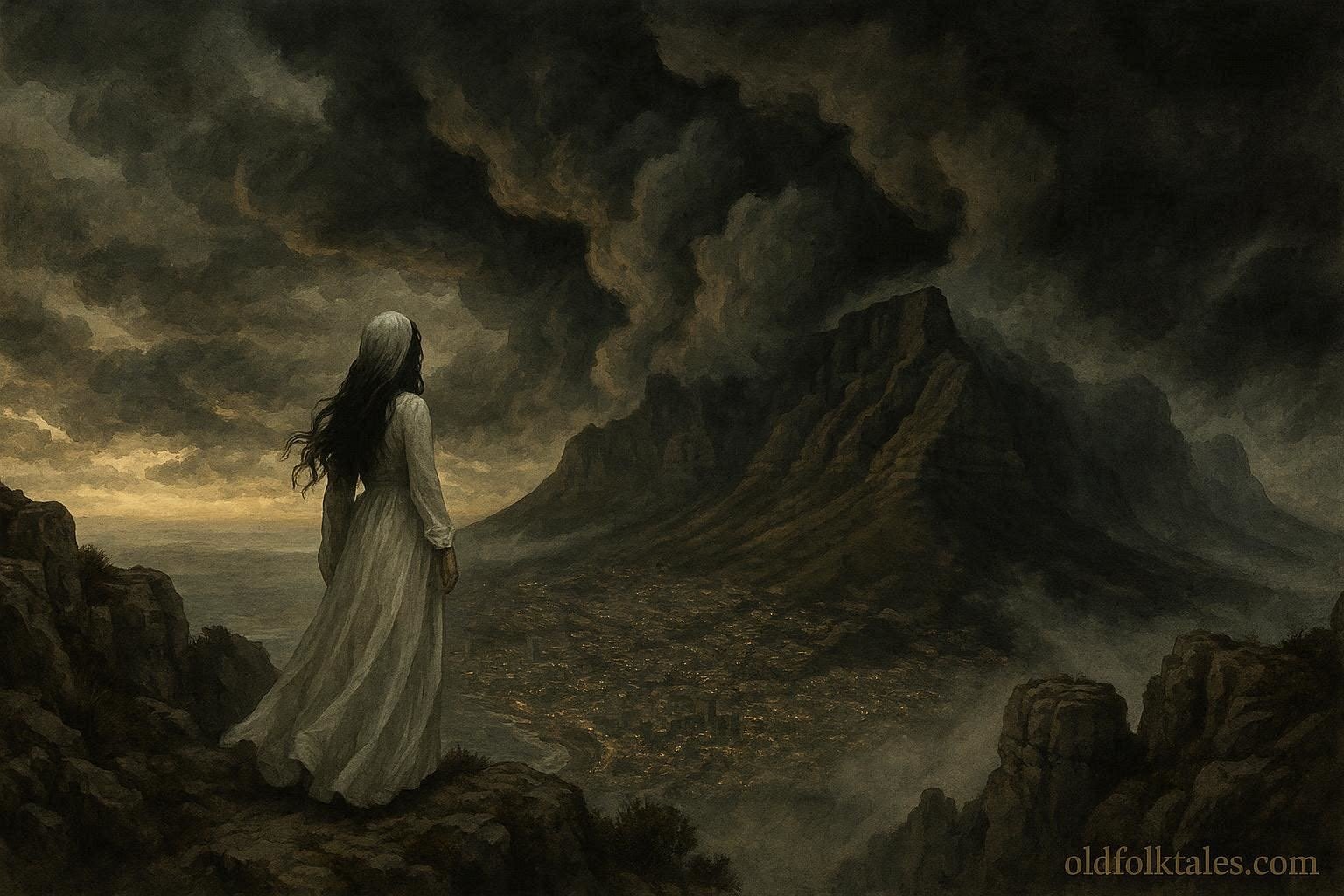
Standing near the edge of a cliff overlooking the city was the figure of a woman dressed entirely in white.
Her clothing moved gently despite the still air.
A long veil covered part of her face, making her features impossible to see clearly.
Daniel stopped immediately.
For several seconds, neither of them moved.
Then the woman slowly turned toward him.
Though her face remained hidden beneath the veil, Daniel felt an overwhelming sense of sadness and warning in her presence.
Not anger.
Not threat.
Warning.
She lifted one hand slowly toward the city below.
At first, Daniel thought she was pointing toward the harbor.
Then he realized smoke was already beginning to rise from part of the waterfront district far below.
At almost the same moment, thunder echoed across the mountain.
The fog thickened violently around him.
When Daniel looked back toward the woman, she was gone.
Completely vanished.
The storm arrived within hours.
Heavy winds and rain battered Cape Town’s harbor while fires spread through parts of the waterfront storage district after lightning struck nearby buildings.
Several ships were damaged during the storm, and political demonstrations already growing in the city quickly turned violent in the chaotic aftermath.
Daniel could not stop thinking about the woman on the mountain.
Over the following months, he quietly investigated older accounts of similar sightings.
What he discovered unsettled him deeply.
Throughout Cape Town’s history, stories of the Veiled Queen appeared repeatedly before major disasters.
Before destructive storms.
Before political violence.
Before epidemics and fires.
Witness descriptions were always nearly identical.
A woman dressed in white.
Seen near the cliffs or pathways of Table Mountain.
Appearing silently before vanishing into mist.
Some historians dismissed the stories as coincidence shaped by fear and imagination.
Others believed the legend reflected collective anxiety projected onto the mountain during periods of uncertainty.
But among local communities, belief in the Veiled Queen remained strong.
Daniel eventually interviewed an elderly Cape Malay storyteller named Amina Davids, who offered a different interpretation of the legend.
“The Queen does not bring disaster,” Amina explained.
“She appears because people stop listening to the warnings already around them.”
According to Amina, the mountain itself represented memory and balance.
When greed, injustice, violence, or division grew too powerful within the city, the Veiled Queen appeared as a reminder that consequences were approaching.
Not through magic.
But through human actions ignored for too long.
Years later, Daniel became one of the city’s most respected writers, known for documenting oral traditions and preserving local folklore before it disappeared.
Yet he never publicly wrote the full truth about what he saw on Table Mountain.
Only near the end of his life did he admit privately to close friends that the Veiled Queen was real.
And even today, some hikers and late-night travelers in Cape Town claim that during heavy mist or before violent storms, a silent woman dressed in white can sometimes still be seen standing along the cliffs of Table Mountain, watching the city below.
Waiting.
Warning.
And disappearing once the first thunder reaches the mountain.
Love this story? Discover our full Southern African folktales collection
Moral Lesson
Warnings often appear long before disaster arrives, but people only recognize them when it is almost too late.
Knowledge Check
- Where is the story set?
It is set around Table Mountain in Cape Town, South Africa. - Who is the Veiled Queen?
She is a mysterious woman in white believed to appear before disasters and unrest. - Who encountered the Veiled Queen in the story?
A young newspaper writer named Daniel Jacobs saw her on the mountain. - What happened after the Queen appeared?
A violent storm and political unrest struck Cape Town shortly afterward. - What did storyteller Amina Davids believe about the legend?
She believed the Queen appears when people ignore growing danger and imbalance. - What lesson does the story teach?
People should pay attention to warnings before problems grow into disasters.
Source
South African folklore. Adapted from Cape Town oral legends preserved in Cape supernatural folklore archives and regional folklore studies.