High in the rugged mountains of Sanaag in northern Somalia, where rocky cliffs rise above dry valleys and winds move endlessly across the highlands, lies the town of Erigavo.
Life in this region has always been shaped by the land.
The mountains determine movement.
The weather shapes survival.
And community ties are strengthened by shared respect for both nature and ancestral tradition.
Among Somali pastoral communities of the highlands, certain places are believed to hold spiritual significance beyond their physical appearance.
Some hills are avoided at night.
Some valleys are used only during specific seasons.
And a few locations are considered sacred because of their connection to ancient rituals said to preserve balance between people and the land.
One of the most respected traditions in the Erigavo region is the legend of the Sacred Flames.
According to oral history preserved across generations, there are ceremonial fires that have burned continuously in hidden mountain locations for as long as memory can recall.
Explore the wisdom and wonder of North African folktales
These flames are not ordinary fires.
They are believed to be maintained through ancestral blessings, ritual guardianship, and strict spiritual laws passed down among elders.
The fires are said to protect nearby settlements from misfortune.
When the flames burn steadily, peace is preserved.
When they weaken, communities become vulnerable to conflict, drought, or instability.
Because of this belief, elders across Sanaag have long treated the Sacred Flames with deep respect.
Long ago, during a period of tension between neighboring clans, the region around Erigavo faced growing uncertainty.
Rainfall had become irregular.
Grazing lands were shrinking.
And competition for water sources increased hostility between pastoral groups who depended on shared resources for survival.
At the center of this fragile situation was a young herder named Guled.
Guled belonged to a family known for guiding livestock across difficult mountain routes. He had grown up hearing stories about the Sacred Flames but had never seen them himself.
To him, they were legends told to teach respect for tradition and unity among clans.
But during the difficult season, something unusual began to happen.
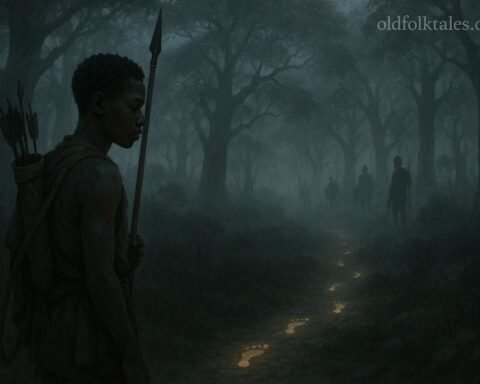
Guled and other herders traveling through the highlands noticed faint glowing light appearing at night in distant mountain areas where no settlements existed.
At first, they assumed it was natural reflection or campfires from unseen travelers.
But the lights remained constant.
Always in the same distant location.
Always appearing at nightfall.
Curiosity grew among younger herders.
Some wanted to investigate.
Others feared disturbing something sacred.
One evening, after tensions between two nearby clans escalated into a violent dispute over grazing land, Guled made a decision.
He would climb toward the distant glow to understand what it truly was.
Despite warnings from elders not to approach the sacred highland zones without guidance, Guled set out early the next morning.
The journey was difficult.
Steep rocky paths made movement slow.
Winds grew stronger as he climbed higher into the mountains.
And the air became colder as the sun began to set.
By nightfall, Guled reached a remote ridge overlooking a hidden valley.
There, he saw it.
A fire burning in the distance.
But it was unlike any fire he had ever seen.
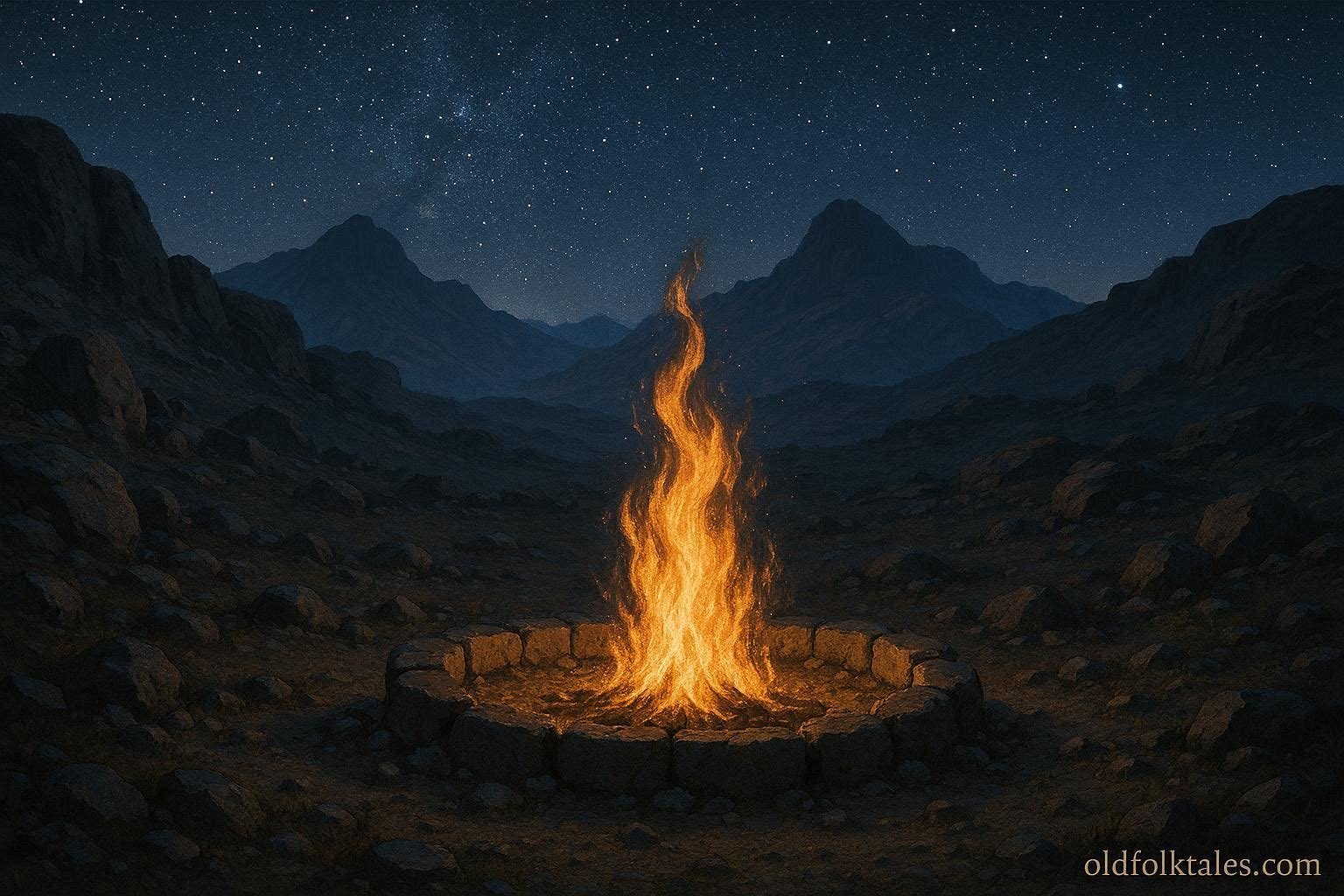
The flames rose steadily from a stone circle placed deep within the mountain basin.
There were no visible people tending it.
No wood or fuel surrounding it.
Yet the fire burned with a calm, steady light that did not flicker violently like ordinary flames.
Instead, it moved gently, almost rhythmically, as if responding to something unseen.
As Guled watched, he noticed something even more unusual.
The air around the fire felt peaceful.
The tension he had carried from the conflict below seemed to ease.
For a moment, he felt no fear, only clarity.
Then he heard a voice.
Not loud.
Not human in the ordinary sense.
But calm, echoing through the wind itself.
“You have come without anger,” the voice seemed to say.
Startled, Guled looked around but saw no one.
The voice continued.
“These flames burn where unity is remembered. They weaken when division grows. They survive only where people choose balance over conflict.”
Guled stood silently, understanding slowly forming in his mind.
The fire was not protecting the land through force.
It reflected the state of the people who lived upon it.
If communities fell into violence and greed, the balance that sustained harmony would weaken.
If unity returned, the fire would remain strong.
As he stood there, Guled noticed something else.
The flames flickered briefly.
Not because of wind.
But as if responding to the memory of conflict he had witnessed earlier that day.
Realizing the significance, Guled returned quickly to his village before dawn.
He shared what he had seen with the elders and clan leaders.
At first, many were skeptical.
Some dismissed it as imagination.
But others recognized the deeper meaning behind the story.
Whether the flames were physical, spiritual, or symbolic, they represented something important.
Balance among people was necessary for survival.
Without it, even the strongest communities would weaken from within.
The elders called for a council between the conflicting groups.
Negotiations were slow and difficult, but eventually agreements were reached to share grazing land more fairly and reduce tensions.
Over time, peace slowly returned to the region.
And according to tradition, travelers passing through the Erigavo highlands still report seeing distant flickers of light in the mountains during clear nights.
Some say they are natural fires.
Others believe they are the Sacred Flames continuing their silent watch.
But among the elders, the belief remains simple.
As long as unity is preserved, the flames will never go out.
And if division grows again, the mountains will remind the people once more.
Continue your journey: Read more East African folktales
Moral Lesson
Unity and balance within communities are what truly protect people from conflict and hardship.
Knowledge Check
- Where is the story set?
It is set in the mountains near Erigavo in the Sanaag region of Somalia. - What are the Sacred Flames?
They are eternal ceremonial fires believed to protect nearby communities. - Who was Guled?
He was a young herder who discovered the meaning of the Sacred Flames. - What did the flames represent?
They represented unity, balance, and harmony among communities. - What happened after Guled’s discovery?
Local clans began resolving conflict and restoring peace. - What lesson does the story teach?
Unity and cooperation are essential for community survival and stability.
Source
Somali folklore. Adapted from Sanaag mountain oral traditions preserved in highland folklore archives and regional ethnographic studies.