Along the southern coast of Somalia, where the Jubba River meets the Indian Ocean near the port city of Kismayo, life has always been shaped by the sea.
For the Bajuni Somali communities who have lived along these shores for generations, the ocean is both a source of sustenance and a force of mystery.
It provides fish for survival.
It connects coastal trade routes stretching across East Africa and the Arabian Peninsula.
And it carries stories older than the harbor walls themselves.
Among these stories is one that fishermen still speak of with caution during quiet nights at sea.
The legend of the Moon Fishermen of Kismayo.
In Kismayo, fishing is often done at night when the waters are calmer and fish rise closer to the surface.
Don’t miss out: Read more Southern African folktales
Experienced fishermen read the ocean like a living language.
They watch the wind.
They follow currents.
And they often rely on the light of the moon to guide their small wooden boats through the dark waters.
But there are nights when the sea behaves differently.
Nights when the waves grow unnaturally still.
Nights when the wind disappears completely.
And nights when the moonlight reflects across the ocean like a silver path stretching endlessly into the horizon.
It is during these nights, according to oral tradition, that the Moon Fishermen appear.
The story begins with an experienced fisherman named Abshir, known in his village for his deep understanding of ocean patterns.
He had spent his entire life navigating the waters off Kismayo and had never believed in supernatural tales told by older fishermen.
To him, the sea was predictable if one knew how to read it properly.
But one particular night would challenge everything he believed.
Abshir and a small group of fishermen set out just after sunset, hoping for a good catch during the full moon.
The weather was calm.
The water was unusually smooth.
And the moon hung bright above the ocean, casting long reflections across the waves.
For several hours, fishing went as expected.
The nets filled steadily.
The boats drifted slowly along familiar currents.
And conversation among the fishermen remained relaxed.
Then, without warning, the sea grew silent.
The fish stopped biting.
Even the movement of the water seemed to pause.
Abshir noticed something strange on the horizon.
At first, he thought it was another fishing boat returning late.
But as it approached, he realized something was wrong.
The boat made no sound.
No oars.
No sails moving in the wind.
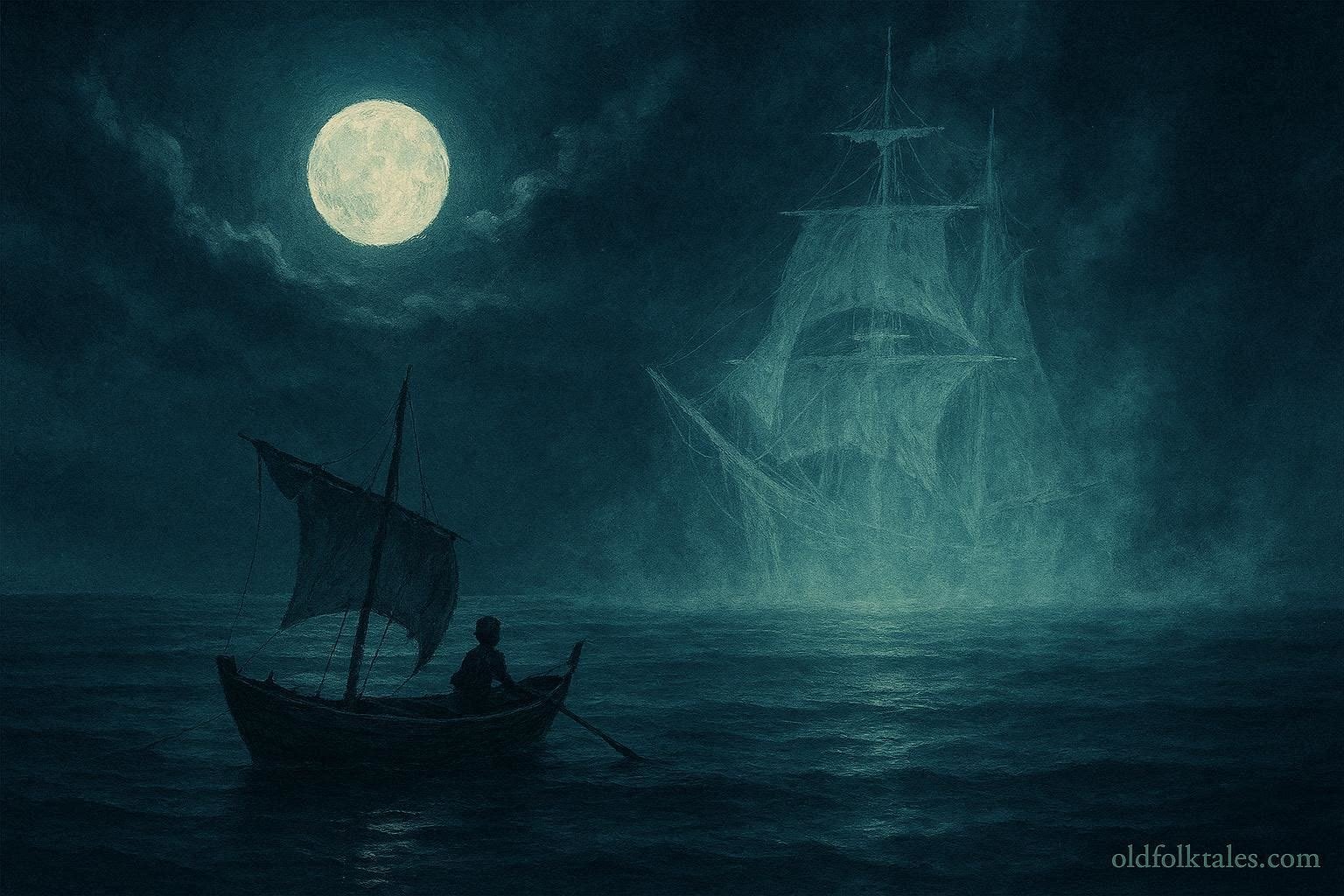
It simply drifted across the water in perfect silence.
As it came closer, Abshir saw that the vessel looked old, almost ancient.
The wood appeared worn but not decayed.
And there were figures aboard it, standing still and facing forward.
None of them spoke.
None of them moved.
The other fishermen noticed it too and began calling out.
But no response came from the approaching boat.
Instead, it continued gliding across the water as if carried by something unseen beneath the surface.
One of the younger fishermen became frightened and suggested turning back immediately.
But Abshir, though uneasy, insisted on observing the strange vessel more closely.
As the distance between the boats narrowed, something even more unsettling occurred.
The water beneath both vessels became perfectly still, reflecting the moon so clearly that it looked like a second sky beneath them.
Then, from the silent boat, a sound emerged.
It was faint at first.
Like distant chanting carried across water.
Then it grew clearer.
A rhythmic pattern of voices, low and echoing, like fishermen singing an ancient song in a language Abshir did not recognize.
The sound felt both familiar and deeply foreign at the same time.
The younger fishermen panicked and began rowing away.
But Abshir remained frozen, watching the ghostly vessel pass beside them.
As it moved, he saw something even more disturbing.
The faces of the figures on the boat were not entirely visible, as if partially hidden by shadow and mist.
But their movements were synchronized with the waves themselves.
It was as though they were not sailing on the ocean.
They were part of it.
The ghostly boat passed without collision or disturbance.
And as quickly as it appeared, it faded into the moonlit distance, dissolving into mist over the water.
When silence returned, the sea slowly began to move again.
The fishermen rowed back to shore immediately, abandoning their catch.
When they reached the village, they reported everything to the elders.
The elders listened without interruption.
When the fishermen finished speaking, an old coastal storyteller named Sheikh Nur nodded slowly.
He was not surprised.
Instead, he explained that the ocean off Kismayo has always been guarded.
According to ancient Bajuni traditions, certain spirits dwell within the waters, especially those connected to the memory of lost sailors, storms, and unreturned voyages.
These spirits are not considered harmful by default.
Rather, they are guardians of balance.
They appear when the sea is disturbed by human greed, disrespect, or approaching danger.
Some elders believed the Moon Fishermen were the spirits of sailors who never returned from sea, continuing their eternal journey across the waters.
Others believed they were ancestral protectors who appear only under specific lunar conditions to warn fishermen of hidden danger beneath the waves.
And a few insisted they were reminders that the ocean is not separate from those who depend on it.
It remembers.
It watches.
And it responds.
Weeks after the encounter, a powerful storm struck the southern coast unexpectedly, damaging several fishing boats that had gone out to sea without warning.
Abshir never forgot what he had seen.
From that day forward, he always respected the ocean more deeply and advised younger fishermen to pay attention not only to the weather, but to the silence of the sea itself.
Because according to tradition, when the water becomes too still under a full moon, it is not peace.
It is preparation.
And somewhere beyond the horizon, the Moon Fishermen may already be watching.
Looking for more? Explore the magic of East African folktales here
Moral Lesson
Nature carries its own memory and balance, and those who depend on it must approach it with respect and awareness.
Knowledge Check
- Where is the story set?
It is set along the coast of Kismayo in Somalia. - Who are the Moon Fishermen?
They are mysterious ghostly sailors believed to appear on moonlit waters. - What did the fishermen witness?
They saw a silent, ghostly boat moving across the ocean at night. - How did the elders interpret the sighting?
They believed it was either ancestral spirits or ocean guardians warning of danger. - What happened after the encounter?
A powerful storm struck the coast days later. - What lesson does the story teach?
The sea must be respected, and nature often gives warnings before danger arrives.
Source
Somali folklore. Adapted from Bajuni maritime oral traditions preserved in Kismayo maritime folklore archives and East African seafaring studies.