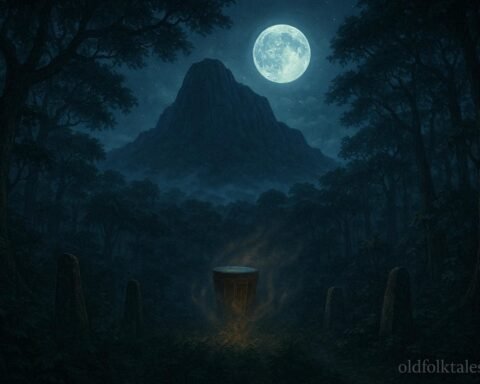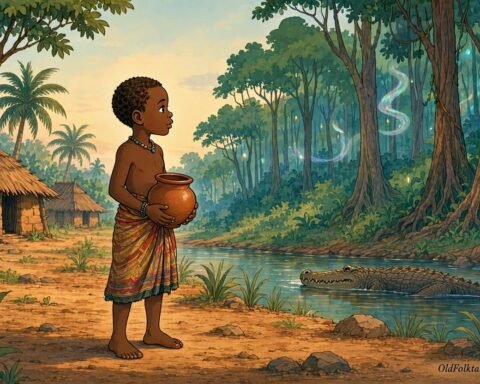
In the northeastern region of Somalia, where the land shifts between rocky plateaus, dry valleys, and coastal winds from the Indian Ocean, lies Puntland, a place where oral tradition and history are deeply intertwined with the landscape.
Among pastoral communities in this region, caves are not seen as empty spaces carved into stone.
They are considered memory places.
Some are believed to shelter ancestral spirits.
Others are thought to preserve warnings from earlier generations.
And a few are strictly forbidden, spoken of only in whispers by elders who insist that certain knowledge should never be disturbed.
One such place is the cave that became known as the Forbidden Cave of Puntland.
For generations, elders warned young people never to enter it.
Not because of visible danger like wild animals or unstable rock formations, but because of what it represented.
Keep reading: Discover more Central African folktales
The cave was believed to hold ancestral records that revealed truths about past conflicts, migrations, and broken agreements between clans.
Some elders said those truths were too painful to be revisited.
Others believed the cave protected knowledge that could disturb peace if misunderstood.
Despite the warnings, curiosity always grows strongest in the young.
Among a small group of hunters living near the coastal inland routes of Puntland were three friends: Hassan, Ibrahim, and Saeed.
They were skilled hunters who often traveled together into the hills in search of goats and small game.
They had heard the stories about the forbidden cave since childhood, but like many young people, they treated them as exaggerated warnings meant to keep them obedient.
One dry season, while tracking animals deeper than usual into unfamiliar terrain, the three hunters noticed something unusual.
A narrow opening in the side of a rocky cliff, partially hidden by stone and brush.
At first, they assumed it was just another small cavern.
But as they approached, they noticed strange markings carved around the entrance.
Symbols they did not recognize.
And patterns that looked deliberately placed rather than naturally formed.
Ibrahim suggested turning back immediately.
But Hassan, driven by curiosity, insisted they take a closer look.
Saeed hesitated the longest, remembering the elders’ warnings.
But eventually, curiosity overcame caution.
They entered the cave.
Inside, the air was cool and still.
Their footsteps echoed softly against the stone walls as they moved deeper into the darkness.
Soon, the narrow passage opened into a larger chamber.
And there they saw something that made all three stop in silence.
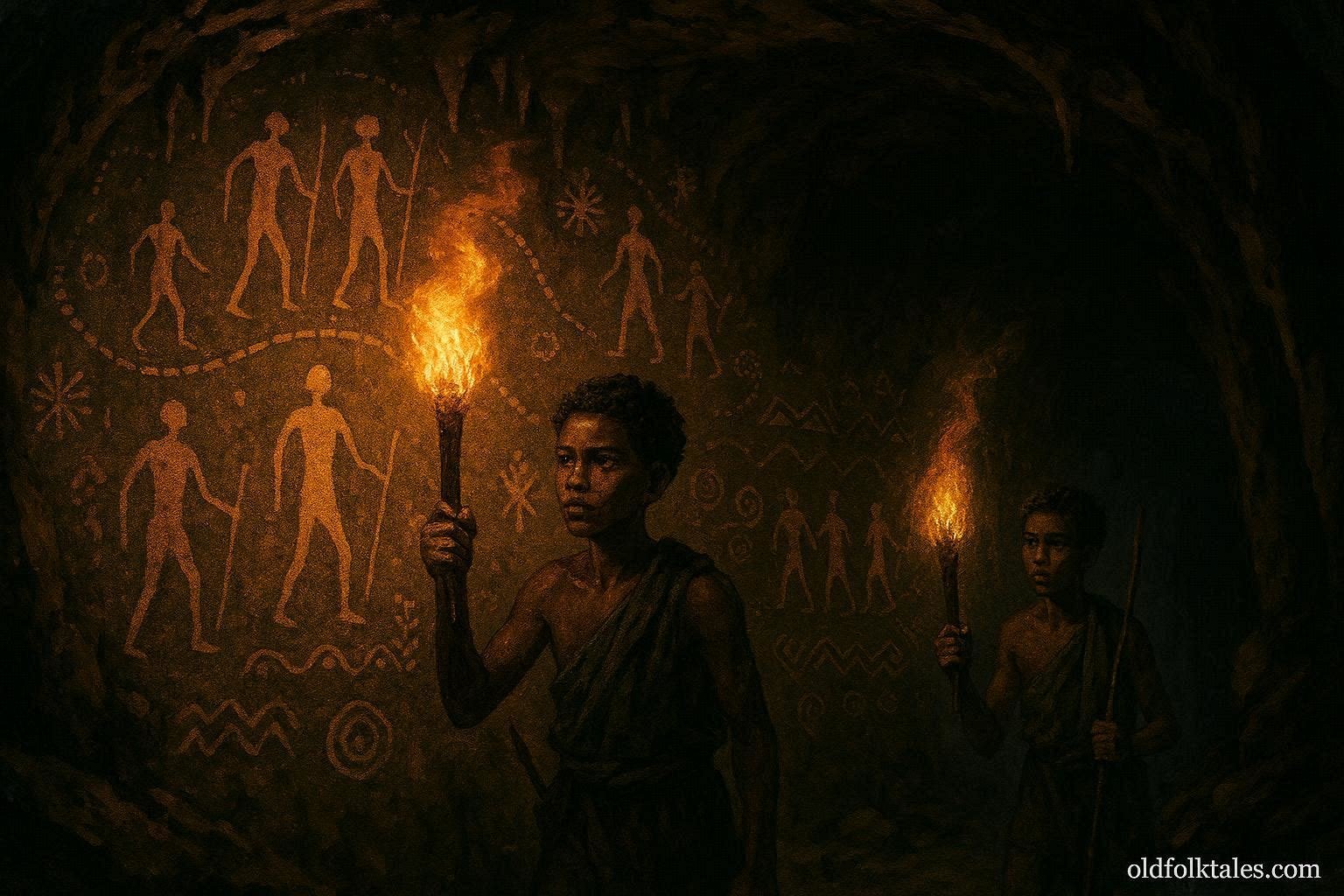
The walls were covered in ancient paintings.
Figures of humans, animals, and symbolic shapes stretched across the rock surface in fading but deliberate patterns.
Some images showed large groups of people migrating across landscapes.
Others depicted battles between clans.
And some showed ceremonial gatherings that seemed tied to rituals long forgotten.
At the center of the chamber was a large mural unlike the rest.
It showed a series of intertwined paths leading to different directions, each marked with symbols representing water, fire, and stars.
Below it were inscriptions in an ancient script none of them could read.
For a long moment, none of them spoke.
The silence inside the cave felt heavier than outside.
As they studied the paintings, Saeed noticed something unsettling.
Some of the figures on the wall seemed to resemble the same clans still living in the region today.
Not identical faces, but symbolic patterns and markings that connected past and present identities.
It was as if the cave was not just recording history.
It was preserving identity.
Then, from deeper within the cave, a faint sound echoed.
Like wind passing through stone tunnels.
Or distant voices speaking in a language just beyond understanding.
Hassan insisted it was only air movement.
But Ibrahim began to feel uneasy.
He suggested leaving immediately.
However, before they could move, the torchlight they carried flickered violently, casting shifting shadows across the painted walls.
For a brief moment, it seemed as though the figures on the cave paintings were moving.
Not physically stepping out of the walls, but shifting within their painted forms, as if responding to their presence.
Panic set in.
The three hunters rushed toward the entrance, stumbling through the narrow passage as the strange sounds grew louder behind them.
They did not stop running until they reached open air again, collapsing outside the cave in exhaustion.
For a long time, none of them spoke.
When they finally returned to their village, they told the elders what they had seen.
The reaction was not surprise.
It was silence.
Heavy and knowing.
One elder finally spoke.
The cave, he explained, was not forbidden because it held danger.
It was forbidden because it held memory.
According to oral tradition, the cave was used long ago by ancestors to record agreements, migrations, and conflicts between clans during times when written language was not widely used.
The paintings were not decoration.
They were documentation.
And some of what was recorded included painful truths about betrayals, broken peace agreements, and forgotten origins that modern clans preferred not to revisit.
The elders believed that disturbing such records without understanding them fully could reopen old divisions that had taken generations to heal.
But something had changed after the hunters’ visit.
Over the following weeks, strange conversations began resurfacing in the village.
Old disputes that had long been settled were quietly mentioned again.
Questions about land boundaries and ancestral claims began to reappear.
It was as if the memory of the cave had awakened something long buried in collective history.
The elders quickly gathered the community.
They reminded everyone that the past must be respected, not used to reopen wounds.
What was recorded in the cave was not meant to divide the present, but to preserve understanding of how unity was achieved.
Slowly, the tensions eased again.
But the story of the Forbidden Cave of Puntland remained.
The three hunters never returned to it.
And no official group was ever sent to study it further.
Even today, elders in parts of Puntland still warn young people that some places do not hide treasure or danger.
They hide memory.
And memory, if disturbed without wisdom, can reshape the present in ways no one is prepared to handle.
Don’t stop yet! See our complete East African folktales collection
Moral Lesson
The past carries lessons meant to guide the present, not to reopen old divisions without understanding and wisdom.
Knowledge Check
- Where is the story set?
It is set in Puntland in northeastern Somalia. - Why was the cave forbidden?
It was believed to contain ancestral records and memories of past clan histories. - What did the hunters discover inside the cave?
They found ancient wall paintings showing migrations, battles, and ceremonies. - What strange experience did they have?
They heard unexplained sounds and saw shifting figures in the paintings. - Why did elders warn against disturbing the cave?
Because its knowledge could reopen old conflicts between clans. - What lesson does the story teach?
Understanding history is important, but it must be approached with wisdom and caution.
Source
Somali folklore. Adapted from northeastern Somali oral traditions preserved in Puntland heritage folklore archives and archaeological folklore studies.