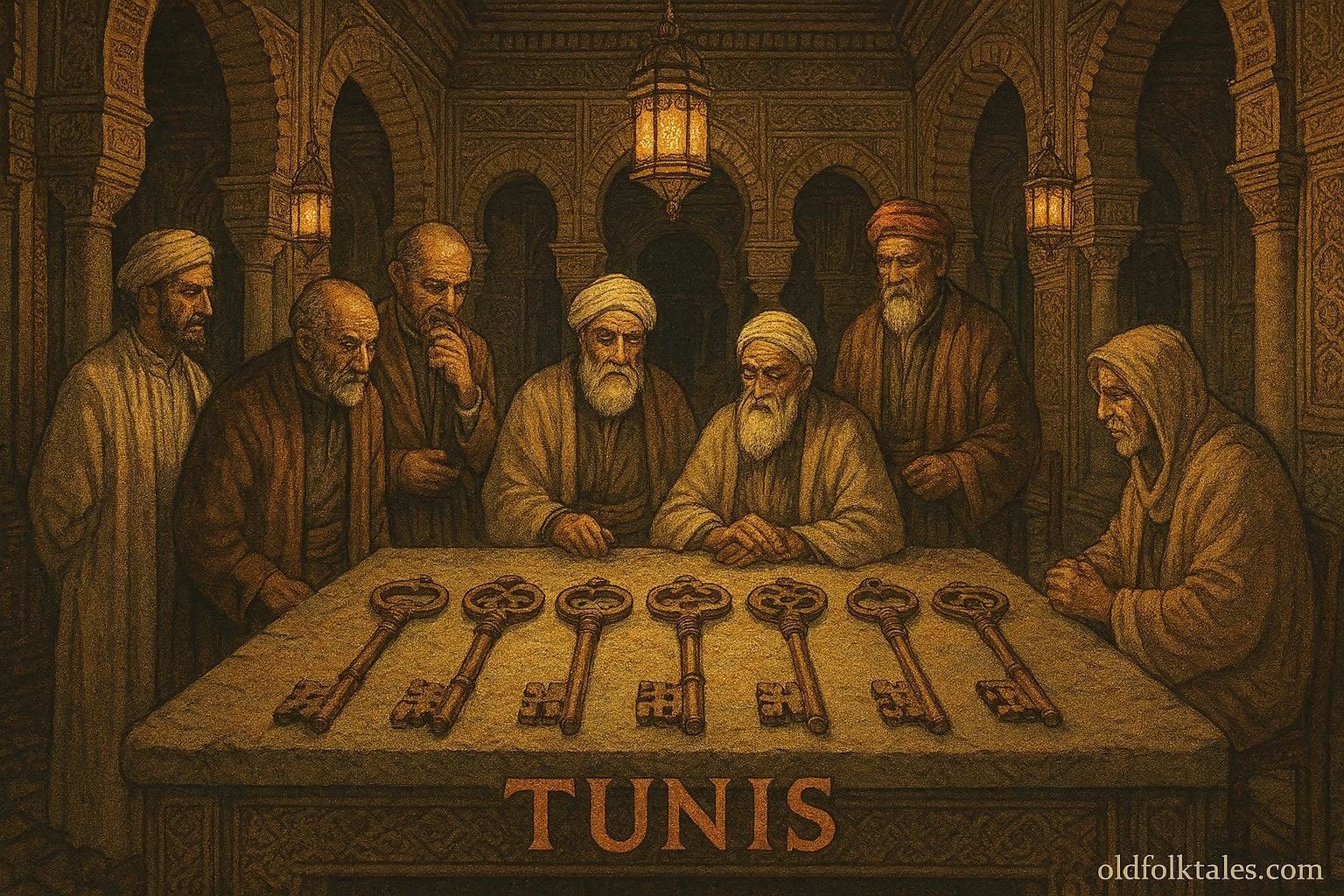
Along the shores of the Mediterranean Sea stood the ancient city of Tunis, a center of trade, learning, and culture that had welcomed travelers from distant lands for centuries. Its bustling markets echoed with the voices of merchants, while its libraries preserved the wisdom of generations. The people of Tunis took pride in their history and often shared stories about leaders whose wisdom and fairness had guided the city through times of prosperity and hardship. Among the most treasured of these stories was the legend of the Seven Keys.
According to ancient tradition, a wise ruler who governed Tunis long ago possessed seven remarkable keys. These were not ordinary keys used to open doors or treasure chests. Each key represented a virtue that every leader should possess. One symbolized wisdom, another justice, another honesty. The remaining keys represented courage, compassion, patience, and responsibility. The ruler believed that no city could thrive unless its leaders practiced all seven virtues. When he died, the keys vanished. Some believed they had been hidden by loyal advisors, while others claimed the ancestors themselves had concealed them until they were needed once more.
As the years passed, the legend became part of the city’s folklore. Children heard the story from their grandparents, and scholars occasionally mentioned it in historical writings. Most people regarded the tale as a beautiful lesson rather than a true account of the past.
Many generations later, Tunis entered a period of uncertainty. The city’s respected governor passed away unexpectedly, leaving no clear successor. Several influential individuals immediately sought the position. Wealthy merchants argued that economic experience made them the best choice. Military commanders claimed their leadership skills qualified them to guide the city. Powerful families promoted their own candidates, and debates soon spread throughout Tunis.
Want more? Read more West African folktales now
The disagreement gradually divided the population. Friends argued in marketplaces. Neighbors took opposing sides. Rumors and accusations became common. Although no violence occurred, many feared the conflict would weaken the city’s unity.
During this troubled period lived a young archivist named Karim. He worked in one of the oldest libraries in Tunis, where he spent his days preserving historical records and organizing ancient manuscripts. Karim loved history and believed that the experiences of past generations often contained lessons for the present.
One afternoon, while cleaning a neglected storage room beneath the library, Karim discovered a narrow passage hidden behind a row of shelves. Curious, he followed the passage into a small chamber that appeared untouched for decades. There, resting inside an old wooden chest covered in dust, he found seven beautifully crafted keys.
Each key was unique.
One was made of bronze.
Another was silver.
Others were fashioned from iron, copper, and metals Karim could not immediately identify.
Most remarkable of all were the symbols engraved upon them. As Karim carefully examined the keys, he realized that the symbols matched descriptions found in ancient writings about the legendary Seven Keys of Tunis.
His heart raced.
Could these truly be the lost keys of the legend?
Karim immediately informed the city’s council of elders. News of the discovery spread rapidly throughout Tunis. Historians, scholars, and community leaders gathered to inspect the artifacts. After studying the keys and comparing them with historical records, many experts concluded that the objects were indeed connected to the ancient tradition.
Excitement swept through the city.
Some people viewed the discovery as a sign.
Others believed the timing could not be a coincidence.
After all, the keys had resurfaced precisely when the city was struggling to choose its next leader.
The council of elders decided to investigate further. Ancient manuscripts found within the library revealed an important detail that had largely been forgotten. The keys were not intended to grant power. Instead, they were used to teach lessons about leadership. Each key corresponded to a challenge designed to test a person’s character.
Inspired by this discovery, the elders proposed a solution.
Any candidate seeking leadership would participate in seven public challenges, each reflecting one of the virtues represented by the keys.
The candidates reluctantly agreed.
The first challenge focused on wisdom. Participants were presented with a complex dispute involving merchants, farmers, and craftsmen whose interests conflicted with one another. Rather than offering quick solutions, the wisest candidates listened carefully, asked thoughtful questions, and considered long-term consequences before speaking.
The second challenge tested justice. Candidates were asked to resolve a disagreement between two families whose conflict had continued for many years. The task required fairness, patience, and the ability to understand both sides.
The third challenge examined honesty. Participants faced situations where personal advantage could easily be gained through deception. Some candidates struggled when confronted with difficult choices, while others demonstrated integrity despite potential costs.
As the challenges continued, the people of Tunis watched closely. For the first time, citizens began paying more attention to character than to wealth, influence, or status. Public discussions shifted. Instead of debating which candidate held the most power, people considered which individuals displayed the virtues represented by the keys.
The fourth challenge tested courage. Candidates were required to make difficult decisions that might be unpopular but necessary for the well-being of the city.
The fifth challenge focused on compassion. Participants met with ordinary citizens facing hardship and were asked how they would address their concerns.
The sixth challenge measured patience. Complex problems were presented without immediate solutions, forcing candidates to demonstrate restraint rather than impulsive judgment.
Throughout the process, Karim continued researching the history of the keys. Deep within the library’s archives, he eventually uncovered a forgotten manuscript written by an advisor who had served the legendary ruler centuries earlier.
The manuscript contained an important message.
It explained that the purpose of the keys was not to identify perfect leaders. No person possessed every virtue completely. Instead, the keys reminded leaders that they must constantly strive to improve themselves and serve their communities with humility.
When the day of the seventh challenge arrived, citizens from across Tunis gathered in the city’s central square.
The final key represented responsibility.
Each candidate was asked a simple question.
“What are you willing to sacrifice for the good of the city?”
The answers varied greatly.
Some spoke about their achievements.
Others described their ambitions.
A few focused on the responsibilities they hoped to assume.
Yet one candidate spoke differently. Rather than discussing power or personal success, he spoke about service. He acknowledged his imperfections, promised to continue learning, and emphasized that leadership was a duty rather than a privilege.
His words resonated deeply with the people.
After careful consideration, the council selected him as the city’s new leader.
The decision was widely accepted because the process had demonstrated fairness and transparency. More importantly, it had reminded everyone that leadership depended upon character rather than status.
The Seven Keys became treasured symbols of the city’s values. They were preserved in a place of honor where future generations could learn their meaning. Schools taught the story to children. Scholars wrote about the lessons it contained. Leaders reflected upon its message whenever difficult decisions arose.
Years later, people still spoke about the remarkable time when the Seven Keys of Tunis reappeared. Some believed the ancestors had returned them to guide the city during a moment of uncertainty. Others thought the discovery was simply a fortunate coincidence.
Karim, however, offered a different perspective.
Whenever someone asked whether the keys possessed magical powers, he smiled and replied, “Their greatest power was never in opening locks. Their purpose was to open hearts and minds.”
The legend endured because its lesson remained timeless. Cities flourish not because of wealth or influence alone but because of leaders who value wisdom, justice, honesty, courage, compassion, patience, and responsibility.
And so the story of the Seven Keys of Tunis continued to be told, reminding every generation that true leadership begins with character.
Fascinated by this tale? Discover more North African folktales
Moral Lesson
True leadership is earned through wisdom, justice, honesty, courage, compassion, patience, and responsibility.
Knowledge Check
1. What were the Seven Keys of Tunis believed to represent?
They represented wisdom, justice, honesty, courage, compassion, patience, and responsibility.
2. Who discovered the keys?
A young archivist named Karim discovered them in a hidden chamber beneath an old library.
3. Why did the keys become important again?
They reappeared during a dispute over who should lead the city of Tunis.
4. How were the keys used by the council?
They inspired seven leadership challenges that tested the character of the candidates.
5. What did the ancient manuscript reveal?
It explained that the keys were meant to teach virtues rather than grant power.
6. What is the main lesson of the story?
Good leadership depends on character, humility, and service to others.
Source
Adapted from Tunisian Arab folklore traditions inspired by historical legends preserved in Tunis historical folklore archives and North African oral heritage studies.