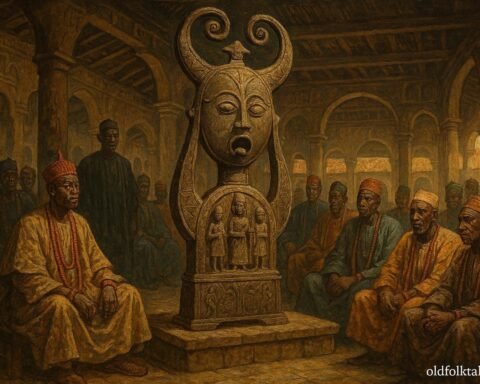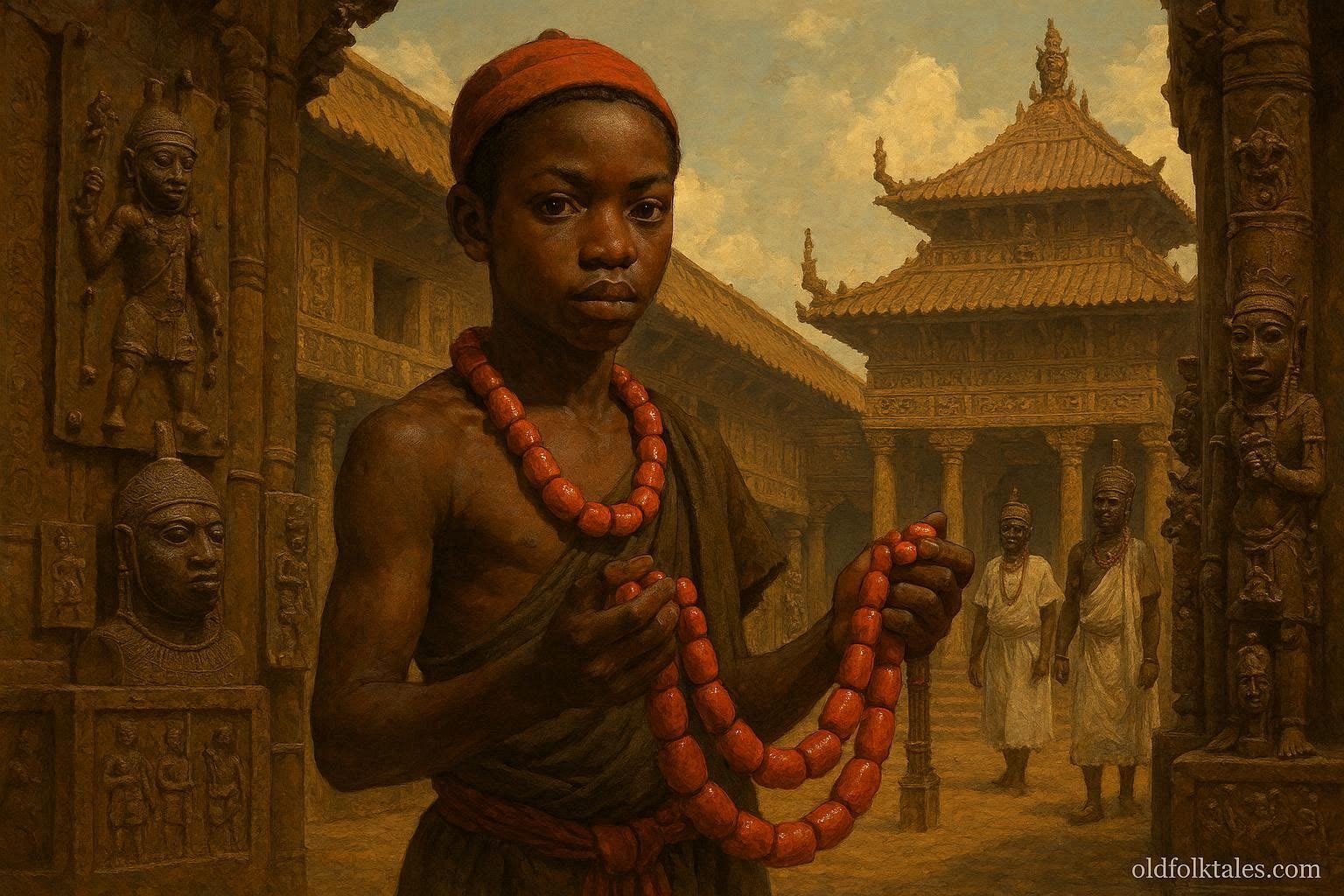
Centuries ago, in the powerful Kingdom of Benin, coral beads were among the most treasured possessions of the royal court. Their rich red color symbolized authority, prestige, and the enduring connection between the Oba, the ancestors, and the people of the kingdom. Passed down through generations, certain bead collections were regarded as sacred heirlooms whose value could never be measured in gold or wealth.
Among these treasures was a magnificent set of coral beads known throughout the kingdom as the Beads of Unity. According to palace tradition, the beads had belonged to several respected rulers and were worn during important ceremonies celebrating peace, leadership, and community. The people believed that the beads represented the shared history of the kingdom and the responsibilities carried by its leaders.
For many years, the sacred beads remained securely protected within the royal palace.
Then one morning, everything changed.
As preparations began for an important royal ceremony, palace attendants opened the chamber where the beads were kept.
The beads were gone.
At first, confusion spread through the palace.
Want to dive deeper? Read more North African folktales today
Servants searched nearby rooms.
Guards inspected entrances and exits.
Officials questioned everyone who had access to the chamber.
Yet no trace of the beads could be found.
News of the disappearance quickly reached the Oba.
The ruler listened carefully as advisers explained the situation.
Many feared the loss would damage public confidence and cast a shadow over the upcoming ceremony.
Others worried that the disappearance might encourage conflict among groups seeking influence within the kingdom.
The Oba remained calm.
“The beads are more than ornaments,” he said. “They carry the memory of our people. We must find them.”
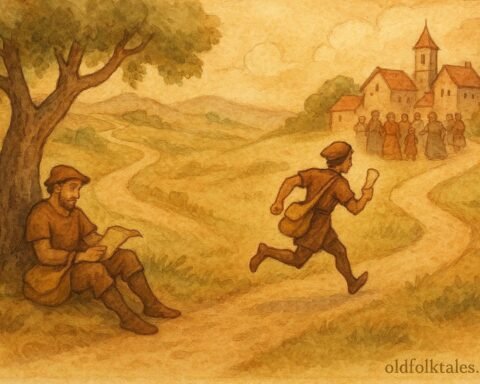
Among those present was a young palace messenger named Osaze.
Known for his honesty and determination, Osaze often carried messages between distant parts of the kingdom. He had traveled widely and understood the customs of many communities.
After hearing the discussions, Osaze stepped forward.
“Your Majesty,” he said respectfully, “allow me to search for the beads.”
Some palace officials doubted that a young messenger could succeed where experienced advisers had failed.
But the Oba saw something valuable in Osaze’s confidence.
“You may go,” the ruler replied. “Follow every clue, no matter how small.”
With the Oba’s blessing, Osaze began his journey.
His search first took him through bustling markets where merchants traded goods from distant lands. He spoke with traders, artisans, and travelers, asking whether anyone had seen unusual coral beads.
Most had not.
However, an elderly bronze caster shared an interesting observation.
“A few days ago,” the artisan said, “I heard rumors of a traveler carrying something wrapped in royal cloth.”
Though the information was vague, it was the first clue Osaze had received.
Following the lead, he continued deeper into the kingdom.
In one village, he met a storyteller who recalled seeing a stranger crossing the road at dawn.
In another settlement, fishermen described a traveler asking questions about ancient royal customs.
Piece by piece, the trail began to take shape.
Yet the further Osaze traveled, the more he realized that recovering the beads would require more than simply finding their location.
Along the way, he encountered people who shared stories about the importance of the beads.
Elders explained how the coral treasures connected generations of rulers.
Artisans described the skill required to preserve royal regalia.
Community leaders spoke about the role symbols played in maintaining unity and continuity.
Osaze listened carefully.
The journey was teaching him that the beads represented much more than royal wealth.
They embodied history, identity, and collective memory.
Weeks later, his search led him to a remote settlement near the edge of the kingdom.
There he encountered an elderly man living alone.
The man welcomed Osaze kindly and offered him food and water.
As they spoke, Osaze noticed a familiar piece of cloth folded neatly inside the hut.
It matched descriptions of the royal fabric that had once wrapped the sacred beads.
The old man observed Osaze’s reaction and smiled gently.
“You have come a long way,” he said.
Osaze nodded.
“I seek the Beads of Unity.”
The man remained silent for a moment.
Then he stood and retrieved a wooden box hidden within the hut.
Inside lay the missing coral beads.
Osaze stared in amazement.
“Why did you take them?” he asked.
The old man shook his head.
“I did not steal them.”
He explained that years earlier, he had served the palace as a guardian of royal traditions. During routine maintenance of the storage chamber, he discovered signs that the beads were slowly deteriorating due to neglect.
Concerned for their preservation, he secretly removed them, intending to restore them before returning them to the palace.
But before he could complete the task, illness prevented his return.
As time passed, fear and uncertainty kept him from explaining what had happened.
Osaze examined the beads carefully.
The old man’s story appeared truthful.
More importantly, the beads had been meticulously cleaned and preserved.
They looked better than they had in years.
After listening to the explanation, Osaze faced a difficult decision.
He could immediately accuse the man of wrongdoing.
Or he could present the full truth to the Oba and allow justice to be guided by wisdom.
Remembering everything he had learned during his journey, Osaze chose honesty.
Together, he and the old guardian returned to Benin.
When they arrived, the palace was filled with anticipation.
The sacred beads had finally been found.
Before the royal court, the elderly guardian explained his actions and accepted responsibility for the confusion he had caused.
The Oba listened carefully.
After hearing the full story, the ruler made his decision.
“The beads have returned,” he declared. “Let this remind us that preserving our heritage requires both responsibility and transparency.”
The old guardian was forgiven, though he was reminded that even good intentions must be accompanied by honesty.
The coral beads were restored to their place of honor.
The royal ceremony proceeded successfully, and the kingdom celebrated not only the return of the artifact but also the lessons learned through its disappearance.
Osaze’s journey became famous throughout Benin.
People admired his patience, fairness, and commitment to truth.
Years later, elders would tell the story of the Lost Coral Beads to younger generations.
They explained that heritage is not merely inherited.
It must be protected, understood, and passed on responsibly.
For objects may carry history, but it is people who ensure that history survives.
Click here to discover more legendary tales from West Africa
Moral Lesson
Cultural heritage must be preserved with honesty, responsibility, and respect so that future generations can understand their identity and history.
Knowledge Check
1. What were the Lost Coral Beads of Benin?
They were sacred royal beads that symbolized heritage, leadership, and unity in the Kingdom of Benin.
2. Who searched for the missing beads?
A young palace messenger named Osaze led the search.
3. Why were the beads important?
They represented the history, identity, and traditions of the kingdom.
4. Where were the beads eventually found?
They were found in the possession of an elderly former guardian of royal traditions.
5. Did the guardian steal the beads?
No. He removed them to preserve them but failed to explain his actions.
6. What is the main lesson of the story?
Protecting heritage requires honesty, responsibility, and respect for the truth.
Source
Adapted from Edo royal traditions and cultural heritage narratives preserved in Benin Kingdom oral history archives and Nigerian historical folklore studies.