Far to the north of mainland Mauritius lie the remote islands of Agaléga, surrounded by vast stretches of the Indian Ocean. For generations, the islanders depended upon the sea for food, travel, and trade. Life there required resilience, cooperation, and a deep understanding of nature.
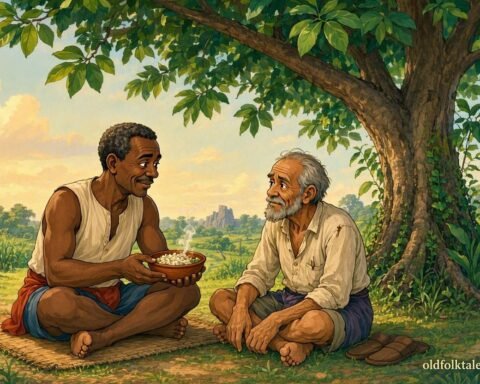
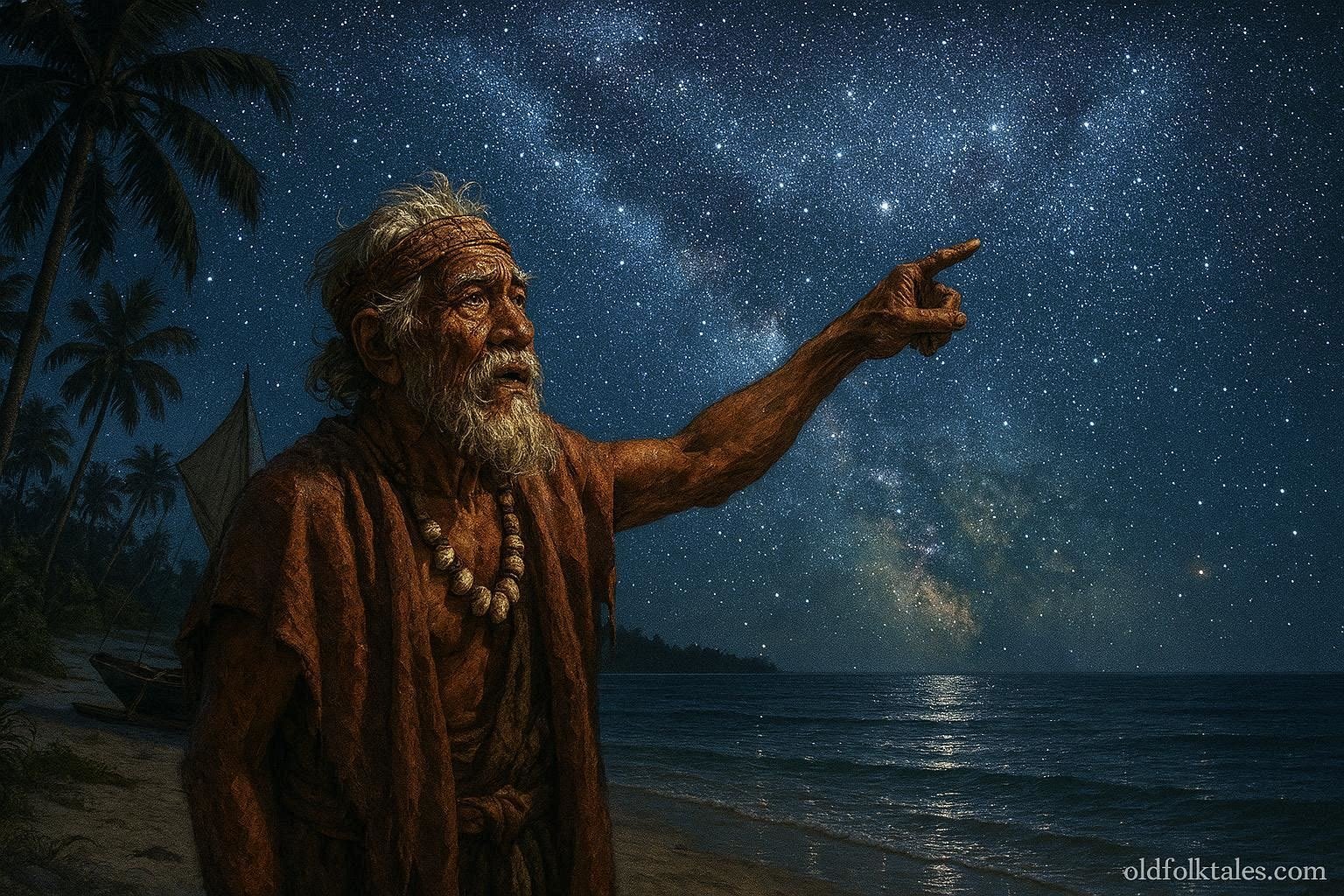
Among the people of Agaléga lived an elderly navigator named Mathieu. He was one of the last islanders who still possessed extensive knowledge of traditional navigation.
Long before modern instruments became common, sailors had relied upon the stars to guide them across the ocean.
Mathieu had learned these skills from his grandfather, who had learned them from his own ancestors.
Night after night, the old navigator studied the sky.
He could identify countless stars, recognize seasonal patterns, and predict changes in weather simply by observing the heavens.
Many younger islanders admired his knowledge, but some considered his methods outdated.
If you liked this story, see our Central African folktales collection
They believed modern tools had made such ancient skills unnecessary.
Mathieu never argued with them.
Instead, he continued quietly observing the sky as he always had.
One year, the island experienced an unusually calm season.
The sea remained peaceful.
Fishing was plentiful.
Trade boats traveled safely between islands.
Most people welcomed the favorable conditions.
Yet Mathieu noticed something unusual.
Several familiar stars appeared slightly different from their normal positions during certain nights.
The changes were subtle.
Most people would never have noticed them.
But decades of experience had trained his eyes to detect even the smallest variations.
At first, he said nothing.
He continued observing the sky each evening.
As the weeks passed, other signs appeared.
Ocean currents behaved differently.
Bird migration patterns changed.
The winds arrived earlier than expected.
Gradually, Mathieu became concerned.
After careful observation, he reached a troubling conclusion.
A powerful cyclone was likely forming far beyond the horizon.
The storm remained too distant for anyone else to detect.
No dark clouds were visible.
No strong winds had yet arrived.
To most people, the ocean appeared completely normal.
Mathieu shared his concerns with village leaders.
Some listened respectfully.
Others were skeptical.
The weather seemed perfect.
Many questioned how a storm could be approaching under such calm conditions.
The old navigator explained the patterns he had observed among the stars and natural signs.
He described how similar conditions had preceded dangerous storms during his youth.
Although uncertain, the community leaders respected his experience.
They agreed to take precautionary measures.
Fishing boats were secured.
Food supplies were stored safely.
Families strengthened roofs and shelters.
Fresh water was collected.
Several younger islanders privately questioned whether such preparations were necessary.
Nevertheless, they participated out of respect for the elders.
Days passed.
The sea remained calm.
Some people began to wonder whether Mathieu had been mistaken.
Then one evening, dark clouds appeared on the distant horizon.
The following morning, strong winds arrived.
Within hours, the cyclone struck.
Massive waves crashed against the coastline.
Heavy rain flooded low-lying areas.
Powerful winds swept across the island.
Yet because of the early preparations, the community was ready.
Boats remained secure.
Food supplies were protected.
Families had already moved to safer locations.
Although the storm caused damage, no lives were lost.
When the cyclone finally passed, the islanders emerged to assess the aftermath.
Many gathered to thank Mathieu.
His knowledge had given them valuable time to prepare.
Without his warning, the consequences could have been far more severe.
The experience transformed how many people viewed traditional wisdom.
Young islanders became eager to learn from the elderly navigator.
Each evening, groups gathered beneath the stars as Mathieu shared his knowledge.
He taught them how to recognize constellations.
He explained how generations of navigators had traveled safely using the sky as their guide.
Most importantly, he taught them that wisdom often comes from careful observation, patience, and respect for knowledge passed down through generations.
As the years went by, several of his students became skilled navigators themselves.
They preserved the lessons they had learned and passed them on to others.
The tradition continued.
Long after Mathieu’s passing, his story remained one of the most respected legends in Agaléga.
People referred to him as the Star Watcher.
His name became associated with foresight, leadership, and wisdom.
Whenever islanders gathered beneath clear night skies, elders often pointed toward the stars and retold his story.
Some said the stars themselves had spoken to him.
Others believed his understanding came from decades of experience and observation.
Whatever the explanation, everyone agreed on one thing.
His knowledge had protected the community when it mattered most.
The legend of the Star Watcher of Agaléga endured because it celebrated more than navigation.
It honored the importance of preserving traditional knowledge, respecting elders, and preparing wisely for challenges that may not yet be visible.
Even today, the story reminds listeners that true leadership is not merely reacting to danger after it arrives.
It is recognizing warning signs early and helping others prepare for the future.
And so, beneath the vast skies of the Indian Ocean, the tale of the Star Watcher continues to shine like the stars that guided him, illuminating the path for future generations.
Don’t stop yet! See our complete East African folktales collection
Moral Lesson
Wisdom, experience, and careful observation can help communities prepare for challenges before they become crises.
Knowledge Check
1. Where does the story take place?
The story takes place on the Agaléga Islands, part of Mauritius.
2. Who was Mathieu?
Mathieu was an elderly navigator known for his knowledge of the stars and traditional navigation.
3. What unusual signs did Mathieu observe?
He noticed changes in star patterns, ocean currents, bird movements, and wind behavior.
4. What danger was approaching the island?
A powerful cyclone was forming beyond the horizon.
5. How did Mathieu help the community?
His warning allowed islanders to prepare before the storm arrived.
6. What is the main lesson of the story?
Traditional knowledge and experience can provide valuable guidance during times of uncertainty.
Source
Adapted from Agaléga oral navigation traditions, Indian Ocean seafaring folklore, and cultural heritage narratives preserved in Agaléga oral navigation folklore archives.