Long ago in the ancient city of Marrakesh, where merchants filled the bustling markets with spices, woven carpets, and gleaming brass lanterns, there lived an elderly pilgrim named Abdallah.
He had spent much of his life traveling from one town to another, visiting places of worship and helping strangers whenever he could.
Although he owned very little, he was rich in faith and contentment.
People admired him because he never spoke falsely, never accepted what did not belong to him, and always shared whatever food he had with those in greater need.
As the years passed, Abdallah longed to complete one final pilgrimage before age made travel impossible.
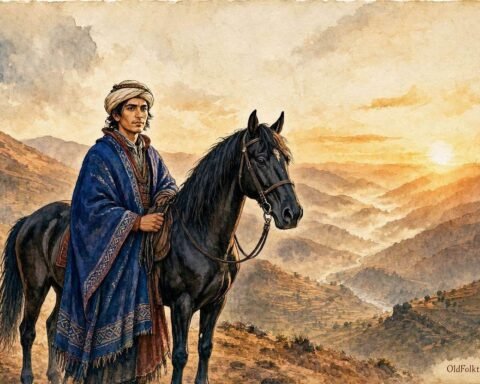
With only a walking staff, a leather waterskin, and a small bag of bread, he began his journey across the plains and foothills surrounding Marrakesh.
For several days, everything went well.
He prayed at dawn and sunset, greeted fellow travelers with kindness, and thanked God for every safe step.
Then, one evening, a violent wind swept across the countryside.
Dark clouds covered the sky, and heavy rain forced Abdallah to leave the main road in search of shelter.
Keep reading: Discover more Central African folktales
He wandered through an unfamiliar valley until he discovered a magnificent garden unlike anything he had ever seen.
Crystal streams flowed between flowering trees.
Birds with brilliantly colored feathers sang from the branches.
The air carried the fragrance of roses and orange blossoms.
At the center of the garden stood a graceful white pavilion.
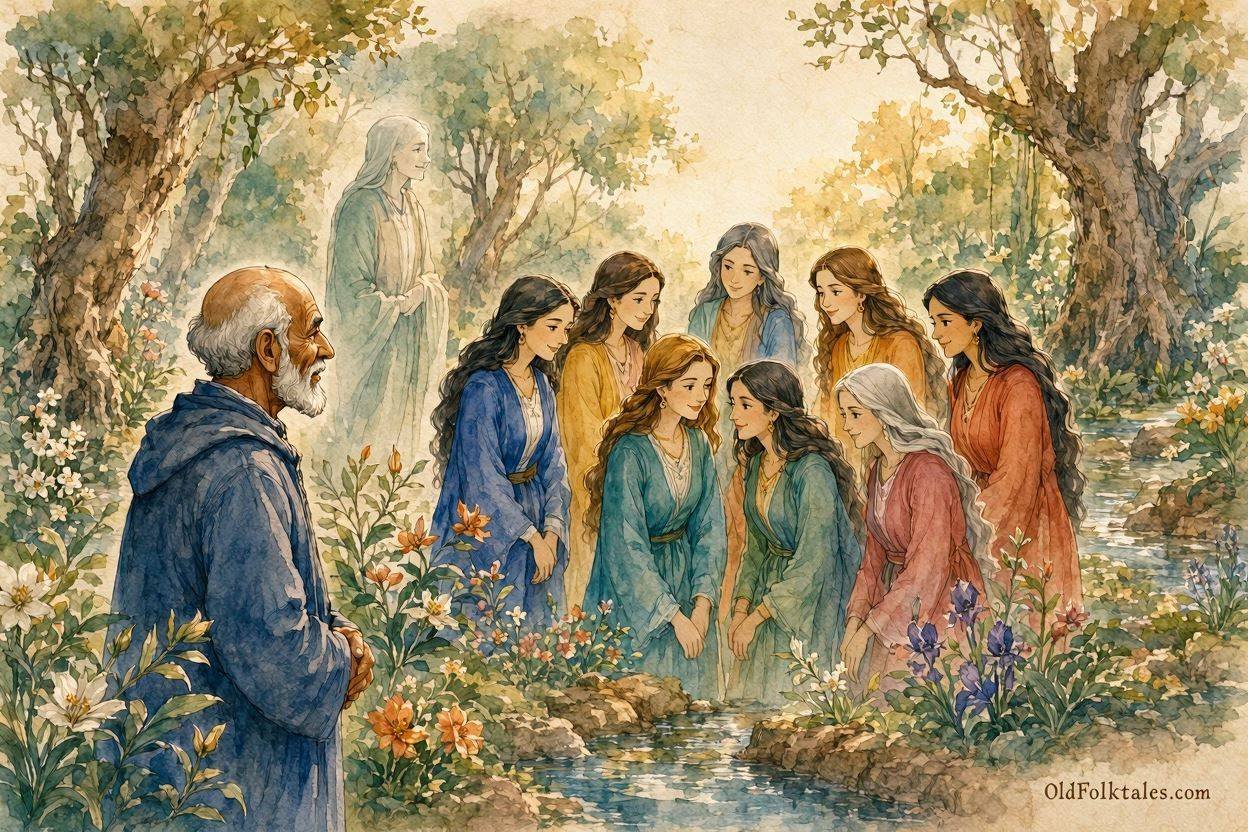
As Abdallah approached, seven young women emerged from the doorway.
Though they dressed simply, each carried herself with remarkable dignity.
Their faces reflected kindness, and their eyes shone with an unusual brightness.
The eldest stepped forward.
“Peace be with you, traveler.”
“And with you,” Abdallah replied, bowing respectfully.
“You have entered a place where few strangers ever arrive.”
“We saw the storm and knew you would need shelter.”
The sisters welcomed him warmly.
They served him fresh bread, sweet dates, honey, and cool spring water.
Abdallah thanked them sincerely for their generosity.
That evening, as they talked together, the eldest sister asked,
“Tell us, pilgrim, what treasure do you seek on your journey?”
Abdallah smiled gently.
“I seek no treasure of gold or jewels.”
“I pray only for the strength to finish my pilgrimage with an honest heart.”
The sisters exchanged quiet smiles but asked no more questions.
Before sunrise, the eldest spoke again.
“There is something you should know.”
“We are not ordinary women.”
“Our mother is known throughout these lands as the Good Afrita, a benevolent spirit entrusted with rewarding those whose hearts remain faithful to truth.”
Abdallah listened quietly, neither frightened nor doubtful.
The youngest sister continued.
“Our mother has watched travelers for many generations.”
“Many desire blessings.”
“Very few deserve them.”
The eldest looked directly at Abdallah.
“Each of us will ask something of you.”
“Your answers will reveal the truth within your heart.”
“If you remain honest until the end, our mother herself will grant you a blessing unlike any you have ever imagined.”
The garden fell completely silent.
Abdallah understood that his greatest test had only just begun.
As the morning sun bathed the garden in golden light, the seven daughters gathered around Abdallah.
The eldest sister stepped forward carrying a small leather purse filled with gold coins.
She placed it before him.
“Traveler,” she said, “you arrived here with almost nothing. Take this purse. No one will know.”
Abdallah gently pushed it back.
“I cannot accept what has not been freely given to me. Wealth gained without honesty brings no lasting peace.”
The eldest smiled.
“You have answered well.”
The second sister offered him a magnificent robe embroidered with silver thread.
“Wear this,” she said. “Everyone will honor you as a wealthy man.”
Abdallah shook his head.
“A person’s character is worth more than fine clothing. Respect earned through appearance soon disappears.”
She bowed with approval.
The third sister brought a tray of delicious food.
“Eat everything,” she urged. “You may never see such a feast again.”
Instead, Abdallah ate only enough to satisfy his hunger.
“The body needs food,” he said, “but greed always asks for more than enough.”
The fourth sister led him to a beautiful fountain whose water sparkled like crystal.
“Drink,” she said. “It is said this water grants long life.”
Abdallah cupped only a small amount in his hands.
“If God grants me many years, I will be grateful. If He grants me few, I will still be grateful.”
The fifth sister smiled warmly.
“You trust more in your Creator than in miracles.”
The sixth sister asked,
“If you were given the chance to become richer than every merchant in Marrakesh, what would you do?”
Abdallah answered without hesitation.
“I would feed the hungry, help travelers, care for widows and orphans, and remember that wealth is a trust, not a possession.”
Finally, the youngest sister stepped forward.
Unlike her sisters, she carried nothing.
She simply asked,
“What is the greatest treasure a traveler can bring home?”
Abdallah thought quietly before replying.
“A heart that has remained honest throughout the journey.”
The seven sisters looked at one another with joy.
At that very moment, a gentle breeze swept through the garden.
The flowers opened wider, and the streams shimmered with silver light.
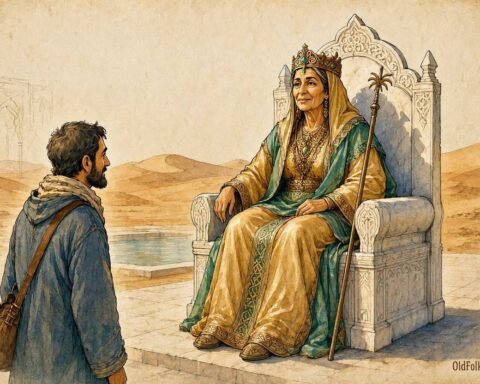
From among the ancient trees appeared a graceful woman clothed in flowing garments that sparkled like the morning dew.
Her presence filled the garden with peace.
The daughters bowed respectfully.
“Our mother has come.”
The Good Afrita smiled kindly at Abdallah.
“For many years,” she said, “my daughters have welcomed travelers.”
“Some sought riches.”
“Others sought power.”
“Many spoke beautiful words while hiding dishonest hearts.”
“But you have remained truthful in every answer.”
She stretched out her hands.
A small wooden staff appeared, carved with delicate patterns of vines and stars.
“This staff holds no magic for selfish gain,” she explained.
“It will always guide you toward those who truly need your kindness.”
“Whenever you help another person with a sincere heart, your own path will never be lost.”
Abdallah accepted the gift with gratitude.
“I shall use it only for good.”
The Good Afrita nodded.
“That is why it was given to you.”
The following morning, Abdallah awoke beneath the shade of an olive tree beside the road.
The enchanted garden had disappeared.
There were no streams, no pavilion, and no sign of the seven sisters.
Only the carved wooden staff rested beside him.
He completed his pilgrimage safely.
Wherever he traveled afterward, he seemed always to arrive where someone needed help.
Sometimes he guided lost travelers home.
Sometimes he comforted the lonely.
Sometimes he shared his last piece of bread with a stranger.
People often wondered how he always knew where to go.
Abdallah would smile gently and say,
“When the heart walks honestly, God always shows the way.”
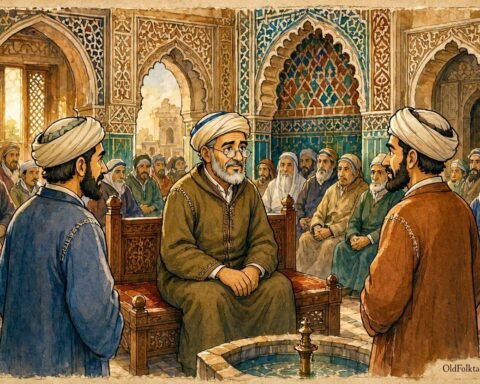
Long after his passing, storytellers in Marrakesh continued to tell of the pilgrim who met the seven daughters of the Good Afrita.
They reminded every generation that extraordinary blessings are not earned through wealth or cleverness, but through faith, honesty, generosity, and a heart that remains faithful even when no one is watching.
And so, The Pilgrim and the Seven Daughters of the Good Afrita became one of the treasured supernatural tales of Moroccan tradition, teaching that the greatest miracles are reserved for those who live with integrity and compassion.
Fascinated by this tale? Discover more North African folktales
Moral Lesson
This Moroccan folktale teaches that faith, honesty, and generosity are treasures greater than wealth. Those who remain truthful and compassionate are rewarded with blessings that benefit both themselves and others.
Knowledge Check
1. Why did Abdallah enter the mysterious garden?
He sought shelter after a violent storm forced him from the main road.
2. Who were the seven young women?
They were the daughters of the Good Afrita, a benevolent female spirit.
3. What did the daughters test in Abdallah?
They tested his honesty, humility, faith, generosity, and freedom from greed.
4. Why did the Good Afrita reward Abdallah?
Because he remained truthful and selfless throughout every test.
5. What gift did the Good Afrita give him?
A carved wooden staff that guided him toward people who genuinely needed his kindness.
6. What is the central lesson of this folktale?
The story teaches that sincere faith, honesty, and generosity bring the greatest and most lasting blessings.
Source: Adapted from “Histoire du pèlerin, de ses sept filles de la bonne Afrîta et du fils du Sultan” in Françoise Légey, Contes et légendes populaires du Maroc (1926).