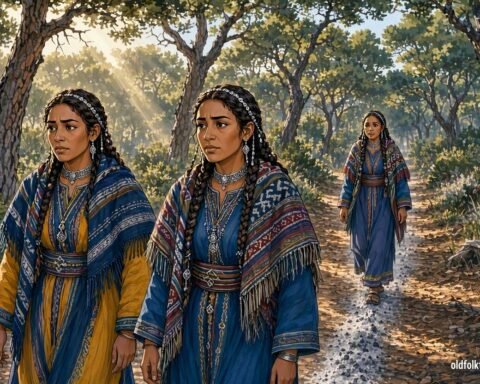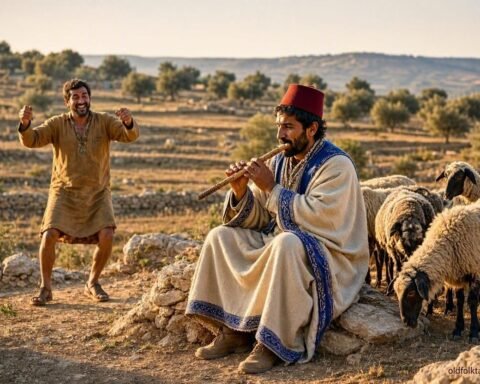
High among the rugged peaks of Morocco’s High Atlas Mountains lay the valleys of Ayt Yafelman, where Amazigh villages clung to rocky hillsides and shepherds guided their flocks across green pastures fed by mountain springs.
The people believed that every mountain held ancient secrets.
Some valleys were said to shelter forgotten saints.
Others hid sacred caves where the spirits of honorable ancestors watched over the land.
Yet among all the stories told beside winter fires, none inspired greater wonder than the legend of the Black Stallion.
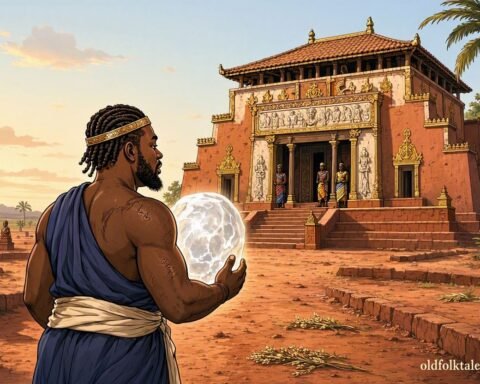
The elders spoke of a magnificent horse whose coat shone darker than the night sky and whose eyes reflected the brilliance of distant stars.
No one claimed to own the stallion.
It could never be captured by ropes or fences.
It appeared only when the future of the people rested upon the choice of a leader.
Many dismissed the tale as an old legend.
Others swore that their grandfathers had seen the mysterious horse standing silently upon lonely mountain ridges before great events changed the history of the valleys.
At that time, the tribes of Ayt Yafelman faced a difficult season.
A long drought had dried many streams.
Pastures grew smaller each month.
Several tribal leaders argued over the remaining water, each believing his own people deserved the largest share.
Old friendships weakened.
If you enjoyed this story, explore our full West African folktales collection
Small disagreements threatened to become lasting feuds.
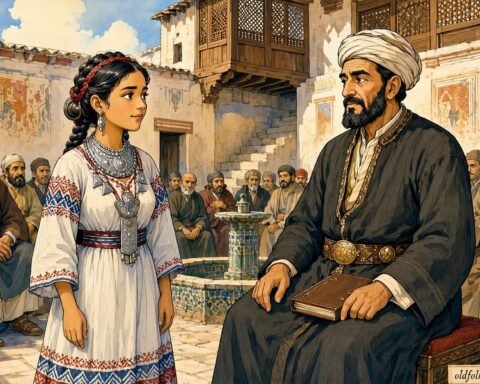
The council of elders gathered beneath an ancient walnut tree that had sheltered generations of meetings.
Every clan sent its leader.
Among them was a young chief named Aksel.
Unlike many of the older leaders, Aksel spoke little during the discussions.
He listened carefully before offering his thoughts.
When he did speak, he encouraged the chiefs to search for solutions that would protect every village instead of only their own.
Some admired his wisdom.
Others dismissed him because of his youth.
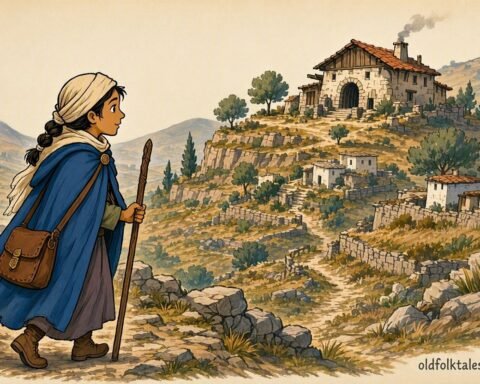
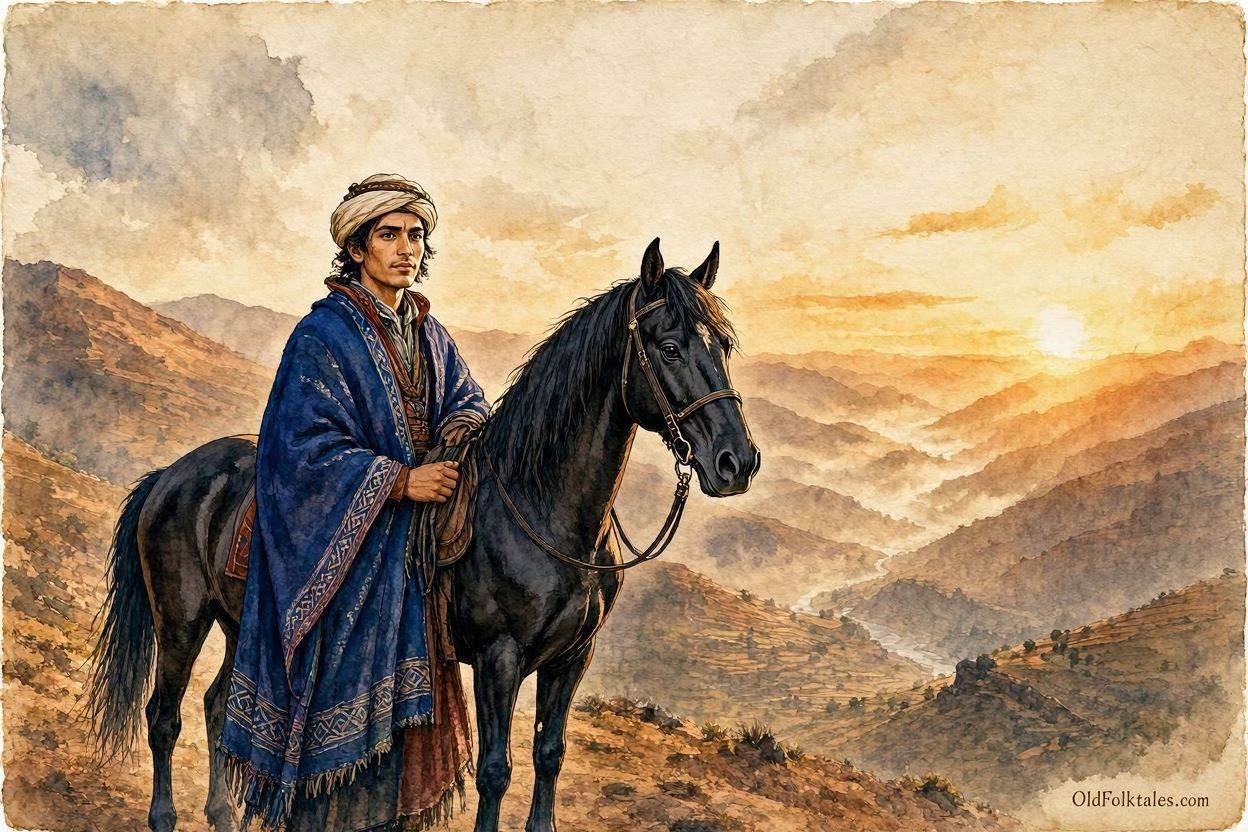
One evening, after another council ended without agreement, Aksel climbed alone toward a mountain pass overlooking the valleys.
He hoped the quiet would help him think.
As the sun disappeared behind the peaks, a cool wind swept across the rocks.
Then he heard the sound of steady hoofbeats.
From the gathering mist emerged a magnificent black stallion.
Its coat shimmered like polished obsidian.
Its mane flowed in the wind without a single strand out of place.
The horse stopped only a few steps away.
It neither neighed nor showed fear.
Instead, it gazed directly into Aksel’s eyes, as though measuring the strength of his heart rather than the strength of his hands.
The young chief remained perfectly still.
He remembered the words of his grandfather.
“The Black Stallion does not come to the strongest warrior. It comes to the one whose choices will shape the future of the people.”
For several quiet moments, neither man nor horse moved.
Then the stallion slowly turned toward a narrow mountain trail that few people ever used.
It looked back once, inviting Aksel to follow.
Without fully understanding why, the young chief stepped onto the ancient path behind the mysterious horse.
The Black Stallion moved silently along the narrow mountain trail.
Aksel followed without speaking.
The moon rose above the High Atlas peaks, casting silver light across the rocks.
After a long climb, the stallion stopped beside a high ridge overlooking every valley of Ayt Yafelman.
From there, Aksel could see the scattered villages below.
Some fields were green.
Others had turned brown from the long drought.
Thin streams wound through the valleys like silver threads.
The Black Stallion lowered its head toward the land.
At that moment, Aksel understood.
The valleys were not separate.
Every stream flowed into another.
If one village claimed all the water, those farther down the mountain would lose everything.
The future of each community depended upon the well being of the others.
As the first light of dawn appeared, the stallion looked once more at Aksel.
Then, without a sound, it disappeared into the mountain mist.
Only its hoofprints remained upon the rocky ground.
Aksel returned to the council that same morning.
The elders noticed a quiet confidence in him.
When the chiefs began arguing once again over the water, Aksel stood and addressed them.
“We have been speaking as though each valley belongs only to one tribe,” he said.
“But the mountains teach us otherwise.”
He drew a map upon the earth with his walking staff.
He showed how every spring, stream, and river connected the villages.
“If the first village keeps everything, the last village will perish.”
“If the last village suffers, trade will fail.”
“If trade fails, every family will feel the loss.”
“The mountain does not divide us.”
“It keeps us alive together.”
The council fell silent.
One elder slowly nodded.
Another rose to examine the map.
Before long, the chiefs began discussing cooperation instead of rivalry.
They agreed to share the mountain springs according to the needs of every community.
They repaired old irrigation channels together.
Young men from different villages worked side by side to build new reservoirs before the next dry season.
When the rains finally returned, the valleys flourished once more.
The harvest was greater than anyone had expected.
Peace replaced suspicion.
The elders often wondered how Aksel had discovered such wisdom.
He simply smiled.
“The mountains have always known the answer,” he would say.
“I merely learned to listen.”
Years later, after Aksel had become one of the most respected leaders in the High Atlas, shepherds claimed they occasionally saw the Black Stallion standing upon the distant ridges at sunrise.
Whenever difficult times approached, its dark figure appeared for only a moment before vanishing into the clouds.
The people believed the mysterious horse was not choosing rulers because of their strength or wealth.
It appeared to those whose decisions would shape the future of their people and whose hearts were guided by honor rather than ambition.
And so, The Black Stallion of Ayt Yafelman became one of the treasured legends of the High Atlas Amazigh, reminding every generation that true leadership begins with wisdom, unity, and the courage to place the good of the community above personal gain.
Want to dive deeper? Read more North African folktales today
Moral Lesson
This Moroccan folktale teaches that true leaders think beyond themselves. Wisdom, unity, and selfless decisions create a stronger future for the entire community.
Knowledge Check
1. Why did the Black Stallion appear to Aksel?
It appeared because his decisions would influence the future of his people.
2. What problem faced the tribes of Ayt Yafelman?
A severe drought caused conflict over the remaining water.
3. What lesson did Aksel learn on the mountain?
He realized that all the valleys depended upon one another and that sharing resources would benefit everyone.
4. How did Aksel persuade the other chiefs?
He explained how the streams connected every village and showed that cooperation was necessary for survival.
5. What happened after the tribes agreed to work together?
They shared the water fairly, repaired irrigation channels, and the valleys prospered when the rains returned.
6. What is the central lesson of this folktale?
The story teaches that wise leadership is built on unity, honor, and decisions that serve the whole community.
Source: Adapted from High Atlas Amazigh oral traditions recorded in Émile Laoust, Contes berbères du Maroc (1949).