In the highlands of Zambia’s Muchinga region, where rolling hills stretched toward the horizon and streams nourished fertile valleys, the Tumbuka people lived closely connected to the rhythms of nature. The arrival of seasonal rains determined the success of harvests, the health of livestock, and the well-being of entire communities. Because of this, stories about rain and weather held a special place in local tradition.
Among the most respected legends was the tale of the Rain Caller, a wise individual said to possess extraordinary knowledge about the land, the skies, and the signs of approaching weather. Elders claimed that long ago, a Rain Caller had helped communities survive severe droughts by understanding nature in ways few others could.
As generations passed, the story gradually faded into legend.
Many people believed the Rain Caller had never existed at all.
Others insisted that the knowledge had simply been forgotten.
During one particularly difficult year, the region faced a terrible drought. Month after month, clouds drifted across the sky without releasing rain. Rivers became shallow. Wells began to dry up. Farmers watched their crops struggle beneath the relentless sun.
Want more? Read more West African folktales now
The situation grew worse with each passing week.
Among those affected was a young shepherd named Mphatso. Every day, he guided his family’s goats across increasingly dry grasslands in search of food and water. As conditions worsened, he became concerned not only for his animals but also for the future of his village.
One evening, while listening to elders discuss the drought, Mphatso heard the old legend mentioned once again.
“The Rain Caller would have known what to do,” one elder said sadly.
The words stayed with him.
Later that night, he asked his grandmother about the story.
She explained that the Rain Caller was believed to have lived generations earlier in the mountains beyond the village.
According to tradition, the Rain Caller understood the language of the land.
By observing plants, birds, insects, winds, and clouds, the wise figure could predict weather changes and help communities prepare for difficult seasons.
Intrigued, Mphatso decided to learn more.
The next morning, he began searching for clues.
Whenever he visited neighboring settlements, he asked elders about the Rain Caller. Most knew only fragments of the story, but each fragment added another piece to the puzzle.
One elder spoke of a hidden cave in the hills.
Another described a collection of carved stones covered with ancient markings.
A third remembered songs that contained instructions for observing nature.
Determined to continue, Mphatso followed every lead.
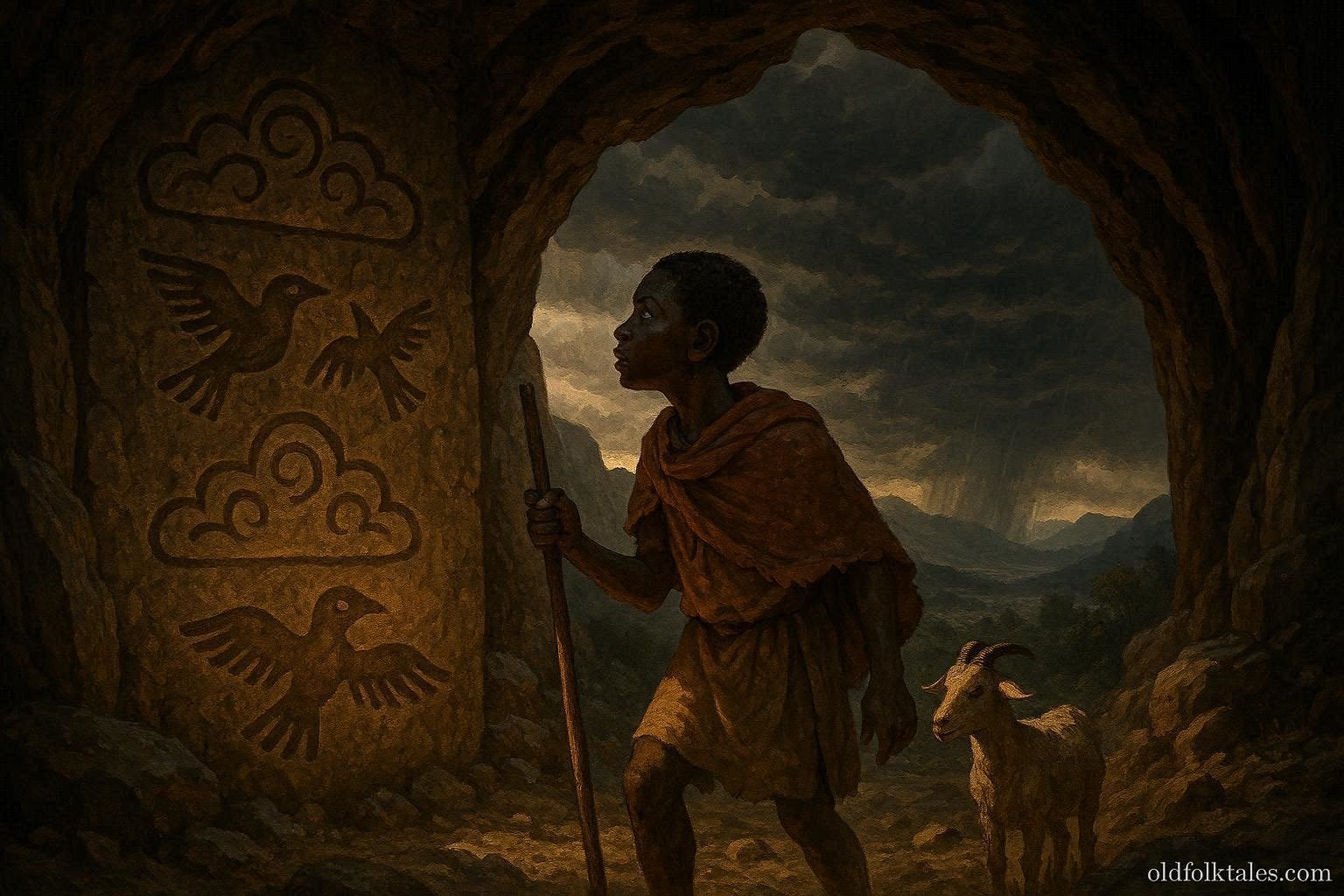
After several weeks of exploration, he reached a remote hillside where he discovered a small cave hidden behind thick vegetation.
Inside, he found something remarkable.
The walls were covered with symbols and drawings.
Some depicted clouds.
Others showed birds, animals, rivers, and stars.
At first, the markings seemed confusing.
Gradually, however, patterns began to emerge.
The symbols were not magical spells.
They were observations.
The drawings recorded how certain birds behaved before rainfall.
They described how particular plants responded to changing moisture levels.
They explained how winds shifted before storms arrived.
Mphatso realized that the legendary Rain Caller’s greatest gift had been knowledge rather than magic.
For many days, he studied the markings.
He compared them with conditions he observed in the surrounding landscape.
Slowly, he began understanding relationships that others had overlooked.
One morning, while watching the sky from a hilltop, he noticed several signs described in the cave.
Specific birds had returned to the area.
Certain flowering plants were blooming earlier than expected.
The direction of the wind had changed.
The clues suggested that rain might not be far away.
Excited by the discovery, Mphatso returned to the village.
He shared what he had learned with community leaders and farmers.
Some people were skeptical.
Others listened carefully.
Because the drought had become so severe, many agreed it was worth considering his observations.
Following his advice, villagers began preparing their fields and repairing irrigation channels in anticipation of rainfall.
Several days later, dark clouds gathered over the hills.
Thunder echoed across the landscape.
At last, rain began to fall.
The long drought was broken.
Cheers spread throughout the village as people celebrated the return of life-giving water.
Although many credited the rain itself for ending the crisis, others recognized the importance of the knowledge Mphatso had uncovered.
His discoveries inspired renewed interest in traditional environmental wisdom.
Elders began teaching younger generations how to observe natural signs.
Families preserved stories that might otherwise have been forgotten.
Over time, Mphatso became known throughout the region.
People called him the new Rain Caller, but he always corrected them.
“The wisdom was never mine,” he would say.
“It belonged to those who came before us. I only helped uncover it.”
Years later, the story of the Rain Caller of Muchinga continued to be told.
Some versions emphasized the mystery of the hidden cave.
Others focused on the drought and the return of the rains.
Yet all versions shared the same lesson.
Knowledge is a treasure that must be preserved.
The wisdom of previous generations can help solve modern challenges.
And those who observe, learn, and share what they know can help entire communities survive and prosper.
Explore more Southern African folktales here
Moral Lesson
Knowledge becomes valuable when it is preserved, shared, and used responsibly for the benefit of others.
Knowledge Check
1. Who was Mphatso?
Mphatso was a young shepherd who searched for the forgotten wisdom of the legendary Rain Caller.
2. What problem did the community face?
The region was suffering from a severe drought.
3. Where did Mphatso find clues about the Rain Caller?
He discovered a hidden cave containing ancient symbols and observations.
4. What was the Rain Caller’s real secret?
The Rain Caller relied on careful observation of nature rather than magic.
5. How did Mphatso help the village?
He used traditional knowledge to predict approaching rainfall and encouraged people to prepare.
6. What is the main lesson of the story?
Preserving and sharing knowledge can help communities overcome challenges.
Source
Adapted from Tumbuka oral traditions and rainmaking legends preserved in Muchinga oral heritage archives.