Centuries ago, long before modern roads and vehicles crossed West Africa, vast networks of footpaths linked distant villages, towns, and trading centers. Along these routes traveled merchants, craftsmen, farmers, and travelers carrying goods from one region to another. Trade was not merely a means of earning wealth. It was also a way for people to share knowledge, establish friendships, and build relationships across great distances.
Among the Dioula people, stories have long been told about the arrival of the first gold traders and the changes they brought to communities throughout the region. These merchants became known not only for the precious metal they carried but also for the connections they created between people who had previously known little about one another.
According to oral tradition, there was once a prosperous community situated near fertile farmland and important travel routes. The villagers were skilled farmers and artisans. They produced enough food to support their families and crafted useful tools from wood, clay, and iron. Although the community was stable, its people had limited contact with distant regions.
Most exchanges took place among neighboring settlements. Goods moved slowly, and information about faraway places was often scarce. Few villagers had traveled beyond the surrounding area, and many could only imagine what existed beyond the horizon.
Love this story? Discover our full Southern African folktales collection
One dry season, word began spreading that a group of merchants was approaching from distant lands. Travelers reported seeing long caravans carrying valuable goods across established trade routes. The merchants were said to possess knowledge of markets located many days away and maintained relationships with communities across vast territories.
Curiosity spread quickly throughout the village.
People gathered to discuss the rumors. Some were excited about the possibility of new opportunities. Others were cautious and uncertain about welcoming strangers whose customs and languages might differ from their own.
Several days later, the merchants arrived.
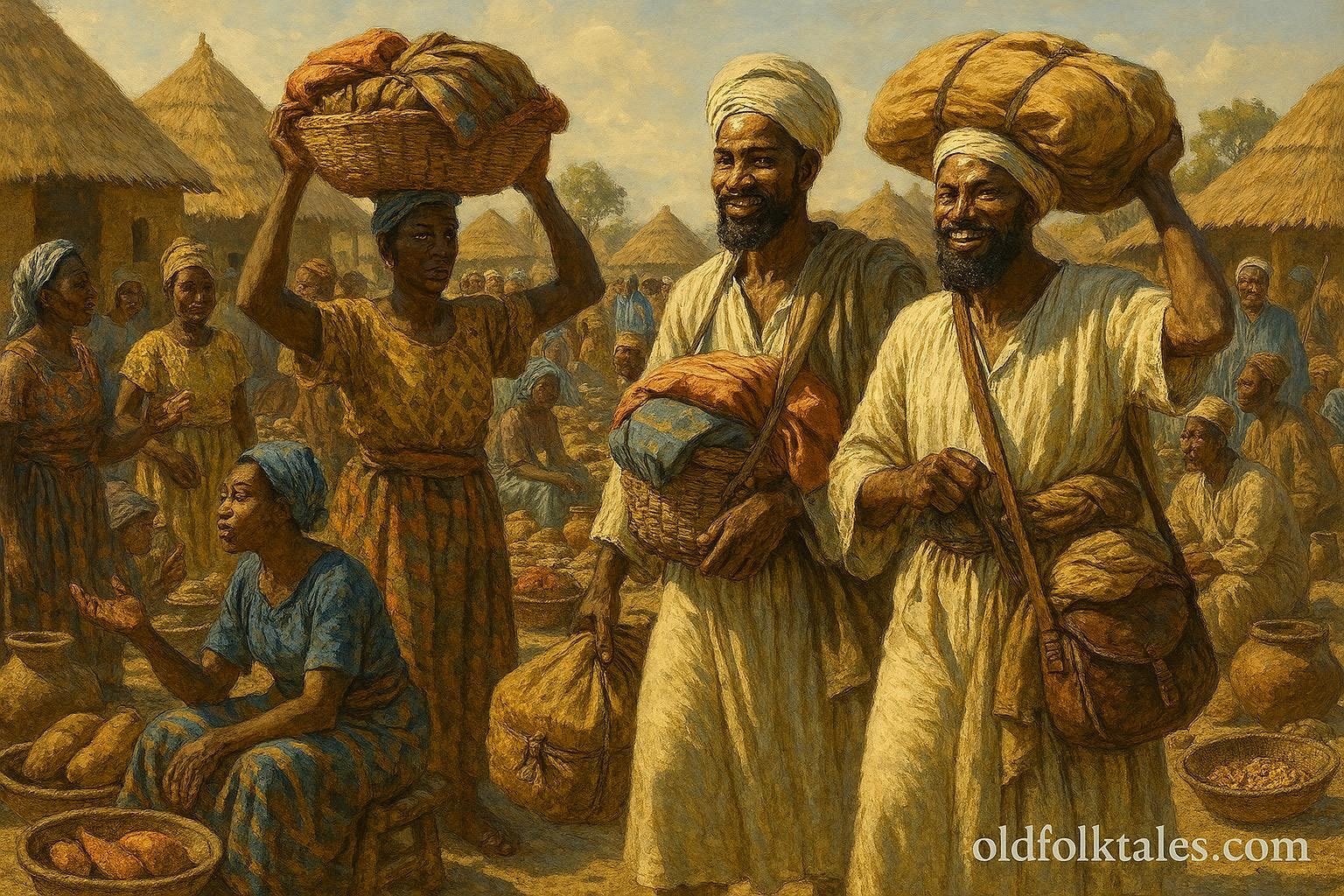
Leading the group was a respected Dioula trader named Bakary. He had spent many years traveling between trading centers and understood the importance of building trust wherever he went. Rather than rushing to conduct business, Bakary first met with village elders and introduced himself respectfully.
The elders welcomed the visitors and invited them to explain the purpose of their journey.
Bakary described how trade connected communities across great distances. He explained that merchants exchanged goods not only to earn a living but also to strengthen relationships between regions. He showed examples of items obtained from distant markets and spoke about places many villagers had never heard of before.
Among the goods carried by the traders were pieces of gold collected through established trade networks. Although gold was highly valued, Bakary emphasized that successful trade depended on honesty and mutual respect rather than precious metals alone.
The villagers listened carefully.
In the days that followed, the merchants established a temporary marketplace. Farmers brought crops to exchange. Artisans displayed their work. Traders presented goods obtained from distant regions.
The marketplace quickly became a place of learning as well as commerce.
People exchanged stories about their homes and traditions. Visitors described distant landscapes, large towns, and bustling markets. Villagers shared knowledge about local farming techniques and community customs.
Many people realized that trade offered opportunities beyond material wealth.
It created pathways for ideas, knowledge, and cultural understanding.
As weeks passed, trust developed between the merchants and the local population. Bakary became known for his fairness. He weighed goods honestly, honored agreements, and treated customers with respect. Other traders followed his example, understanding that long term success depended upon reputation.
Soon neighboring communities began visiting the marketplace as well.
The number of traders increased. New goods appeared. Farmers found larger markets for their harvests, while artisans discovered customers interested in their craftsmanship. Economic activity expanded steadily.
The changes were significant.
Families earned additional income through trade. New skills were introduced. Information traveled more quickly between communities. People who had once lived in relative isolation now participated in broader regional networks.
Yet success also brought challenges.
As commerce grew, disagreements occasionally arose concerning prices, responsibilities, and trade practices. Some individuals sought quick profits without considering the importance of fairness.
Recognizing these dangers, Bakary frequently reminded people that trust formed the foundation of all successful trade.
Without trust, agreements could not endure.
Without honesty, partnerships would fail.
Without cooperation, prosperity would be short lived.
The elders agreed.
Together with the merchants, they established guidelines designed to encourage ethical behavior. Disputes were resolved through discussion. Agreements were witnessed by respected community members. Traders who acted dishonestly faced consequences that protected the integrity of the marketplace.
These measures strengthened confidence among participants.
As a result, trade continued to flourish.
Over the years, the marketplace became known far beyond the local region. Travelers arrived from distant communities seeking opportunities to exchange goods and establish partnerships. New friendships emerged. Marriages linked families from different areas. Cultural traditions spread along the same routes used by merchants.
The influence of the gold traders extended beyond economics.
They demonstrated that cooperation could create prosperity for many people at once. Rather than competing endlessly against one another, communities learned the value of collaboration. Shared success became possible when trust guided relationships.
As Bakary grew older, younger merchants sought his advice.
He taught them that wealth should never be measured solely by the amount of gold a person possessed. True wealth included reputation, integrity, knowledge, and the ability to maintain strong relationships with others.
These lessons became part of Dioula oral tradition.
Generations of traders repeated stories about the arrival of the first gold merchants and the transformation they inspired. The narrative reminded listeners that commerce carries responsibilities as well as rewards.
The prosperity enjoyed by later generations did not emerge by chance. It was built upon foundations established by people who valued fairness, cooperation, and mutual respect.
Long after the original traders were gone, their influence remained visible in the thriving networks they helped create. Markets continued operating. Communities remained connected. Trade routes carried not only goods but also ideas and friendships.
The story survived because it offered an important lesson for every generation.
Economic success is strongest when it is supported by trust. Communities prosper when people exchange fairly, honor their commitments, and recognize the benefits of cooperation.
For the Dioula people, the arrival of the first gold traders became more than a story about commerce. It became a reminder that relationships are often more valuable than wealth itself and that lasting prosperity grows from integrity, respect, and shared opportunity.
Want more? Read more West African folktales now
Moral Lesson
Trust, honesty, and cooperation create stronger and more lasting prosperity than wealth alone.
Knowledge Check
1. Who led the group of early traders?
A respected Dioula merchant named Bakary.
2. Why were villagers interested in the traders?
They brought goods, knowledge, and connections to distant regions.
3. What helped the traders earn trust?
Their honesty, fairness, and respect for local customs.
4. How did trade benefit the community?
It expanded economic opportunities and encouraged cultural exchange.
5. What did Bakary teach younger merchants?
That reputation and integrity are as valuable as wealth.
6. What is the main lesson of the story?
Prosperity grows when trust and cooperation guide human relationships.
Source
Adapted from Dioula oral traditions, trans Saharan and regional trade narratives, and West African trade history archives.