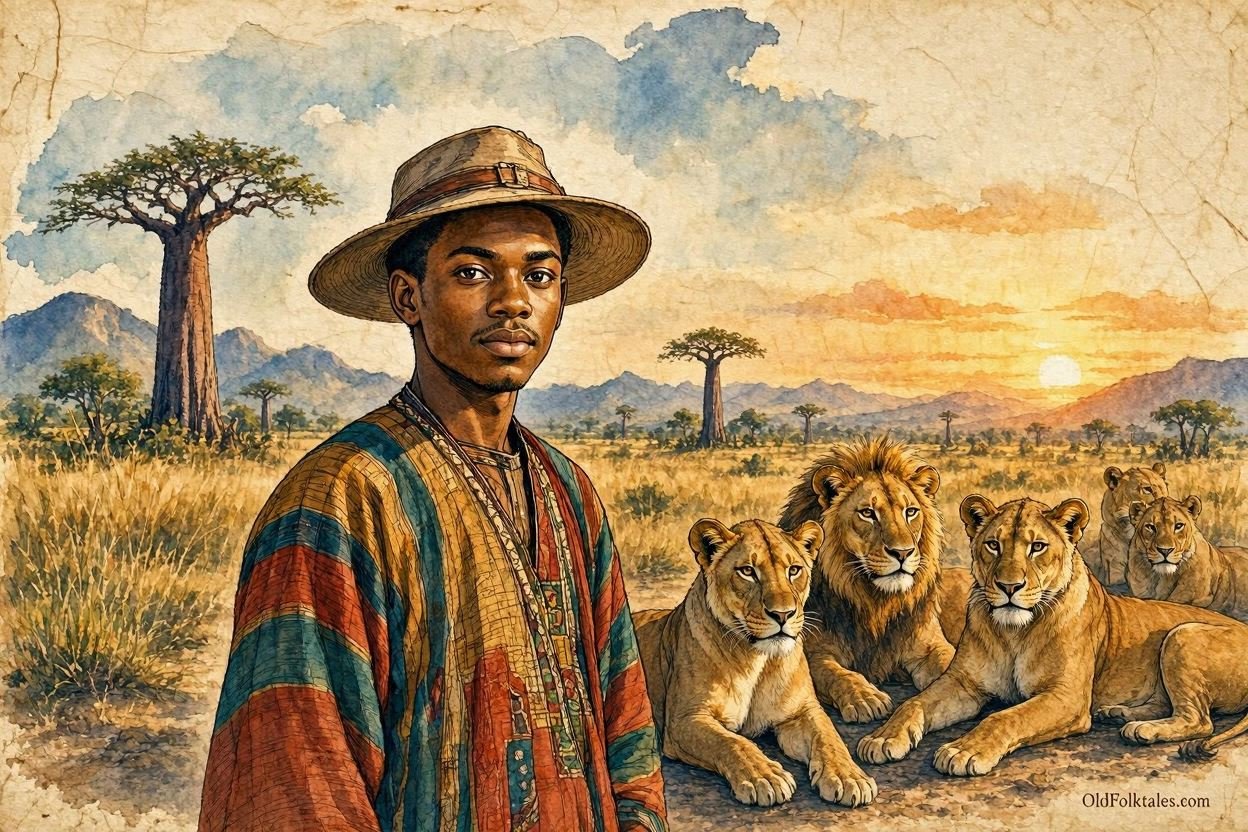
Across the wide grasslands of southern Angola, where golden savannahs stretched toward distant mountains and ancient baobab trees stood like silent guardians, the Herero people lived by herding cattle and honoring the traditions passed down through countless generations.
Among them was a cheerful boy named Tjivanda.
He loved following the older herders into the open plains, watching antelope race across the grass and listening to stories told around evening fires. Although he was still young, he dreamed of one day becoming a skilled protector of his family’s cattle.
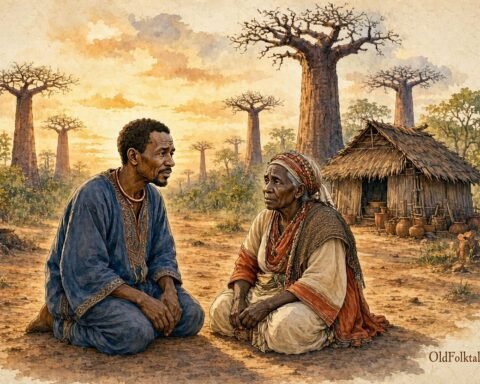
His grandmother often reminded him, “The savannah is generous, but it also keeps many secrets. Never wander beyond the places your elders have shown you.”
Tjivanda always promised he would obey.
One dry season, while helping herd cattle near the foothills, a frightened antelope suddenly dashed through the grass. Curious, Tjivanda followed it, believing he could discover where it had come from.
He ran farther than he realized.
When he finally stopped, the familiar hills had disappeared behind him.
The herd was nowhere to be seen.
No voices answered his calls.
As evening settled across the savannah, fear slowly filled his heart.
Looking for more? Explore the magic of East African folktales here
He climbed onto a large rock and waited, hoping someone would find him before darkness covered the land.
Instead, another sound reached his ears.
A deep roar echoed across the plain.
Then another.
A pride of lions emerged from the tall grass.
Tjivanda froze.
He remembered every warning he had ever heard about the great hunters of the savannah.
The largest lion approached slowly.
Its golden eyes remained fixed on the frightened child.
Tjivanda closed his eyes, expecting the worst.
But nothing happened.
When he looked again, the lion simply sat before him, watching quietly.
Behind the great lion came a lioness followed by three playful cubs.
The cubs circled Tjivanda curiously before settling beside him as though he were no threat at all.
The lioness gently nudged a piece of fresh meat toward the hungry boy.
Too frightened to move at first, Tjivanda eventually accepted the unexpected gift.
That night, he slept beneath the stars while the lions rested nearby, their watchful presence keeping other dangerous animals away.
When morning arrived, the pride did not leave him behind.
Instead, they walked slowly across the grasslands, often pausing to make sure the child followed safely.
Days turned into weeks.
Weeks became months.
Unable to find his way home, Tjivanda gradually learned to survive beside the lions.
He discovered how to read the direction of the wind, recognize approaching storms by watching the birds, and find hidden waterholes even during the harshest dry season.
He learned that the lions never hunted carelessly.
They protected their cubs fiercely but fought only when necessary.
Above all, they lived as one family, each member watching over the others.
As the years passed, Tjivanda grew taller and stronger.
Although he never forgot that he was human, the wisdom of the lions became part of the way he understood the world.
Far away, his family never stopped hoping he might still be alive.
Then, one season, a group of hunters spotted a young man walking calmly beside a pride of lions without fear.
The astonishing sight would soon change the lives of everyone in the village.
The hunters watched in amazement from a distance.
The young man walked confidently beside the lions, and the great animals showed him neither fear nor aggression. When they reached a watering hole, the pride rested peacefully while he filled a calabash with water.
One of the hunters looked closely at the young man’s face.
“There is something familiar about him,” he whispered.
As the lions wandered farther into the grassland, the young man noticed the hunters. Instead of running away, he approached them calmly.
“I greet you,” he said.
The hunters were surprised to hear him speak their language so clearly.
“What is your name?” the oldest hunter asked.
The young man paused before answering.
“My name is Tjivanda.”
The hunters exchanged astonished glances.
Many years earlier, the village had searched everywhere for a little boy by that very name.
They had believed he had perished in the wilderness.
The hunters invited him to return with them.
Before leaving, Tjivanda walked to the lions.
The great lion, now old and scarred with age, gently touched its head against his shoulder.
The lioness looked at him quietly, while the younger lions watched from behind her.
Though no words were spoken, Tjivanda understood their farewell.
He bowed respectfully before turning toward his own people.
When he arrived at the village, no one recognized him at first.
Then an elderly woman stepped forward.
She looked into his eyes and placed her trembling hand upon his face.
“My grandson,” she whispered.
It was his grandmother.
Tears of joy filled the eyes of the villagers as they welcomed Tjivanda home after so many years.
Life among people felt unfamiliar at first.
The noise of the village replaced the quiet sounds of the savannah.
Sleeping beneath a roof seemed strange after years beneath the open sky.
Yet little by little, Tjivanda found his place once again.
The villagers soon realized he possessed remarkable knowledge.
He could predict approaching storms by observing the flight of birds.
He knew where hidden springs remained during the driest months.
He taught the herders how to read the movements of wild animals to avoid danger without harming them unnecessarily.
When lions approached the grazing lands, Tjivanda discouraged the young warriors from hunting them.
“The lions are not our enemies,” he explained. “They hunt to live, just as we herd cattle to live. When we understand their ways, we can protect our livestock without destroying the balance of the land.”
The elders listened carefully.
Following his advice, they began moving their cattle before lions reached the grazing fields and built stronger nighttime enclosures for their herds.
Soon, conflicts between people and lions became rare.
The village prospered because wisdom had replaced fear.
As the years passed, Tjivanda became one of the most respected advisers among the Herero people.
Whenever disagreements arose, he reminded everyone of what he had learned from the lions.
“Strength protects,” he would say, “but patience guides. A family survives because each member watches over the others.”
Long after Tjivanda’s lifetime, parents continued telling his story to their children.
They explained that the wilderness is not only a place of danger but also a place of learning for those who approach it with humility and respect.
The tale of The Boy Raised by Lions became a treasured legend among the people of southern Angola, reminding every generation that wisdom can be found in unexpected places and that true courage is shown not by conquering nature but by learning to live in harmony with it.
Don’t miss out: Read more Southern African folktales
Moral Lesson
This Angolan folktale teaches that courage, humility, and respect for nature lead to true wisdom. It also reminds us that understanding others, even those who seem different or dangerous, creates peace instead of conflict.
Knowledge Check
1. How did Tjivanda become separated from his family?
He wandered too far while following an antelope and became lost in the savannah.
2. Why did the lions spare Tjivanda?
Instead of harming him, they accepted him into their pride and protected him as he grew.
3. What important lessons did Tjivanda learn from the lions?
He learned patience, cooperation, survival skills, and the importance of protecting one’s family.
4. How did Tjivanda help his village after returning home?
He shared his knowledge of nature, helping the villagers protect their cattle while living peacefully alongside wildlife.
5. Why did the elders value Tjivanda’s advice?
His unique experiences gave him wisdom that benefited both the people and the natural world.
6. What is the central lesson of this Angolan folktale?
The story teaches that true wisdom comes from respecting nature, learning from experience, and using knowledge to build harmony.
Source: Adapted from Southern Angolan oral traditions documented in ethnographic folklore collections by Carlos Estermann, reflecting Herero and Southern Angolan storytelling traditions.