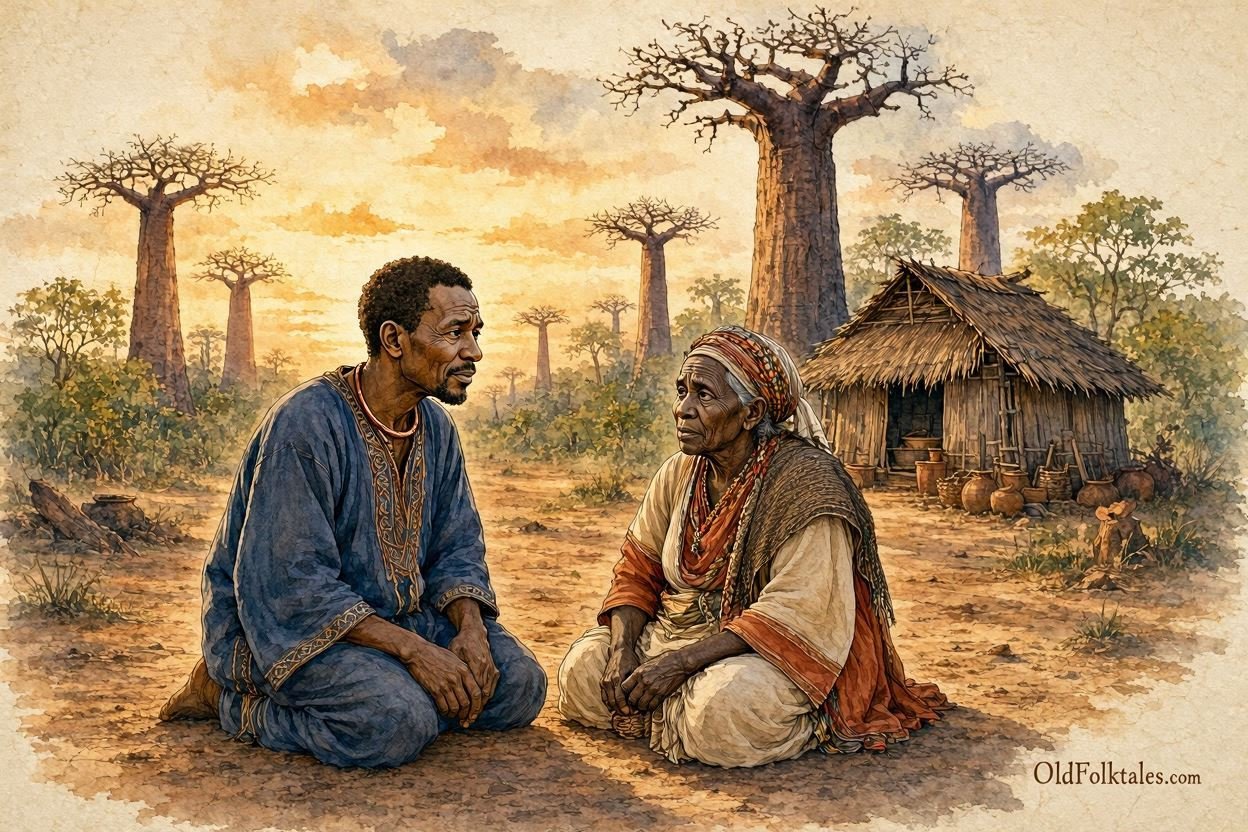
In the fertile lands of the Mbundu people, where rivers wound through forests and royal villages stood beneath towering baobab trees, there ruled a king named Ngola Kambi. His kingdom was prosperous, its markets busy with traders, and its farms yielded abundant harvests each season.
The people admired their king for his courage in battle and his skill in settling disputes. Under his leadership, neighboring kingdoms respected the Mbundu throne, and peace had lasted for many years.
Yet the elders often reminded the young that even the greatest ruler must remain faithful to his word.
“A promise,” they would say, “is stronger than the walls of a palace.”
Many years before ascending the throne, Ngola Kambi had been a young prince.
During one season of severe drought, he had become separated from his hunting companions while chasing a wounded antelope deep into the forest.
Exhausted and thirsty, the prince eventually collapsed beside a narrow stream.
Looking for more? Explore the magic of East African folktales here
There he was discovered by an elderly woman who lived alone in a small hut hidden among the trees.
Without asking his name or expecting a reward, she carried water to him, prepared food from her humble garden, and cared for him until he regained his strength.
When the prince prepared to leave, he thanked the old woman sincerely.
“If I should ever become king,” he promised, “I will return and make certain that you never know hardship again.”
The woman smiled kindly.
“My son,” she replied, “I ask only that you remember your words.”
Soon afterward, the prince found his way home.
Life moved forward.
His father passed away.
Ngola Kambi was crowned king, and the responsibilities of ruling filled every hour of every day.
He judged disputes, welcomed foreign visitors, strengthened trade, and protected the kingdom from its enemies.
As the years passed, the memory of the lonely hut in the forest slowly faded.
The promise he had once made was forgotten.
One planting season, however, strange events began troubling the kingdom.
Healthy crops withered overnight despite steady rainfall.
Royal messengers repeatedly lost their way on familiar roads.
Drums sounded by themselves during the quiet hours before dawn, though no drummer could be found.
Even the king’s most trusted advisers struggled to explain the mysterious happenings.
The royal diviners searched for answers but discovered no sign of disease, invading enemies, or natural disaster.
Finally, the oldest elder in the kingdom requested permission to address the king.
After listening quietly to every report, the elder asked only one question.
“My king, is there a promise you once made but never fulfilled?”
Ngola Kambi frowned.
He searched his memory but could think of nothing.
“I have broken no treaty,” he answered.
The elder lowered his head respectfully.
“Not every promise is made before witnesses,” he replied. “Some are spoken quietly, yet the ancestors hear them all.”
That night, the king found himself unable to sleep.
As the palace grew silent, fragments of an old memory slowly returned to him.
A forest.
A stream.
An elderly woman.
A simple promise spoken with youthful sincerity.
At dawn, Ngola Kambi rose from his bed with a troubled heart.
He knew there was only one way to discover whether the forgotten words of long ago still awaited him.
Before the sun had fully risen, King Ngola Kambi left the royal palace with only the oldest elder and two trusted attendants.
He wore no crown and carried no royal banners.
“This journey is not about my throne,” he said quietly. “It is about my word.”
They traveled for two days through forests and across rivers until the king finally recognized the narrow path he had walked as a young prince.
The trees had grown taller.
The stream still flowed gently over smooth stones.
But the little hut seemed older than he remembered.
Its roof had begun to sag, and the garden surrounding it had become overgrown with weeds.
The king approached slowly.
Seated beneath a shade tree was the same elderly woman, now much older but with the same gentle smile.
She looked at him for a long moment.
“I wondered if you would ever remember,” she said softly.
The king knelt before her.
“Mother,” he said with deep humility, “I have no excuse. You saved my life, and I gave you my word. I allowed the duties of the palace to bury my promise beneath the passing years.”
The old woman placed a hand on his shoulder.
“I never desired riches,” she replied. “I wished only to know that a good man would remain true to his word after becoming a great king.”
Her kindness made the king’s regret even deeper.
He immediately ordered his attendants to repair her home, restore her garden, and provide everything she needed for the rest of her life.
But the old woman gently shook her head.
“Do not stop with me,” she said. “There are many widows, elders, and forgotten people throughout your kingdom who have no one to care for them. If you truly wish to keep your promise, remember them as well.”
The king remained silent.
He realized that his forgotten promise was not only about one woman.
It was about the kind of ruler he had promised to become.
When he returned to the capital, Ngola Kambi called together his council, village chiefs, and elders.
He told them everything.
He did not hide his mistake or blame anyone else.
“A king who cannot admit his own failure,” he declared, “cannot expect honesty from his people.”
He announced new laws requiring every village to care for its elderly, widows, and orphans.
Royal officers were instructed to travel throughout the kingdom each season to ensure that no vulnerable person was abandoned.
He also established a yearly Day of Promises, when families, leaders, and neighbors gathered to fulfill forgotten obligations and reconcile broken relationships.
As these changes spread across the kingdom, the mysterious troubles slowly disappeared.
The crops flourished once again.
The royal drums remained silent except during celebrations.
Travelers found their roads without confusion, and peace returned to the land.
The oldest elder smiled as he watched the kingdom prosper.
“The ancestors did not seek to punish the king,” he said. “They wished only to remind him that leadership begins with faithfulness.”
Many years later, when Ngola Kambi’s reign came to an end, people remembered him not only for his victories or his wealth but for the humility he showed after correcting his greatest mistake.
Parents often repeated his story to their children.
“A promise may grow old,” they would say, “but it never disappears.”
And so, the tale of The King’s Forgotten Promise continued to be told among the Mbundu people, reminding every generation that true honor is measured not by the promises we make, but by the promises we faithfully keep.
Don’t miss out: Read more Southern African folktales
Moral Lesson
This Angolan folktale teaches that integrity means keeping one’s promises, even after many years. True leadership is shown through humility, accountability, and faithful action.
Knowledge Check
1. What promise did Prince Ngola Kambi make?
He promised to care for the elderly woman who saved his life if he ever became king.
2. Why did the kingdom experience strange misfortunes?
The king had forgotten his promise, and the mysterious events reminded him of his neglected duty.
3. How did the king respond after remembering his promise?
He sought out the elderly woman, admitted his mistake, and fulfilled his promise with humility.
4. What advice did the elderly woman give the king?
She urged him to care not only for her but for all the vulnerable people in his kingdom.
5. What new tradition did the king establish?
He created a yearly Day of Promises to encourage people to fulfill forgotten obligations and restore broken relationships.
6. What is the central lesson of this Angolan folktale?
The story teaches that promises should be honored, and true leaders earn respect through integrity and accountability.
Source: Adapted from Mbundu oral traditions preserved in Óscar Ribas’ Missosso: Literatura Tradicional Angolana, together with related ethnographic studies of Angolan traditional literature.