Within the ancient Luba Kingdom, long before written records preserved the deeds of kings, there burned a fire unlike any other.
It was not the largest fire in the kingdom, nor the brightest.
Yet every chief, elder, and royal servant regarded it with the deepest respect.
The people called it The Sacred Fire.
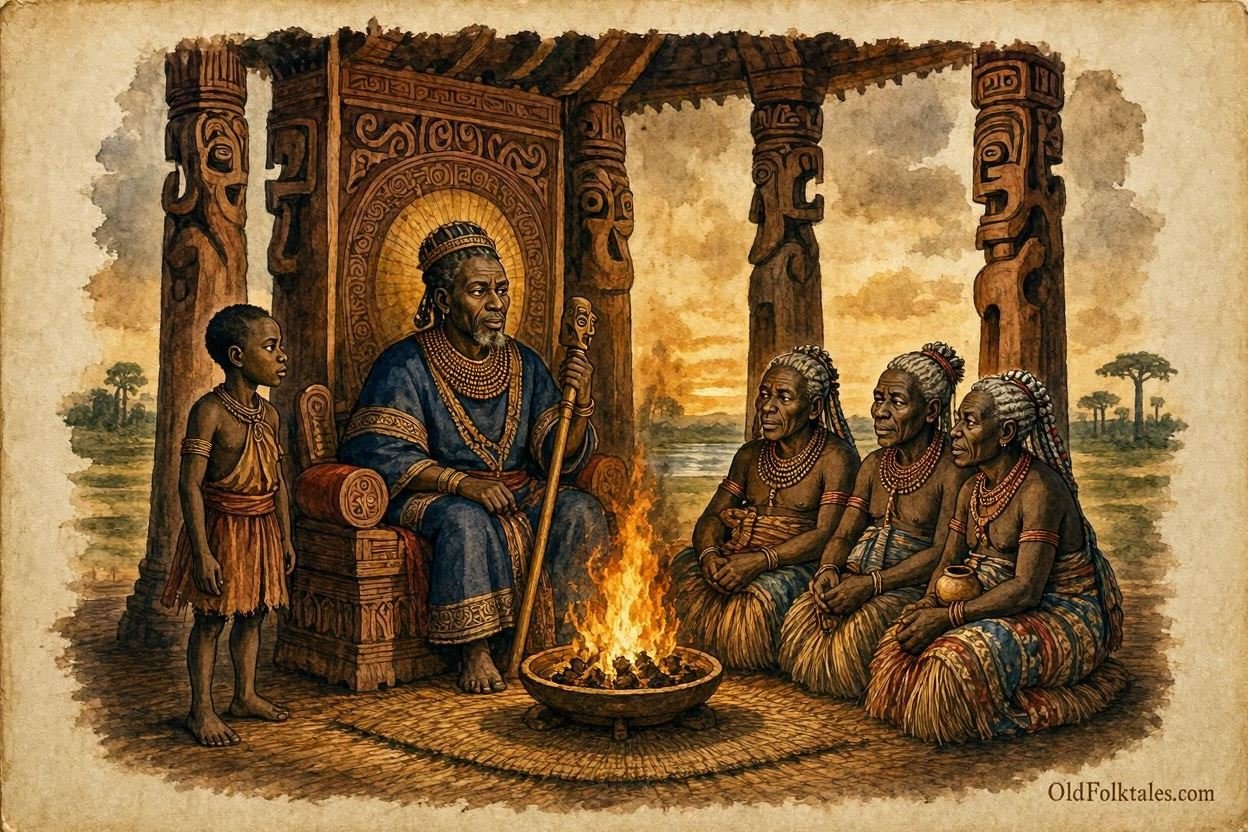
It burned day and night in the heart of the royal court, sheltered beneath a beautifully carved pavilion of wood and thatch.
According to the elders, the flame had first been lit by the kingdom’s founding ruler after the ancestors blessed the Luba people with peace and unity.
Since then, every king had sworn to protect it.
The fire represented far more than warmth or light.
It symbolized the life of the kingdom itself.
As long as the flame burned, the people believed harmony would endure between the rulers, the ancestors, and the land.
For generations, trusted guardians watched over the Sacred Fire.
They worked in silence, taking turns throughout the day and night.
Only carefully chosen wood from sacred trees could feed the flame.
Every morning, prayers of gratitude were offered before fresh logs were placed upon the glowing embers.
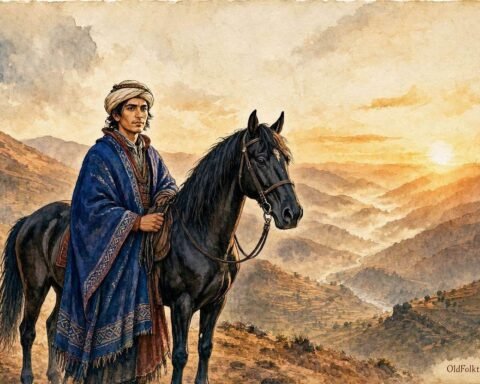
Among the royal attendants was a young man named Mukeba.
Fascinated by this tale? Discover more North African folktales
He had recently been chosen as the youngest guardian ever entrusted with helping care for the Sacred Fire.
Mukeba was hardworking, eager to learn, and deeply honored by the responsibility.
The chief guardian often reminded him, “Never think your duty is small. A kingdom remains strong because every person faithfully carries the task entrusted to them.”
Mukeba listened carefully and carried out every instruction with great care.
Months passed without incident.
The Sacred Fire continued to burn steadily.
The kingdom prospered.
Harvests were plentiful.
Trade flourished.
Families celebrated festivals beneath peaceful skies.
One afternoon, messengers arrived at the royal court carrying urgent news of a dispute between two distant chiefs.
The king immediately called his advisers together.
In the excitement that followed, many attendants rushed to prepare for the council meeting.
Mukeba also hurried to assist.
Before leaving the pavilion, he glanced at the Sacred Fire.
Only a few glowing logs remained.
“I will return in just a moment,” he thought.
“The fire will surely last until then.”
Believing the task could wait, Mukeba hurried after the other attendants.
The royal meeting lasted much longer than anyone expected.
As evening settled over the kingdom, dark clouds covered the sky.
A cool wind swept through the empty pavilion where the Sacred Fire had been left unattended.
The last glowing ember slowly faded.
Then, for the first time since the days of the kingdom’s founders, the Sacred Fire went out.
No one noticed until the chief guardian returned after sunset.
He stopped in disbelief.
The hearth was cold.
The flame that had united generations of Luba kings had disappeared into darkness.
The chief guardian immediately rang the royal bell.
Its deep sound echoed across the palace and into the surrounding villages.
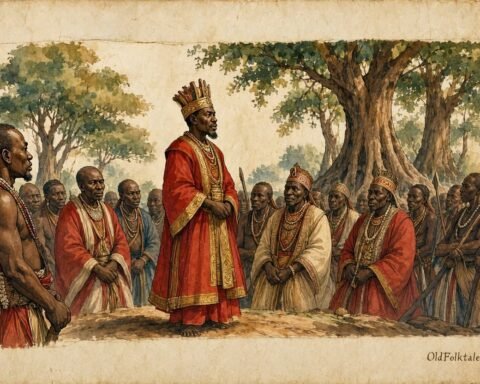
The king, his advisers, and the royal elders hurried to the pavilion.
When they saw the cold hearth, silence filled the air.
No one spoke.
For generations, the Sacred Fire had never been allowed to die.
Mukeba slowly stepped forward.
His hands trembled.
“I was responsible,” he admitted. “I believed I could leave for only a short time. I thought someone else would notice before the fire faded.”
The king looked at the frightened young guardian.
“You have spoken the truth,” he said. “That requires courage.”
The oldest elder then addressed everyone gathered around the empty hearth.
“The fire did not die because of wickedness,” he said. “It died because one important duty was treated as though it could wait.”
His words settled deeply in every heart.
The elders agreed that the Sacred Fire could not simply be relit like an ordinary cooking fire.
Before a new flame could burn, the kingdom had to renew its commitment to the values the fire represented.
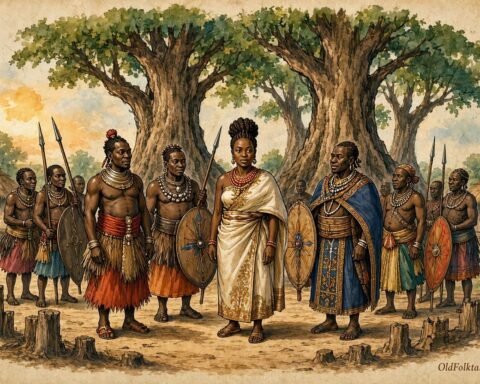
For three days, chiefs traveled from every province to the royal capital.
Families gathered in prayer and reflection.
Old disagreements were peacefully resolved.
Debts were forgiven.
Neighbors who had quarreled reconciled with one another.
The people cleaned the royal grounds together and repaired neglected roads leading to the capital.
The king himself worked alongside ordinary villagers, carrying wood and helping prepare the sacred pavilion.
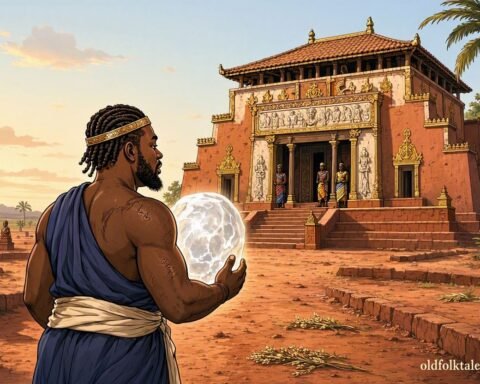
When the third sunrise arrived, the royal historian carried a firestone said to have belonged to the ancestors.
The oldest priest carefully struck the stone until a single spark appeared.
The tiny flame was placed upon dry grass.
Slowly it grew stronger.
Then it was transferred to carefully chosen sacred wood.
As the fire rose once again, the people cheered with gratitude.
The king turned to Mukeba.
“You made a mistake,” he said, “but you accepted responsibility instead of hiding the truth. Let this lesson guide your life.”
Mukeba knelt before the Sacred Fire.
“From this day forward,” he promised, “I will remember that even the smallest responsibility may protect the future of many people.”
Years later, Mukeba himself became the chief guardian of the Sacred Fire.
Whenever a new apprentice joined him, he would point to the steady flame and tell the story of the night it nearly disappeared.
“The fire is not protected by one person alone,” he would say.
“It continues to burn because every generation accepts its responsibility with care.”
The people of the Luba Kingdom never forgot that lesson.
The Sacred Fire remained a symbol of faithful leadership, shared responsibility, and the enduring bond between the rulers, the people, and the memory of their ancestors.
And so, The Sacred Fire of the Luba Kings became one of the treasured royal legends of the Luba people, reminding every generation that great kingdoms are preserved not only by mighty rulers but also by ordinary people who faithfully fulfill the duties entrusted to them.
Keep reading: Discover more Central African folktales
Moral Lesson
This Luba folktale teaches that every responsibility, no matter how small it seems, contributes to the well being of the whole community. Honest leadership begins with faithfully caring for what has been entrusted to us.
Knowledge Check
1. What did the Sacred Fire symbolize in the Luba Kingdom?
It symbolized the life, unity, and continuity of the kingdom.
2. Why did the Sacred Fire go out?
Mukeba left it unattended, believing he would return before it needed more wood.
3. How did Mukeba respond when the fire was discovered to have gone out?
He admitted his mistake honestly and accepted responsibility.
4. Why did the elders refuse to relight the fire immediately?
They believed the people first needed to renew their commitment to unity, responsibility, and peace.
5. How was the Sacred Fire restored?
After days of reconciliation and preparation, the elders lit a new flame using a sacred firestone and carefully tended it.
6. What is the central lesson of this folktale?
The story teaches that faithful responsibility, honesty, and shared commitment are essential for preserving a community’s strength and traditions.
Source: Adapted from Luba royal traditions discussed in Jan Vansina’s Kingdoms of the Savanna (1966).