In the broad plains of southern Angola, where scattered acacia trees cast long shadows across the grasslands and towering termite mounds rose like ancient monuments from the earth, there stood a peaceful village belonging to the Ovambo related people.
The villagers believed that every termite mound carried a story.
Some were simply homes for tiny insects that tirelessly shaped the land.
Others, the elders whispered, had existed long before the oldest families settled there and were watched over by unseen ancestral spirits.
Because of this belief, no one disturbed the oldest mounds without first offering a prayer of respect.
Among them all stood one enormous mound at the edge of the forest.
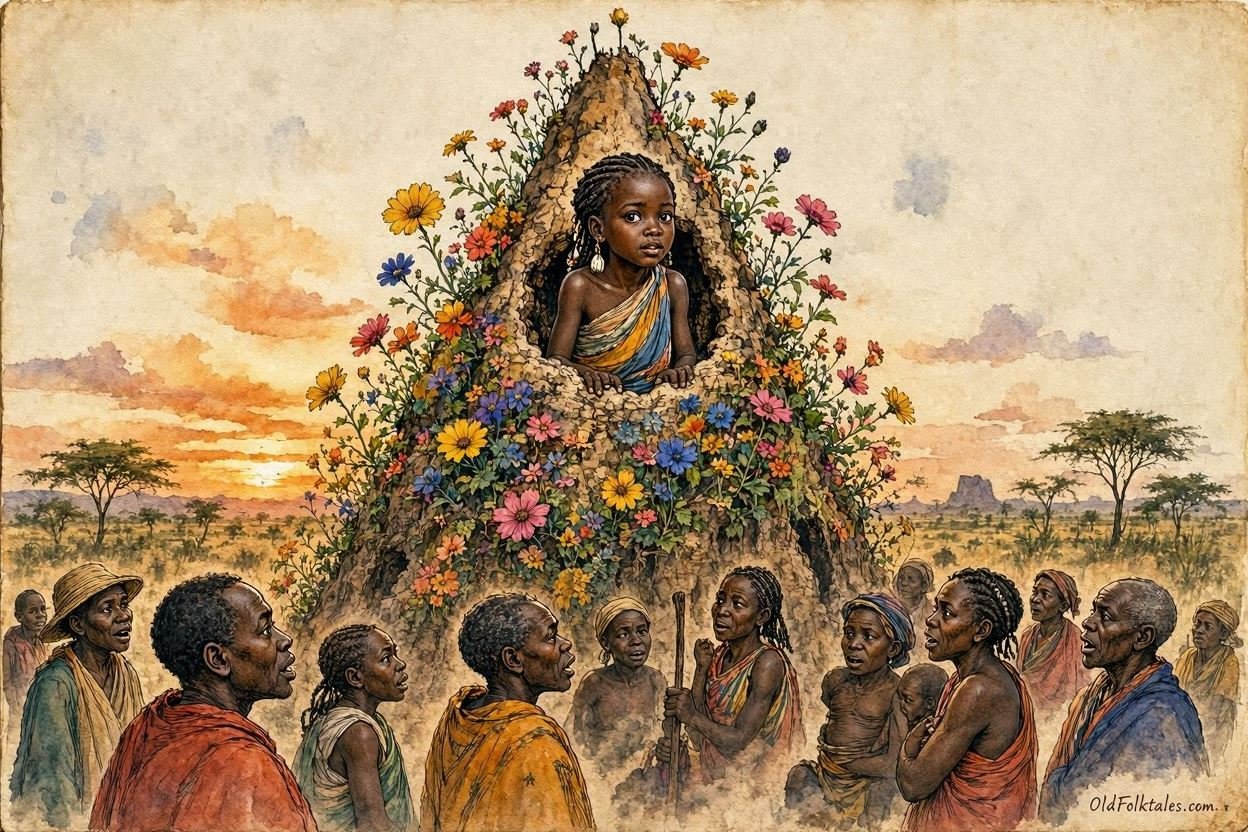
It was taller than any person in the village and crowned with wild flowers that bloomed even during the driest months.
Birds often perched upon it, but no animal ever dug into its sides.
The villagers simply called it The Sacred Mound.
For generations, strange stories surrounded the place.
Travelers sometimes claimed they heard laughter drifting through the grass at sunset.
Fascinated by this tale? Discover more North African folktales
Herders spoke of seeing tiny footprints leading to the mound but never away from it.
Others dismissed the tales as tricks of the wind.
One unusually quiet morning, a young shepherd named Nangolo led his goats toward the grazing fields near the sacred mound.
As he rested beneath a nearby tree, he heard the sound of gentle singing.
The voice was soft and beautiful, unlike anything he had ever heard.
Believing another shepherd was nearby, he searched the grasslands.
He found no one.
The singing continued.
This time, it seemed to come from inside the termite mound itself.
Startled, Nangolo stepped closer.
“Who is there?” he called.
The singing stopped immediately.
Silence returned.
When Nangolo told the elders what he had heard, most smiled politely.
“You have spent too many hours beneath the hot sun,” one elder joked.
But the oldest woman in the village became thoughtful.
“The stories may be older than we remember,” she murmured.
The following evening, several villagers accompanied Nangolo back to the sacred mound.
As the sun dipped below the horizon, they too heard the mysterious song.
No one spoke.
The melody seemed both joyful and sorrowful, as though it carried memories from another age.
Then, before their astonished eyes, a narrow crack slowly appeared along the side of the mound.
From the opening stepped a young girl, perhaps twelve years old.
She wore a simple garment woven from grasses and carried a small basket filled with wild flowers.
Her face was calm.
Her eyes reflected a quiet wisdom far beyond her years.
The villagers stood frozen.
The girl looked at each of them with a gentle smile.
“I have been waiting,” she said softly.
No one could find the words to answer.
The oldest elder finally stepped forward.
“Child,” he asked carefully, “who are you?”
The girl looked toward the setting sun before replying.
“I belong to the land that remembers.”
Before anyone could ask another question, she turned and walked back toward the termite mound.
To everyone’s amazement, the opening closed behind her as though it had never existed.
The villagers returned home filled with questions.
Who was the mysterious girl?
Why had she appeared after so many generations?
And what did she mean when she said she belonged to the land that remembers?
None of them realized that her arrival marked the beginning of a remarkable change that would transform their village forever.
The next evening, the villagers gathered once again near the sacred termite mound.
As the last rays of sunlight disappeared beyond the horizon, the familiar melody drifted across the grasslands.
Once more, a narrow opening appeared in the mound.
The mysterious girl stepped outside, carrying her basket of wild flowers.
This time, she did not return immediately.
Instead, she looked at the villagers and smiled.
“You have come with peaceful hearts,” she said. “That is why the land has allowed you to see me.”
The oldest elder stepped forward.
“We wish to know who you are.”
The girl placed one of the flowers upon the ground.
“My name is Nambili,” she replied. “Long before your grandparents were born, this place was protected by those who promised to keep peace between the people, the land, and the animals. When those promises were forgotten, I remained here until the time came to remind the village once again.”
Her words puzzled everyone.
The villagers had always believed the mound was sacred, but few remembered why.
Over the following days, Nambili appeared each evening.
She never stayed until darkness fell, yet every visit brought a lesson.
She showed the farmers how to recognize signs that rain would soon arrive by watching the flight of swallows and the blooming of certain wild plants.
She taught the herders where fresh grazing lands would appear after the first storms.
She explained which medicinal herbs could heal fever and which plants should never be touched.
Most importantly, she reminded the villagers that the land could remain generous only if they treated it with gratitude and care.
Slowly, the village began to change.
Neighbors who had argued over farmland started sharing water during the dry season.
Hunters stopped taking more animals than their families needed.
Children were taught to plant young trees whenever old ones were cut down.
As the people worked together, the harvests became richer than anyone could remember.
The rivers flowed longer into the dry months, and the grazing fields remained green.
Visitors from neighboring villages marveled at the peace and prosperity they found there.
Many asked how such harmony had returned.
The villagers simply smiled and pointed toward the sacred termite mound.
One season, however, a wealthy trader arrived from a distant land.
When he heard stories about the mysterious girl, he became convinced that the mound concealed great riches.
“If a child lives inside it,” he said, “there must also be hidden treasure.”
Ignoring the warnings of the elders, he returned at dawn with several workers carrying heavy iron tools.
As they struck the side of the mound, the earth trembled beneath their feet.
A powerful wind swept across the plain.
The birds took flight.
The sky darkened although no storm had been expected.
Frightened, the workers dropped their tools and ran.
The trader stumbled to the ground.
Just then, Nambili appeared before him.
“There is no gold hidden here,” she said calmly. “The greatest treasure has always been the wisdom that protects this land.”
Ashamed, the trader lowered his head.
“I was blinded by greed,” he admitted.
Nambili helped him to his feet.
“When people seek riches without respect, they lose both. But those who care for the land leave a wealth that future generations can share.”
The trader apologized to the villagers and joined them in repairing the damaged mound.
From that day forward, no one ever attempted to disturb it again.
As the years passed, Nambili appeared less often.
One evening, she gathered the villagers for the final time.
“My work is finished,” she said gently. “You no longer need someone to remind you what your ancestors already taught.”
She placed her basket of flowers beside the mound.
As the sun slipped below the horizon, she stepped inside.
The opening slowly closed, and the mound became silent once more.
Although Nambili was never seen again, wild flowers continued to bloom on the mound throughout every season, even during years of drought.
The villagers believed it was a sign that the ancestors still watched over them.
From generation to generation, they told the story of The Girl Hidden Inside the Termite Mound, reminding every child that the greatest inheritance is not buried beneath the earth but lives in the wisdom, unity, and respect passed from one generation to the next.
Love this story? Discover our full Southern African folktales collection
Moral Lesson
This Angolan folktale teaches that a community prospers when its people honor their ancestors, care for the land, and place wisdom above greed.
Knowledge Check
1. Why was the termite mound considered sacred?
The villagers believed it was protected by ancestral spirits and held ancient traditions.
2. Who was Nambili?
She was a mysterious girl who appeared from the sacred termite mound to restore forgotten wisdom to the village.
3. What lessons did Nambili teach the villagers?
She taught them to care for nature, share resources, respect one another, and preserve their ancestral traditions.
4. Why did the wealthy trader try to break open the mound?
He believed it contained hidden treasure and ignored the elders’ warnings.
5. What did the trader learn?
He learned that true treasure is wisdom, not material wealth, and that greed brings shame instead of prosperity.
6. What is the central lesson of this Angolan folktale?
The story teaches that respecting ancestral wisdom, protecting nature, and living in unity create lasting blessings.
Source: Adapted from Southern Angolan oral traditions documented in the ethnographic works of Carlos Estermann, reflecting Ovambo-related traditions of southern Angola.