Across the grasslands and forests of Central Angola, the Imbangala became known in regional history and oral tradition for their disciplined warrior bands and highly organized way of life. Their reputation spread through stories told by elders, travelers, and neighboring communities. Although many accounts differed in detail, they agreed on one important truth. The strength of the Imbangala did not come from weapons alone. It came from the discipline, loyalty, and shared commitment that united every member of the group.
According to oral tradition, no person could simply declare themselves a member of an Imbangala warrior band. Membership required trust, dedication, and a willingness to place the welfare of the community above personal ambition. Before joining, every candidate had to demonstrate courage, honesty, and respect for established customs. Elders carefully observed each individual, believing that true character revealed itself through actions rather than words.
Among the most respected customs remembered in these traditions was the taking of a solemn oath. This ceremony marked the moment when a new member accepted the responsibilities that came with belonging to the community. The oath was not viewed as a promise made for a single day. It represented a lifelong commitment to discipline, loyalty, and service.
Preparations for the ceremony often began several days in advance. Elders selected a suitable gathering place, usually an open space where the entire community could assemble. Families cleaned the area, musicians prepared ceremonial drums, and respected leaders reviewed the customs that would guide the event. The atmosphere reflected both celebration and seriousness because everyone understood the importance of the occasion.
Continue your journey: Read more East African folktales
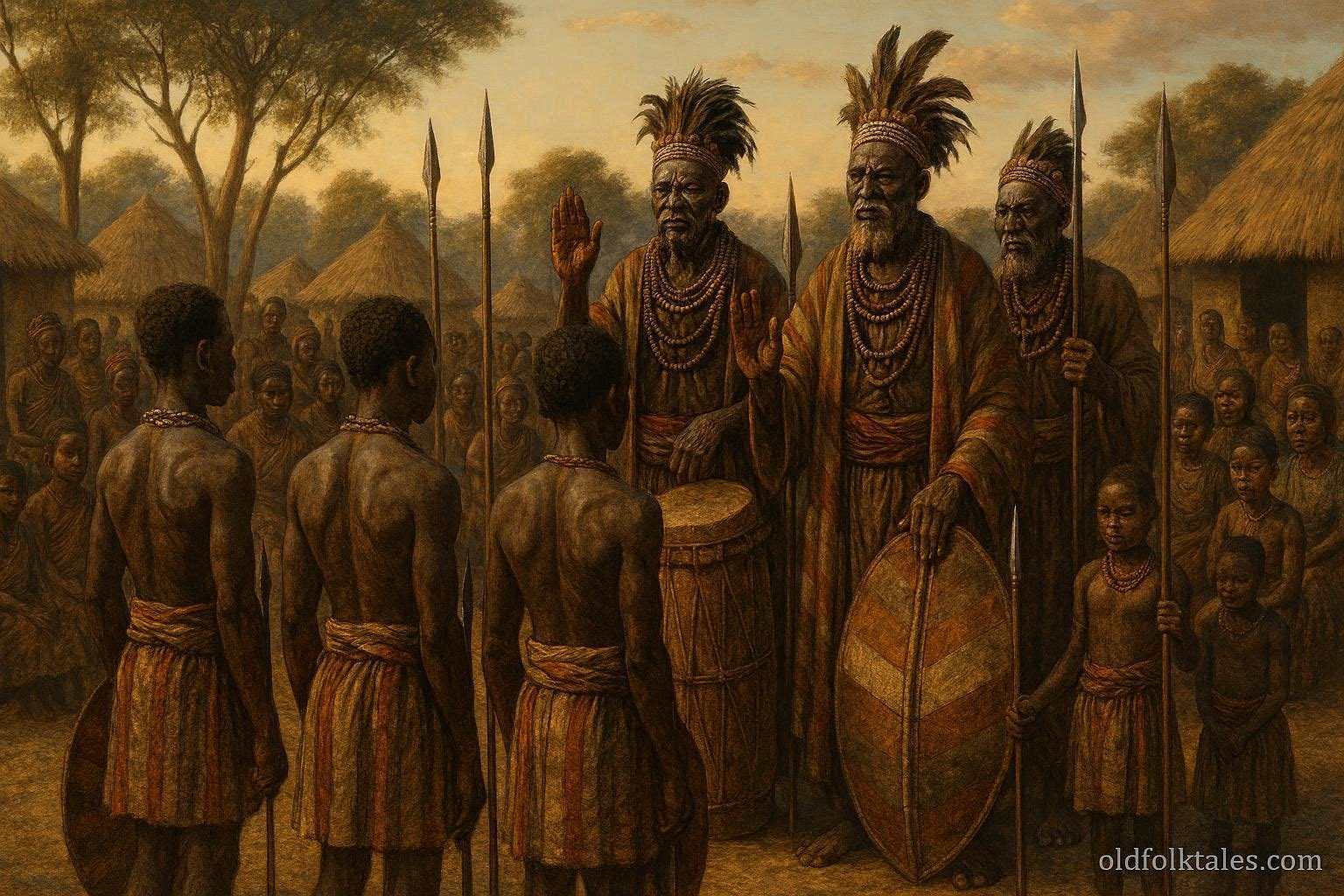
On the appointed day, people arrived from nearby settlements to witness the ceremony. Elders occupied places of honor while experienced warriors stood nearby to welcome the candidates. Relatives gathered to offer encouragement, knowing that the decisions made that day would shape the future of each participant.
Before the oath itself, the candidates were reminded why the tradition existed. A senior elder addressed the gathering and explained that courage without discipline could become recklessness. Strength without wisdom could become destruction. Loyalty without integrity could lose its meaning. Only when these qualities worked together could a community remain secure and united.
The candidates listened in silence.
Each understood that becoming a member of the warrior band meant accepting responsibilities beyond personal achievement. They were expected to protect the vulnerable, respect their leaders, support their companions, and uphold the customs that preserved harmony within the community.
Following the elder’s address, respected members of the warrior band shared stories from earlier generations. They recalled individuals whose loyalty had saved companions during difficult journeys. They described moments when discipline prevented unnecessary conflict. They praised those who chose wisdom instead of pride when making important decisions.
These stories reminded everyone that the oath represented practical values rather than empty words.
When the time arrived, the candidates stepped forward together.
Standing before the assembled community, they repeated the traditional promises after the elder. They pledged to remain loyal to one another, to obey lawful leadership, to protect the community during times of danger, and to conduct themselves with honor in both victory and hardship.
The gathering responded with quiet approval.
Experienced warriors then welcomed the new members, symbolizing that they now shared responsibility for the welfare of the entire group. Families celebrated not because their relatives had become fighters, but because they had accepted the duties expected of trustworthy adults.
The ceremony concluded with music, dancing, and communal meals. Yet the true significance of the oath became visible only in the months and years that followed.
New members quickly learned that discipline influenced every aspect of daily life.
Training required patience and consistency. Warriors practiced movement, coordination, observation, and teamwork. They learned that success depended upon cooperation rather than individual glory. Every exercise emphasized mutual trust.
Elders frequently reminded younger members that loyalty extended beyond military service.
A loyal person assisted neighbors during harvests, supported families facing hardship, respected agreements between communities, and contributed to public works that benefited everyone.
In this way, the oath strengthened both the warrior band and the wider society.
One season, oral tradition recalls, prolonged drought placed enormous pressure on several neighboring communities. Water sources became scarce, harvests declined, and competition for limited resources increased. Tensions rose as different groups worried about the future.
Some young warriors suggested using force to secure additional supplies.
The elders disagreed.
They reminded everyone of the oath.
The promises required courage, but they also required wisdom and restraint. Rather than provoking conflict, respected leaders organized meetings with neighboring communities to discuss fair sharing of available resources.
The negotiations were not easy.
Each community faced genuine hardship.
However, because the leaders approached one another with honesty and respect, agreements were eventually reached. Wells were shared according to established schedules, grazing areas were managed cooperatively, and food assistance was provided to the most vulnerable families.
The crisis passed without unnecessary violence.
Many later credited the values expressed in the oath for helping preserve peace during a difficult period.
Another story tells of a young warrior who became separated from his companions during a long journey. Although frightened and uncertain, he remembered the teachings given during the oath ceremony. Instead of acting recklessly, he remained calm, observed his surroundings carefully, and eventually reunited with the group.
When asked how he had maintained his composure, he replied that the oath reminded him never to allow fear to overcome discipline.
His experience became another lesson shared with future generations.
As the years passed, the oath continued to shape the character of those who accepted it.
Children listened as elders explained its meaning.
Young people looked forward to the day when they might prove themselves worthy of taking similar responsibilities.
Even older members found renewed purpose in mentoring the next generation.
The tradition survived because each generation understood that its strength depended upon the willingness of ordinary people to honor extraordinary commitments.
Although history brought many changes to Central Angola, memories of the Imbangala oath remained part of oral tradition.
Storytellers emphasized that the greatest achievement of the ceremony was not the creation of skilled warriors.
Its true success lay in forming individuals who valued loyalty over selfishness, discipline over impulse, and responsibility over personal gain.
Today, historians and cultural researchers continue to study Imbangala traditions to better understand the complex societies that flourished in Central Africa.
While historical sources sometimes present differing perspectives, oral traditions consistently highlight the importance of shared values in maintaining unity.
The story of the Oath of the Imbangala continues to remind listeners that communities become stronger when trust is earned, promises are honored, and courage is guided by wisdom.
Explore more Southern African folktales here
Moral Lesson
True strength is measured not only by courage but by discipline, loyalty, and the willingness to serve others.
Knowledge Check
1. What was the purpose of the Imbangala oath?
It marked a lifelong commitment to loyalty, discipline, and service to the community.
2. Who witnessed the oath ceremony?
Elders, experienced warriors, families, and members of the community.
3. What values did the oath emphasize?
Loyalty, courage, discipline, integrity, and responsibility.
4. How did the oath help during the drought?
It encouraged leaders to negotiate and share resources peacefully rather than resorting to conflict.
5. Why did elders share stories before the oath?
To teach that true strength comes from honorable actions and wise decisions.
6. What is the main lesson of the story?
Communities thrive when courage is guided by discipline, loyalty, and responsibility.
Source
Adapted from Imbangala oral traditions, ethnographic studies of Central Angola, and materials preserved in Imbangala ethnographic archives and Central African historical tradition collections.