The woodlands of Cangandala have long been among Angola’s most treasured natural landscapes. Towering trees, open grasslands, winding streams, and rich forests created a home for countless animals that had lived there for generations. Among them was the magnificent Giant Sable Antelope, an animal admired for its graceful appearance, powerful curved horns, and quiet strength. To the Mbundu communities living near these forests, the Giant Sable was far more than remarkable wildlife. It represented the richness of nature and reminded people that every living creature had its own place within the balance of the land.
For countless generations, the people of the surrounding villages depended upon the forests of Cangandala. They gathered fruits, collected medicinal plants, harvested honey, and hunted wild game to feed their families. Yet elders consistently reminded younger generations that the forest was not an endless storehouse. Every resource had limits, and nature rewarded only those who treated it with care and respect.
Among the villagers lived a respected hunter named Kalombo. Although many admired his remarkable skill with a bow and spear, they respected him even more for his wisdom. He often reminded younger hunters that success was measured not by the number of animals taken but by the judgment shown during every journey into the forest.
Whenever young apprentices asked him how to become great hunters, Kalombo never spoke first about weapons.
Instead, he spoke about patience.
Want to dive deeper? Read more North African folktales today
He taught them to recognize animal tracks without disturbing them unnecessarily. He explained how to observe the changing seasons and understand when certain animals were raising their young. He encouraged them to notice the flowering of particular trees because these often signaled the arrival of migrating animals.
“Nature always speaks,” he would say.
“The wise hunter learns to listen before acting.”
Every hunting expedition began before sunrise.
The hunters gathered quietly outside the village carrying only the equipment they truly needed. Before entering the forest, the eldest among them reminded everyone of the customs handed down by previous generations.
They would never hunt more than their community required.
They would never disturb nesting places without reason.
They would never waste any part of an animal that had provided food.
These customs were not written in books.
They lived in memory, passed from one generation to another through stories, observation, and experience.
One year, after several successful harvests, game became especially abundant throughout Cangandala.
Some younger hunters grew excited.
They suggested organizing larger hunting parties to gather more meat than ever before.
Kalombo listened carefully before responding.
He asked a simple question.
“What will remain for next season if we take everything today?”
The young men fell silent.
Kalombo explained that true abundance could never be measured by immediate gain.
The greatest success belonged to communities that ensured the forest continued providing for future generations.
His words reflected lessons he himself had learned from older hunters many years earlier.
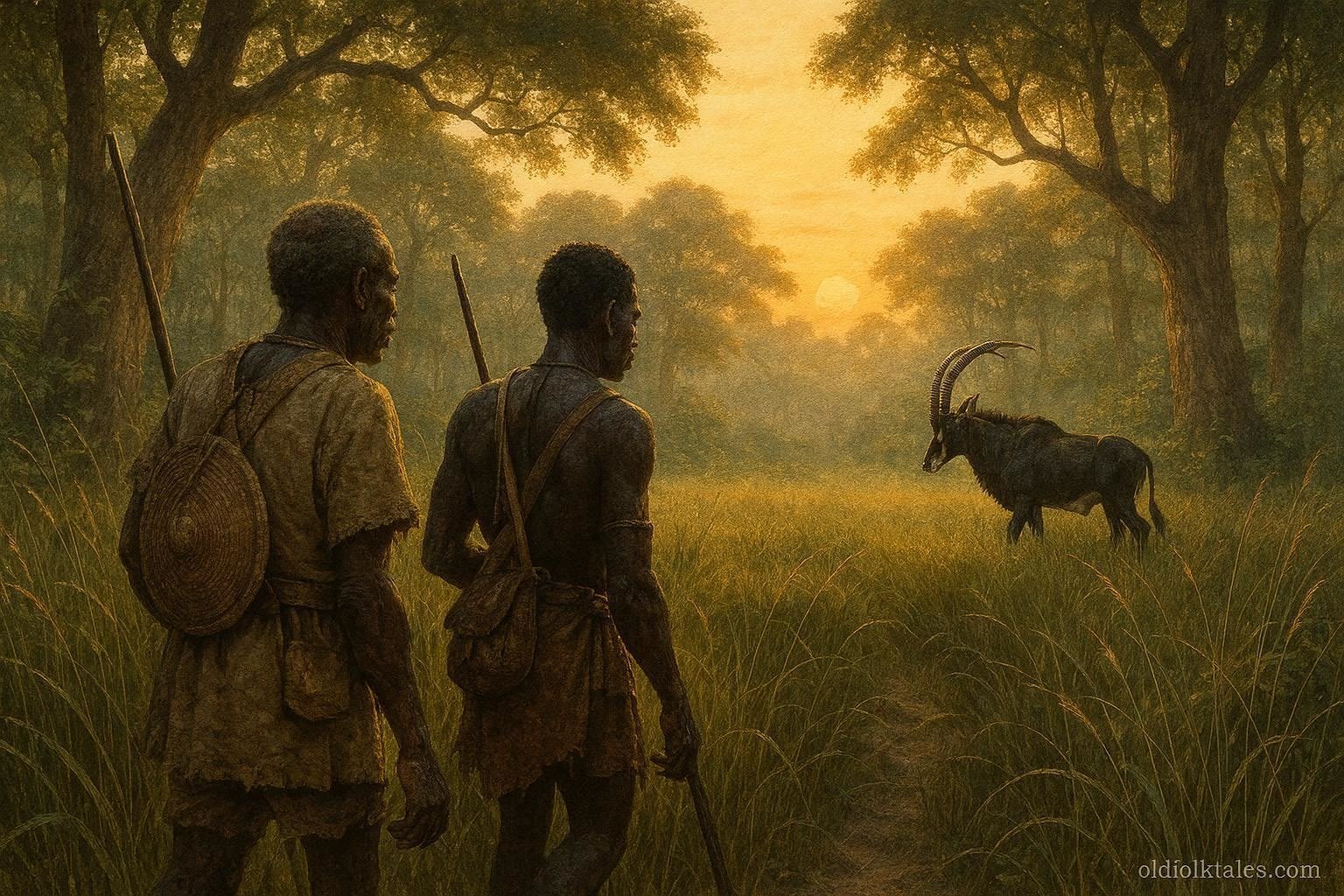
A few weeks later, the hunters encountered a remarkable sight.
Deep within the woodland, they observed a small herd of Giant Sable Antelope moving quietly through tall grasses.
The magnificent animals paused briefly before disappearing among scattered trees.
The younger hunters immediately reached for their weapons.
Kalombo gently raised his hand.
“No,” he said quietly.
“They are raising their young.”
He explained that ancestral customs discouraged disturbing animals during vulnerable seasons.
The herd was allowed to continue its journey undisturbed.
Although some apprentices initially questioned the decision, they later understood its importance.
The following year, healthy herds continued to thrive within the forest.
The lesson remained with them for the rest of their lives.
As the seasons passed, Kalombo continued teaching far more than hunting techniques.
He explained the importance of maintaining clean streams because both people and animals depended upon them.
He encouraged families to protect fruit-bearing trees that supplied food for birds and other wildlife.
He reminded villagers that destroying forests for short-term gain would eventually harm everyone.
Children often accompanied elders on shorter walks through the woodland.
Rather than carrying weapons, they carried baskets for collecting useful plants and fallen fruits.
These journeys became opportunities to learn the names of trees, understand animal behavior, and recognize the delicate connections between every part of the environment.
One afternoon, a group of children discovered an injured young antelope caught beneath fallen branches after a violent storm.
Unsure what to do, they sought Kalombo’s guidance.
The old hunter carefully examined the animal.
He instructed the children to free it gently without causing additional harm.
Once released, the frightened antelope quickly disappeared into the forest.
The children expected praise for helping the animal.
Instead, Kalombo thanked them for respecting life.
He explained that kindness toward nature strengthened the bond between people and the land they depended upon.
As years passed, neighboring communities noticed that Cangandala remained rich in wildlife while animals became increasingly scarce elsewhere.
Visitors asked the elders why their forests continued to flourish.
The answer was always the same.
The people respected the customs taught by their ancestors.
They hunted responsibly.
They harvested carefully.
They protected habitats that sustained countless forms of life.
These practices required patience and self-restraint, but they ensured lasting prosperity.
Eventually, Kalombo grew old.
Although he no longer joined long hunting expeditions, younger hunters frequently visited him for advice.
He reminded them that the greatest hunter was not the strongest or the fastest.
The greatest hunter was the one who left the forest healthier than he found it.
When Kalombo passed away, the community gathered beneath a large tree overlooking the woodland.
Elders shared stories of his wisdom.
Hunters recalled the many lessons he had taught.
Children remembered the kindness he had shown while explaining the secrets of the forest.
His teachings became part of the oral traditions passed to future generations.
Even today, stories from Cangandala continue to celebrate the relationship between people and nature.
The Giant Sable Antelope remains one of Angola’s most treasured animals and a symbol of the country’s remarkable natural heritage.
The traditions associated with the hunters of Cangandala remind listeners that survival has always depended upon balance rather than excess.
Communities flourish when they recognize that forests, rivers, animals, and people are connected through mutual responsibility.
The wisdom preserved by the Mbundu people teaches that every generation inherits the natural world from those who came before.
Each generation also carries the responsibility of protecting it for those who will come after.
The story of the Hunters of Cangandala therefore remains more than a tale about hunting.
It is a lasting lesson about stewardship, restraint, and respect for the living world.
Explore more Southern African folktales here
Moral Lesson
Those who respect nature today help ensure its abundance for future generations.
Knowledge Check
1. Why was the Giant Sable Antelope important to the Mbundu communities?
It symbolized the richness of nature and the balance of the forest.
2. What did Kalombo teach young hunters first?
Patience, observation, and respect for nature before hunting skills.
3. Why did Kalombo refuse to hunt the sable herd?
Because the animals were raising their young and needed protection.
4. How did the people of Cangandala keep their forests healthy?
By hunting responsibly, protecting habitats, and using natural resources wisely.
5. What did the children learn after rescuing the injured antelope?
That kindness and respect for wildlife strengthen the bond between people and nature.
6. What is the main lesson of the story?
Protecting nature ensures that future generations can also benefit from its gifts.
Source
Adapted from Mbundu oral traditions, cultural narratives associated with Cangandala, ethnographic studies of Angolan hunting customs, and materials preserved in Cangandala cultural heritage archives and Angolan ethnographic collections.