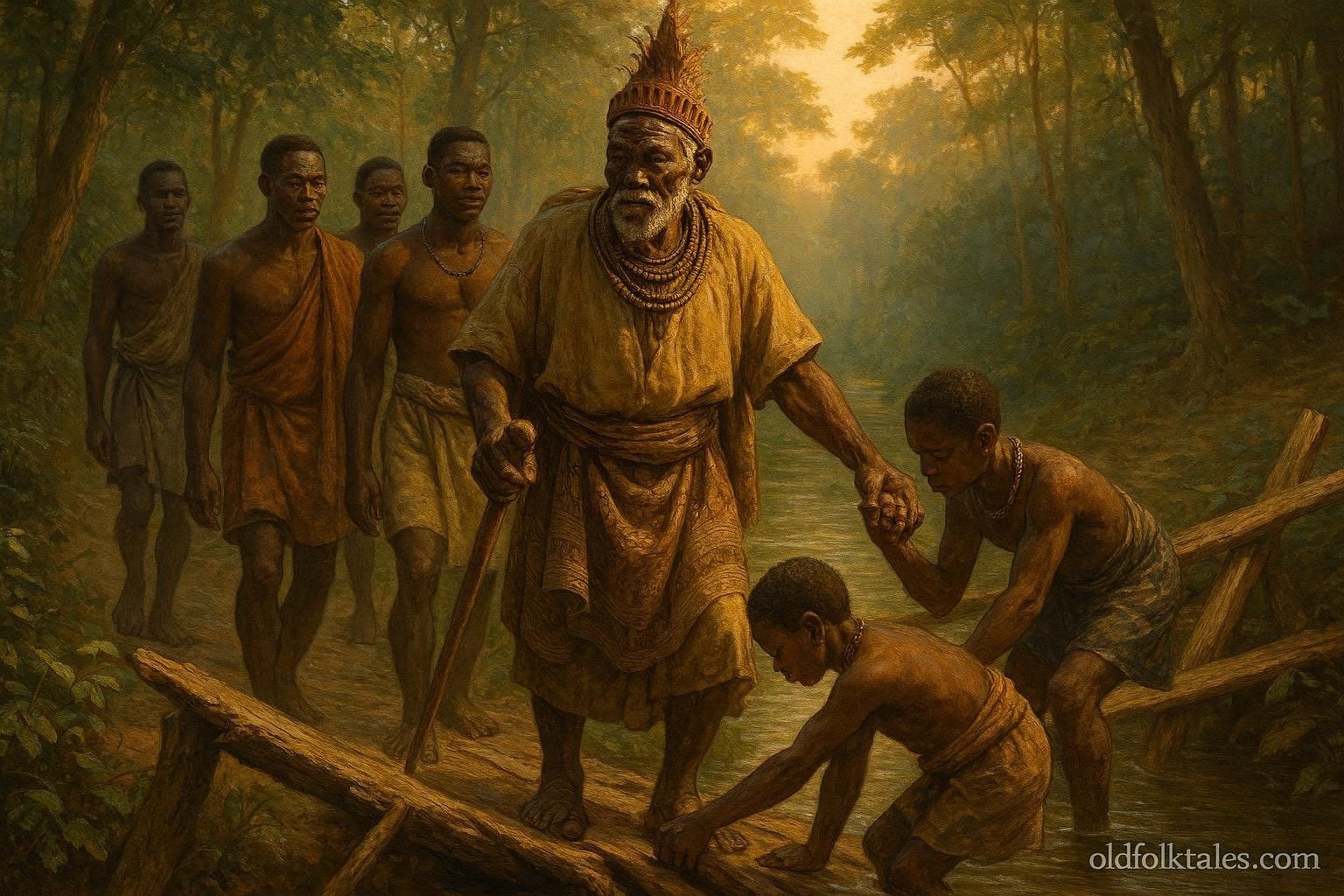
Leadership has long held a place of honor in Ngbaka society, where chiefs were expected to govern with fairness, wisdom, and deep concern for the welfare of their people. Elders taught that authority was never inherited by strength alone. It had to be earned through character, sound judgment, and selfless service. The legend of The Last Journey of Chief Mbanza tells how one aging ruler chose an unexpected way to reveal the person truly worthy of leading after him.
For more than forty seasons, Chief Mbanza ruled the Ngbaka village of Koli with fairness and wisdom.
He settled disputes without favor.
He welcomed strangers with kindness.
He never ate until widows and orphans had been fed.
Because of this, neighboring villages respected him, and his own people trusted his judgment without question.
As the years passed, however, age slowly weakened him.
His once powerful voice became softer.
His long walks through the village became shorter.
One evening, after watching the sun disappear beyond the forest, Chief Mbanza gathered the village elders.
“My final journey has come.”
The words spread quickly through Koli.
Everyone understood their meaning.
The chief knew his time on earth was drawing to an end.
The question that troubled every household was the same.
Who would become the next chief?
Chief Mbanza had no son.
Neither had he ever named a successor.
Many believed the strongest warrior deserved the position.
Others favored the wealthiest family.
Some thought the oldest elder should inherit the staff of leadership.
Continue your journey: Read more East African folktales
The chief listened to every opinion.
Then he smiled.
“At sunrise tomorrow,” he announced, “four men will walk with me.”
“By sunset, one of them will return as your future chief.”
The village waited eagerly for dawn.
The four chosen men were very different.
Bara was the greatest hunter in the region.
He rarely missed his target and believed courage was the highest virtue.
Seko was wealthy.
His storehouses overflowed with grain, goats, and trade goods.
He believed prosperity proved a person’s wisdom.
Duma was a respected speaker.
He could persuade almost anyone with his words.
Many admired his confidence.
The youngest was Luma.
He owned little.
He was neither the strongest nor the richest.
He simply helped anyone who needed him.
Some villagers wondered why he had even been invited.
Before sunrise, the four men met Chief Mbanza at the edge of the village.
The chief carried only his walking staff.
“No servants will accompany us.”
“No guards.”
“Only the five of us.”
Without explaining where they were going, he began walking along an old forest path.
For several hours no one spoke.
Then they reached a fallen bridge crossing a narrow stream.
An elderly woman stood nearby, unable to carry her heavy bundle across the broken crossing.
Bara glanced at the chief.
“We must continue.”
“Our journey is important.”
Seko nodded.
“Others will help her later.”
Duma politely greeted the woman but continued walking.
Only Luma stopped.
He gathered strong branches.
He repaired enough of the crossing to help the woman reach the other side.
Then he carried her bundle to the next path before hurrying to catch the others.
Chief Mbanza said nothing.
The journey continued.
Near midday they came upon several frightened children searching for a missing goat.
The animal had wandered into thick bushes.
Bara sighed impatiently.
“We are losing time.”
Seko laughed.
“It is only one goat.”
Duma told the children to ask their parents for help.
Again, only Luma entered the bushes.
After a long search he found the frightened animal tangled among vines.
He carefully freed it before returning it to the grateful children.
Chief Mbanza simply continued walking.
No praise.
No criticism.
As afternoon approached, the travelers reached another village.
Smoke rose into the sky.
A cooking hut had caught fire.
People rushed with water gourds, trying desperately to stop the flames from spreading.
Without hesitation, Luma dropped his belongings and joined them.
He formed a line carrying water from the nearby stream.
Soon the fire was extinguished.
Bara crossed his arms.
“This journey will never end if we stop everywhere.”
Seko agreed.
“A chief should think about great matters, not every small problem.”
Duma smiled confidently.
“Leadership requires efficiency.”
Chief Mbanza remained silent.
By sunset they reached the top of a gentle hill overlooking the valley.
The chief finally stopped walking.
He turned toward the four men.
“I asked each of you to walk beside me.”
“You believed you were following your chief.”
“In truth…”
“I was following each of you.”
The men looked at one another in confusion.
Chief Mbanza faced Bara first.
“You possess courage.”
“But courage without compassion becomes pride.”
He turned to Seko.
“You understand wealth.”
“But wealth without generosity leaves people hungry.”
Then he looked at Duma.
“Your words are powerful.”
“But words without action soon lose their meaning.”
Finally he faced Luma.
“You never once asked who was watching.”
“You simply served.”
“You forgot the journey.”
“You remembered the people.”
The old chief removed the carved staff he had carried throughout his life.
Slowly, he placed it into Luma’s hands.
“A chief does not walk ahead because he is greater.”
“He walks ahead so others may walk safely behind.”
Silence filled the hill.
No one argued.
Even the other three men lowered their heads in respect.
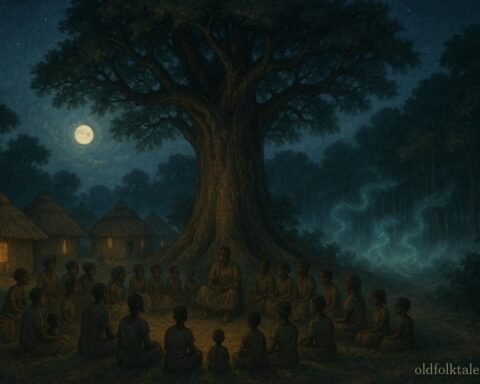
When the travelers returned to Koli the following morning, the villagers gathered beneath the great meeting tree.
Many expected the strongest hunter to appear carrying the chief’s staff.
Others expected the wealthy trader.
Instead, they saw Luma walking quietly beside the aging ruler.
Chief Mbanza raised one hand.
“I have chosen.”
“The journey has spoken.”
He told the people everything that had happened along the road.
Some smiled.
Others wiped tears from their eyes.
For they realized that none of the challenges had been accidents.
Every person needing help had become part of the chief’s final lesson.
Several days later, Chief Mbanza died peacefully.
The entire village mourned.
Yet there was no dispute over succession.
Everyone had witnessed the wisdom of his choice.
As chief, Luma governed exactly as his predecessor had hoped.
He visited the sick before holding council meetings.
He listened to children as carefully as he listened to elders.
He judged fairly, even when friends stood before him.
Whenever young people asked how he had become chief despite owning so little, he smiled.
“I did not win the journey.”
“I simply forgot that it was a test.”
The elders continued telling the story through the generations, reminding every future leader that titles, wealth, and strength may impress people for a season, but service earns respect that lasts a lifetime.
Today, the legend of The Last Journey of Chief Mbanza reflects an enduring principle found throughout Central African leadership traditions: true authority belongs to those who place the needs of their community above their own ambitions. Though the chief’s final journey belongs to folklore, its lesson continues to inspire wise and compassionate leadership.
Keep reading: Discover more Central African folktales
Moral Lesson
True leadership is measured not by power, wealth, or reputation, but by a willingness to serve others with humility, fairness, and compassion.
Knowledge Check
1. Why did Chief Mbanza organize one final journey?
To discover who truly possessed the character needed to become the next chief.
2. Who were the four men chosen to accompany the chief?
Bara the hunter, Seko the wealthy trader, Duma the speaker, and Luma the humble helper.
3. Why did Luma repeatedly stop during the journey?
He chose to help people in need without realizing his actions were part of the chief’s test.
4. What lesson did Chief Mbanza teach about leadership?
A true leader serves others before seeking honor or authority.
5. Why did the villagers accept Luma as their new chief?
Because they understood that his compassion and selflessness proved he was the most worthy successor.
6. What is the central message of the story?
The greatest leaders earn respect through service, humility, and justice.
Source
Inspired by Ngbaka leadership traditions and oral storytelling, with reference to Central African political anthropology, Ngbaka ethnographic studies, and Central African oral history research.