The wide grasslands of Northern Nigeria were home to many animals that lived according to customs passed down from one generation to the next. Each creature had its own place in the great plains, and every elder taught the young that wisdom was just as important as strength or speed. Among these animals lived the graceful Hartebeest, admired for his long legs, swift movements, and proud bearing.
No animal could outrun him across the open savannah, and he knew it.
Whenever the animals gathered near the watering places or rested beneath the shade of the acacia trees, Hartebeest would boast about his speed and elegance. He believed that no danger could ever overtake him and that no advice from the older animals was worth listening to.
The elderly Antelope often warned him.
“Speed is a wonderful gift,” the old animal would say, “but pride can cause even the fastest feet to stumble.”
Hartebeest merely laughed.
“What need have I for caution?” he replied. “Before danger comes near me, I shall already be beyond its reach.”
The older animals exchanged worried glances, for they knew that confidence without wisdom often led to sorrow.
One dry season, when the rivers had begun to shrink beneath the scorching sun, the animals traveled greater distances each day in search of fresh water. The journey was tiring, and every creature had to remain alert, for hunters and fierce predators often waited along the narrow paths leading to the remaining pools.
Keep reading: Discover more Central African folktales
Before setting out one morning, the oldest animals gathered everyone together.
“We must travel as one herd,” they advised. “No one should race ahead alone. The strongest must protect the weakest, and every animal must watch for signs of danger.”
The herd agreed.
Everyone, that is, except Hartebeest.
He smiled proudly and shook his head.
“Why should I move at the pace of slower animals?” he asked. “By the time you arrive, I will already have drunk my fill and found the best grazing land.”
Without waiting for anyone else, he bounded across the open plains, leaving the others far behind.
The morning breeze rushed past him as he ran.
He admired his own shadow stretching across the golden grass and congratulated himself for ignoring what he considered unnecessary warnings.
Soon he reached a quiet stream hidden between tall reeds.
Believing he was completely safe, Hartebeest lowered his head to drink, unaware that unseen eyes were already watching from the surrounding grass.
As Hartebeest drank from the quiet stream, the tall reeds around him swayed gently in the warm breeze. Believing he was alone, he paid little attention to the silence that had settled over the grassland.
Then, without warning, danger struck.
A powerful hunter who had been hiding among the reeds sprang from his hiding place. Startled, Hartebeest leaped into the air and raced across the plain with all the speed for which he was famous.
His swift legs carried him over rocks, through patches of dry grass, and across shallow streams. The hunter pursued him for as long as he could, but Hartebeest’s speed soon carried him far beyond reach.
At last, exhausted but unharmed, Hartebeest stopped beneath a lonely tree.
His heart pounded.
His body trembled.
For the first time in his life, he realized how close he had come to losing everything.
As he rested, he remembered the words of the old Antelope.
“Speed is a wonderful gift, but pride can cause even the fastest feet to stumble.”
He lowered his head in shame.
Had he listened to the elders and remained with the herd, many watchful eyes would have noticed the hidden danger long before he reached the stream. Instead, his pride had placed him in great peril.
Slowly, Hartebeest made his way back to the others.
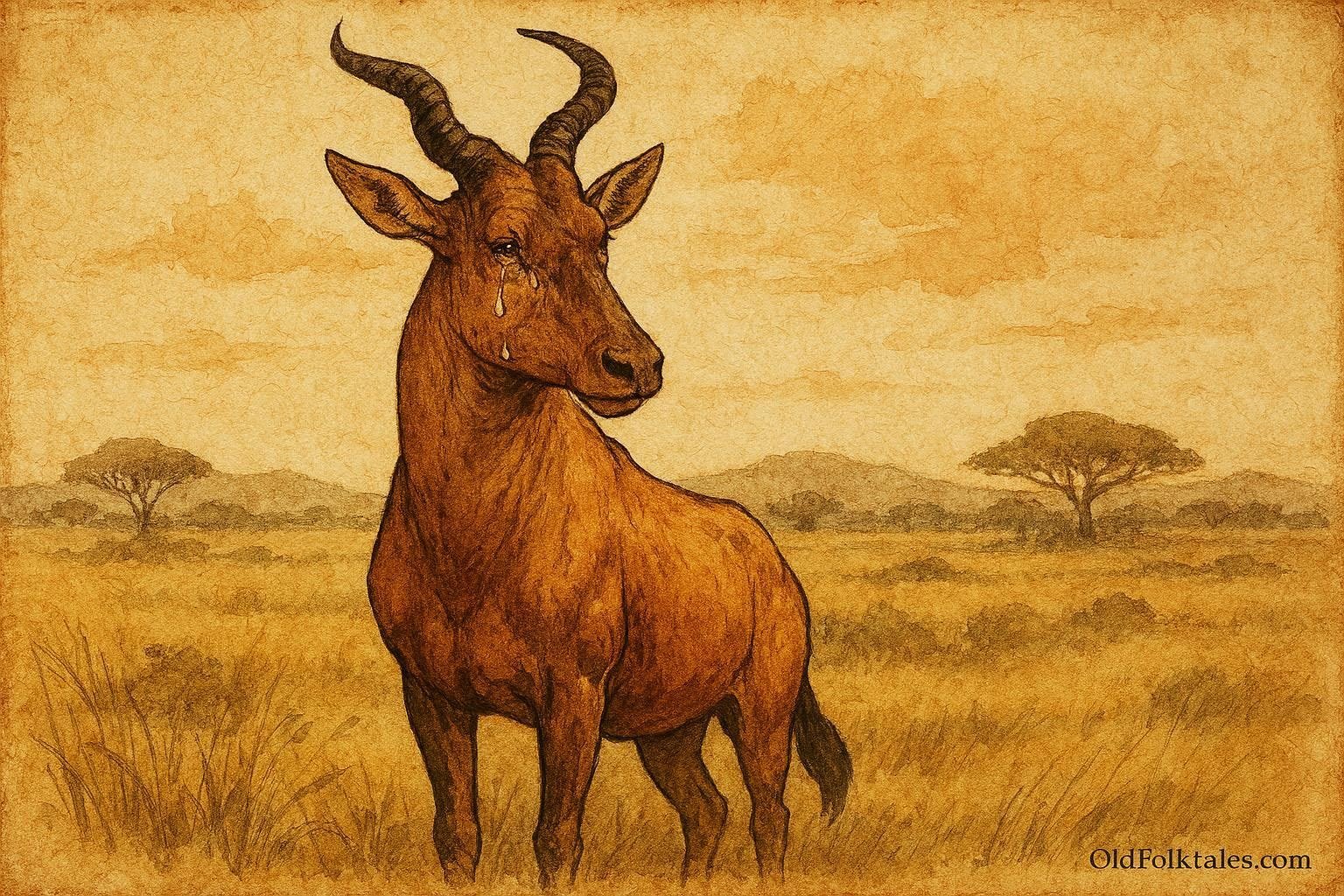
When the herd saw him, they noticed that his bright eyes were filled with tears.
The elderly Antelope stepped forward, relieved that the young animal had survived.
“My son,” the old one asked gently, “what has happened?”
Hartebeest bowed his head.
“I believed my speed alone could protect me,” he admitted. “I ignored the wisdom of those who had walked these plains long before I was born. Today I learned that strength without humility is a poor companion.”
The old Antelope nodded kindly.
“The lesson has cost you fear instead of your life,” he said. “That is a blessing. Remember it, and let others learn from your experience.”
From that day onward, Hartebeest never again boasted about being the fastest animal on the savannah. Whenever the herd traveled together, he remained close to the others, watching over the younger animals and listening carefully whenever the elders spoke.
Yet the memory of that frightening day never left him.
Whenever he recalled how narrowly he had escaped danger because of his pride, tears gathered in his eyes.
The elders told this story to every new generation, explaining that the Hartebeest’s sorrowful eyes remind people that pride often blinds us to wise counsel, while humility protects us from needless suffering.
And so, according to the Hausa people, the Hartebeest is often seen with tears in his eyes—not because he is weak, but because he never forgot the painful lesson that wisdom is greater than pride.
Want more? Read more West African folktales now
Moral Lesson
This Hausa folktale teaches that natural gifts such as strength, beauty, or speed should never lead to pride. True wisdom comes from listening to good advice, respecting the experience of elders, and recognizing that no one succeeds alone.
Knowledge Check
1. Why was the Hartebeest admired by the other animals?
He was admired for his remarkable speed, graceful movements, and ability to outrun every other animal on the savannah.
2. What mistake did the Hartebeest make?
He ignored the elders’ advice and traveled alone because he believed his speed made him invincible.
3. What danger did the Hartebeest face?
A hunter lying in wait near a secluded stream suddenly attacked him.
4. How did the Hartebeest escape?
He escaped by running at great speed, but the frightening experience humbled him.
5. Why does the Hartebeest always have tears in his eyes according to the folktale?
His tears remind him of the fear and regret he felt after nearly losing his life because of pride.
6. What is the central lesson of this Hausa folktale?
The story teaches that humility and wise counsel are more valuable than relying only on one’s natural abilities.
Source: Hausa folktale, Northern Nigeria. Adapted from Black Folk Tales: Retold from the Haussa of Northern Nigeria by Erick Berry (1928).