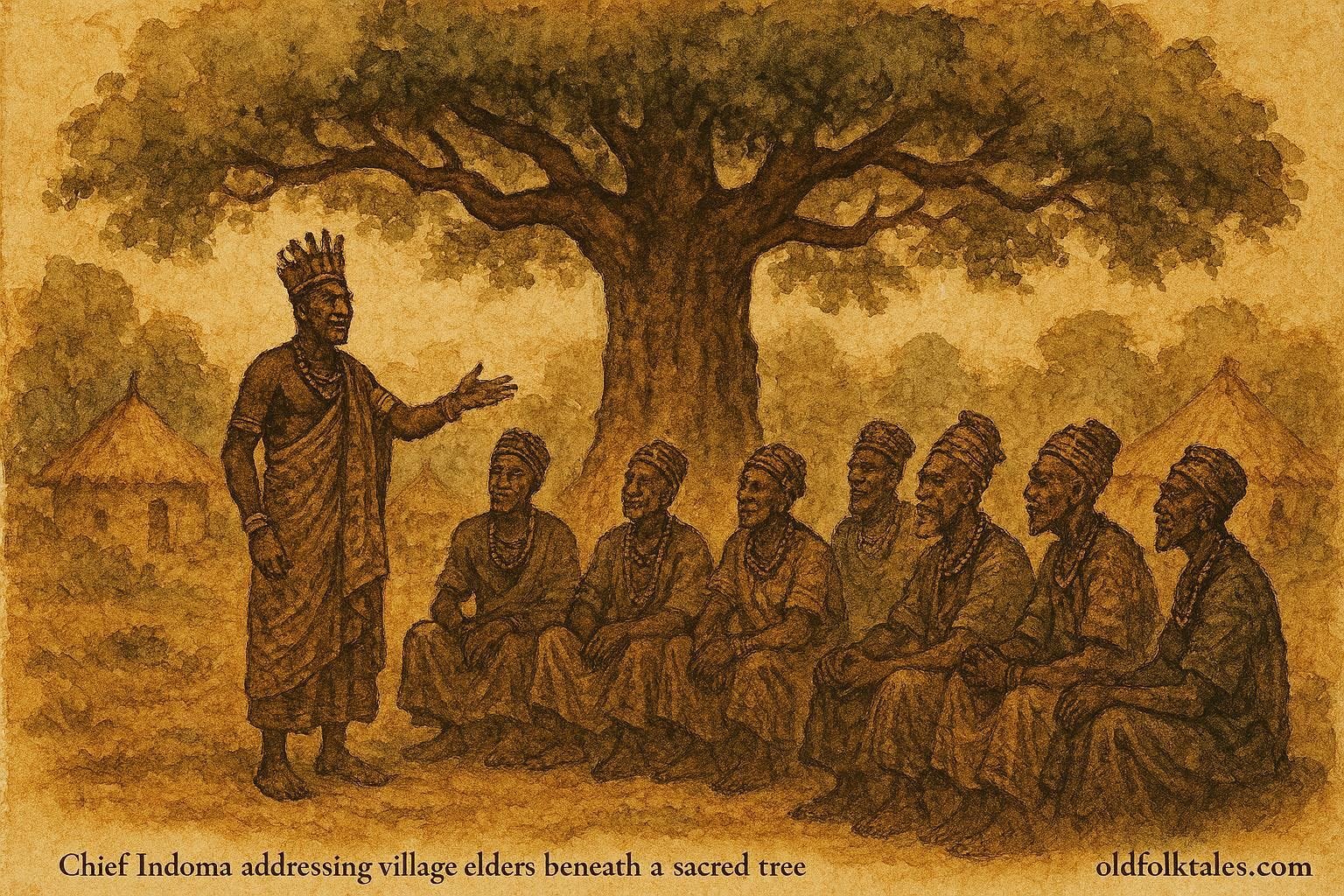
Long ago, in the forested hills of Ikom in Southern Nigeria, there lived a respected ruler known as Chief Indoma. His people admired him for his strength, wisdom, and ability to settle disputes with fairness. Under his leadership, the farms flourished, hunters returned with plentiful game, and traders traveled safely through the surrounding villages.
Yet beneath the peace of the land lay an ancient custom that filled many hearts with fear.
Whenever the elders believed that powerful spirits had become displeased, they demanded that human sacrifices be offered. They believed that only by giving human life could disasters, famine, sickness, or war be driven away from the community.
The practice had been followed for generations, and few dared to question it.
Whenever misfortune struck, anxious villagers whispered that the spirits were angry. The elders gathered in solemn meetings, consulting the priests and keepers of sacred traditions. If they declared that a sacrifice was required, the entire village accepted the decision without protest.
Many families lived with constant fear that someone they loved might one day be chosen.
Keep reading: Discover more Central African folktales
Chief Indoma was deeply troubled whenever these ceremonies were announced.
Although he respected the customs handed down by his ancestors, he could not ignore the sorrow they brought. He had watched grieving mothers weep, fathers lower their heads in helpless silence, and innocent people lose their lives because everyone feared disobeying traditions that no one fully understood.
Often, after the village had fallen asleep, Indoma sat alone outside his compound, thinking about his responsibilities.
“A ruler,” he reflected, “must protect his people. But how can I protect them if they fear not only enemies from beyond our borders but also the customs within our own land?”
These thoughts weighed heavily upon him.
Before long, another season of hardship arrived.
The rains failed to come at their usual time. Streams shrank, crops began to dry beneath the hot sun, and hunger slowly spread through the villages.
Soon whispers filled every gathering place.
“The spirits are angry.”
“Our ancestors have abandoned us.”
“A sacrifice must be made.”
The village priests called for an assembly of elders.
After long discussions and sacred rituals, they reached the conclusion many had expected.
Another human sacrifice was required.
The announcement spread quickly through the community like a cold wind.
Women gathered their children close.
Young men avoided the village square.
Families prayed that misfortune would not fall upon their own households.
Although Chief Indoma attended the council meeting, he remained silent while the elders spoke. He listened carefully as each priest explained that the sacrifice would restore harmony between the people and the unseen world.
When they finished, all eyes turned toward the chief.
One elder stepped forward.
“Our fathers followed this path,” he declared. “Their fathers did the same before them. If we abandon the customs of our ancestors, greater disasters will surely come.”
Several elders nodded in agreement.
But Chief Indoma did not answer immediately.
Instead, he looked across the gathering at the worried faces of his people.
He saw fear where there should have been hope.
He saw despair where there should have been courage.
Finally, he rose to his feet.
“My people,” he began quietly, “our ancestors handed down many traditions worthy of honor. They taught us to respect our elders, care for our families, keep our promises, and live peacefully with our neighbors.”
The square became completely silent.
“But wisdom also requires us to ask whether every custom truly serves the good of the people.”
A murmur spread through the crowd.
Some elders frowned.
Others exchanged uneasy glances.
No chief before Indoma had ever spoken so openly against a practice that had existed for generations.
Yet Indoma continued calmly.
“If the purpose of leadership is to protect life, then we must search carefully before taking it.”
His words stirred both admiration and concern.
Some villagers secretly agreed with him but feared speaking aloud.
Others believed questioning the old customs would invite even greater suffering upon the land.
The meeting ended without a final decision.
For the first time anyone could remember, the village found itself divided—not by anger, but by uncertainty.
Would the ancient custom continue?
Or would Chief Indoma find another way to save both his people and their traditions without shedding innocent blood?
The days that followed were filled with uncertainty.
Throughout the villages of Ikom, people spoke in hushed voices about the chief’s words. Some believed he had shown remarkable courage by questioning a custom that had stood for generations. Others feared that even discussing such matters might offend the unseen powers the sacrifices were meant to appease.
Chief Indoma understood the seriousness of the moment. Rather than acting in haste, he summoned the elders, priests, hunters, and respected heads of families to another council. He wanted every voice to be heard before any decision was made.
When everyone had gathered beneath the great meeting tree, the chief rose and addressed them.
“My duty is not only to preserve the ways of our ancestors,” he said, “but also to preserve the lives of the people entrusted to my care. A tradition that fills every household with fear deserves careful thought.”
The oldest priest stepped forward.
“Our fathers believed that sacrifice protected the land,” he replied. “If we abandon what they practiced, who can say what misfortune may follow?”
Chief Indoma listened respectfully.
“I do not speak against our ancestors,” he answered. “They acted according to the knowledge they possessed. But every generation must also use wisdom when facing its own challenges.”
The council fell silent.
For many hours the elders debated. Some defended the ancient custom, while others admitted that they, too, had long been troubled by the suffering it caused. Families who had lost loved ones in previous sacrifices quietly shared their grief, reminding everyone that every victim had once been someone’s child, brother, sister, or parent.
Their words touched many hearts.
At last, Chief Indoma stood once more.
“If our purpose is to seek peace and blessing for the land,” he declared, “then let us offer what comes from our labor instead of taking innocent life.”
He proposed that the people gather the finest fruits from their farms, healthy animals from their herds, baskets of newly harvested yams, palm oil, kola nuts, and other valuable gifts as offerings during the sacred ceremonies. At the same time, the entire community would unite in prayer, reconciliation, and acts of generosity toward one another.
The suggestion surprised the assembly.
Some elders hesitated, uncertain whether such a change could succeed. Others saw wisdom in the chief’s proposal, for it honored the spiritual traditions of the people without bringing sorrow to innocent families.
After long discussion, the council agreed to follow Chief Indoma’s guidance.
When the day of the ceremony arrived, the entire village gathered at the sacred place. Instead of mourning and fear, there was a spirit of unity. Men and women carried offerings from the fruits of their work, while elders prayed for peace, abundant harvests, good health, and protection over the land.
No cries of grief were heard that day.
Instead, songs of hope rose through the forest.
Before long, the rains returned.
Dark clouds gathered above the hills, and gentle showers soaked the thirsty earth. Streams filled once more, crops began to flourish, and the fear that had gripped the community slowly gave way to renewed confidence.
Many people believed the land had been blessed not because innocent blood had been shed, but because the people had come together with sincere hearts and mutual compassion.
From that time forward, the story of Chief Indoma was remembered throughout the region. He became known not only as a courageous ruler but also as a wise leader who balanced respect for tradition with concern for the welfare of his people.
His example reminded future generations that true leadership requires more than authority. It demands wisdom, compassion, and the courage to seek a better path when old customs no longer serve the common good.
Thus the people of Ikom preserved the memory of Chief Indoma, whose name became associated with justice, thoughtful leadership, and the protection of human life.
Want more? Read more West African folktales now
Moral Lesson
This Ikom folktale teaches that true leadership is measured by wisdom, compassion, and the courage to protect others. While traditions deserve respect, genuine leaders carefully consider whether every custom continues to serve the well-being of their people.
Knowledge Check
1. Who was Chief Indoma?
Chief Indoma was a respected ruler of the Ikom people, remembered for his wisdom, fairness, and compassionate leadership.
2. What troubled Chief Indoma most?
He was deeply troubled by the community’s tradition of offering human sacrifices whenever misfortune struck.
3. How did Chief Indoma respond to the elders’ proposal?
He encouraged careful reflection and proposed offering the fruits of the people’s labor instead of taking innocent human lives.
4. Why was the council divided?
Some elders wished to preserve the ancient custom, while others recognized the suffering it caused and supported a more compassionate approach.
5. What happened after the new ceremony was held?
The rains returned, the land became fruitful again, and the people believed that unity, gratitude, and sincere devotion had brought renewed blessings.
6. What is the central lesson of this Ikom folktale?
The story teaches that wise leadership combines respect for tradition with compassion, justice, and the courage to protect the community.
Source: Ikom folktale, Southern Nigeria. Adapted from Ikom Folk Stories from Southern Nigeria by Elphinstone Dayrell (1913).