Among the rolling hills of southern Angola, where rugged mountains overlooked open grasslands and ancient baobab trees watched over generations of families, there was a village of the Nyaneka Humbe people. The villagers lived by tending cattle, cultivating the land, and honoring the customs handed down by their ancestors.
Every child grew up hearing stories about a sacred cave hidden among the rocky hills beyond the village.
The elders called it the Cave of the Sleeping Ancestors.
They believed the spirits of wise ancestors rested there, watching over the living and preserving the knowledge of generations long gone. No one entered the cave without a worthy reason, and children were warned never to wander near it alone.
“The cave does not welcome the curious,” the oldest elder often said. “It opens only to those who are ready to learn.”
Most children obeyed the warning.
One boy, however, found the mystery impossible to ignore.
His name was Kando.
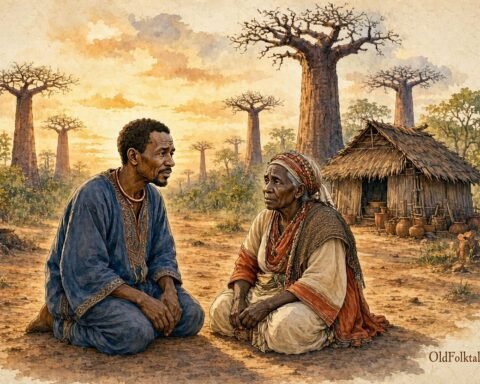
Kando was bright, energetic, and eager to understand everything around him. Whenever elders gathered beneath the shade of the great baobab tree to discuss old traditions, he listened from a distance, hoping to hear stories of the ancestors, the spirits, and the hidden places of the land.
Fascinated by this tale? Discover more North African folktales
Although he had learned much from the elders, one question remained in his mind.
What truly lay inside the sacred cave?
Each time he asked, the elders smiled but refused to answer.
“Some knowledge must be discovered through patience,” they would say.
As Kando grew older, his curiosity only deepened.
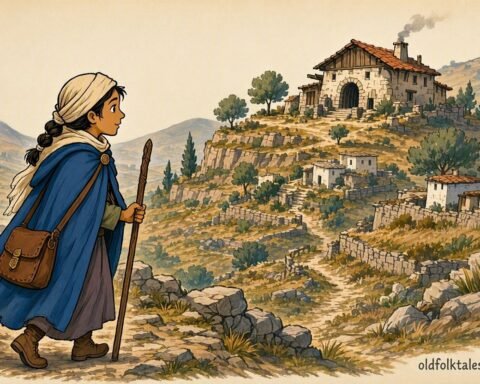
One cool morning, after helping his father lead the cattle to pasture, he quietly made his way toward the distant hills.
The journey was longer than he had imagined.
He crossed shallow streams, climbed rocky slopes, and walked through fields where wildflowers swayed gently in the breeze. Eagles circled high above the cliffs, while small antelopes disappeared into the tall grass at the sound of his footsteps.
By midday, he reached the foot of a towering cliff unlike any he had ever seen.
Hidden behind thick vines was the entrance to a great cave.
The air that drifted from within was cool and still.
For a moment, Kando remembered the warnings of the elders.
He almost turned back.
Instead, he took a deep breath, whispered a respectful greeting to the ancestors, and stepped inside.
The cave was silent except for the gentle sound of water dripping from the ceiling.
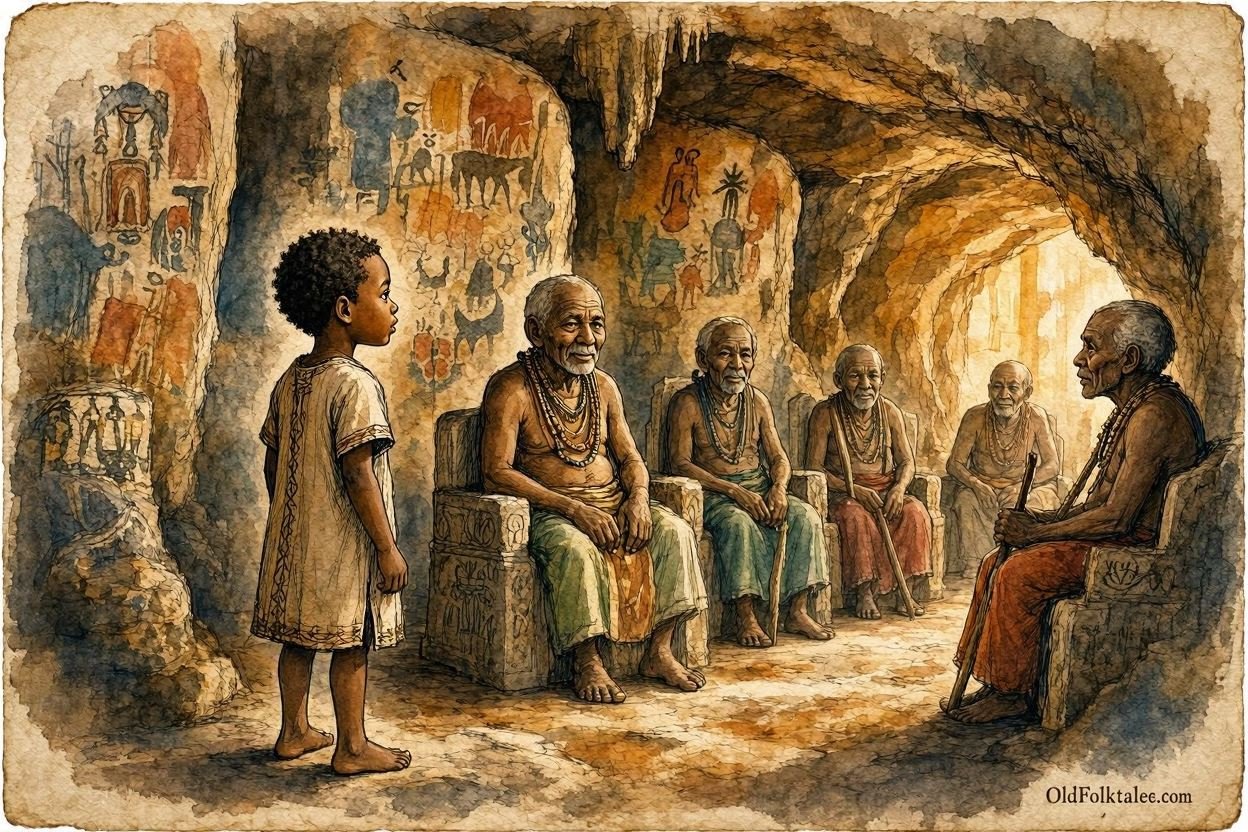
Sunlight filtered through narrow cracks in the rock, illuminating ancient paintings of hunters, cattle, birds, and families gathered around evening fires.
The deeper Kando walked, the more he felt as though he had entered another world.
Then he reached a vast chamber.
Stone seats circled the room, and upon each sat a motionless figure wrapped in animal skins.
They appeared to be sleeping.
Their faces were calm, untouched by time.
Kando stood frozen.
He realized he was standing before the ancestors whose stories had been told for generations.
Just as he began to step backward, a warm voice echoed gently through the chamber.
“You have come seeking answers.”
Slowly, the figures opened their eyes.
Kando’s heart pounded as he realized the sleeping ancestors had awakened.
Kando stood in respectful silence as the ancient figures slowly rose from their stone seats.
None of them looked frightening.
Their faces reflected kindness, wisdom, and the quiet confidence of those who had lived honorable lives.
The eldest among them stepped forward, leaning upon a beautifully carved staff.
“You have entered this place with respect,” the elder said. “Many seek the wisdom of the ancestors, but few come with a heart willing to listen.”
Kando lowered his head.
“I have always wanted to know what it truly means to become an adult,” he replied. “The elders say that age alone is not enough, but they never explain why.”
The chamber became still.
Then another ancestor spoke.
“A child believes that growing older is measured by the passing of seasons. An adult understands that maturity is measured by responsibility.”
As the words echoed through the cave, the stone walls around Kando began to shimmer.
Suddenly, he saw visions unfolding before him.
In the first vision, a young hunter caught more game than his family needed. Instead of sharing with his hungry neighbors, he hid the meat until it spoiled.
The vision faded.
“What did he lose?” asked one of the ancestors.
“His food,” Kando answered.
The elder smiled gently.
“He lost something greater. He lost the trust of his people.”
A second vision appeared.
This time, a young woman gave the last of her grain to an elderly traveler during a season of drought. Soon afterward, unexpected rains returned, and her fields produced the finest harvest in the village.
“What made her rich?” another ancestor asked.
“Her kindness,” Kando replied.
The ancestors nodded.
A third vision emerged.
A proud young man refused to care for his aging parents because he believed they were too old to teach him anything. Years later, when he faced hardship, no one came to help him because he had forgotten those who had once cared for him.
The chamber grew quiet once more.
The eldest ancestor looked at Kando.
“Strength may build a house,” he said, “but character builds a family. Wisdom guides a community, and respect keeps traditions alive.”
Kando listened carefully, realizing that every lesson pointed toward the same truth.
Being an adult meant more than becoming taller or stronger.
It meant serving others before thinking of oneself.
The eldest ancestor handed Kando a smooth stone carved with the image of a baobab tree.
“Carry this,” he said. “Not because it possesses magic, but because it will remind you that the strongest trees grow slowly. So does wisdom.”
Kando accepted the gift with both hands.
“I will remember.”
The ancestors smiled.
“The lessons of this cave are not meant to remain here,” they said together. “Take them back to your people. Live them each day, and you will honor those who came before you.”
A warm light gradually filled the chamber.
When Kando opened his eyes again, he found himself standing alone near the entrance of the cave.
The carved stone was still resting in his hand.
He walked back to the village before sunset.
When the elders saw him carrying the stone, they immediately understood where he had been.
Instead of scolding him, the oldest elder smiled.
“The cave accepted you,” he said quietly.
Kando nodded.
“It taught me that adulthood begins when we choose responsibility over selfishness, service over pride, and wisdom over impatience.”
The elders welcomed him into their gathering that evening for the first time.
From that day onward, Kando became known for his fairness, humility, and willingness to help others. As the years passed, he grew into one of the village’s most respected leaders, often settling disputes with patience and guiding young people with the same wisdom he had received inside the sacred cave.
Whenever children asked whether the Cave of the Sleeping Ancestors truly existed, Kando would smile.
“It is real,” he would say. “But the greatest lesson is not hidden inside the cave. It is found in the way we choose to live each day.”
And so, the story of The Cave of the Sleeping Ancestors continued to be shared among the Nyaneka Humbe people, reminding every generation that true adulthood is earned through wisdom, responsibility, respect, and service to others.
Love this story? Discover our full Southern African folktales collection
Moral Lesson
This Angolan folktale teaches that adulthood is not determined by age but by wisdom, responsibility, compassion, and respect for one’s family, community, and ancestors.
Knowledge Check
1. Why did Kando visit the sacred cave?
He wanted to discover the meaning of adulthood and learn the wisdom of the ancestors.
2. What did the ancestors show Kando?
They revealed visions that taught the importance of generosity, respect, responsibility, and good character.
3. What gift did the eldest ancestor give Kando?
A carved stone bearing the image of a baobab tree as a reminder that wisdom grows with patience.
4. What did Kando learn about becoming an adult?
He learned that true adulthood is measured by responsibility, service, and integrity rather than age.
5. How did Kando change after leaving the cave?
He became a humble and respected leader who guided others with wisdom and fairness.
6. What is the central lesson of this Angolan folktale?
The story teaches that wisdom, responsibility, and respect for others are the true marks of maturity.
Source: Adapted from Southern Angolan oral traditions documented by Carlos Estermann in his ethnographic studies of the Nyaneka Humbe people.