Far beyond the fertile valleys of Morocco, where the golden sands of the Sahara stretched farther than the eye could see, Amazigh caravans followed ancient routes known only to experienced guides and the stars above.
Travelers often spoke of mysterious places hidden beneath the desert winds.
Some told of forgotten cities buried beneath dunes.
Others whispered of invisible oases that appeared only to those with pure intentions.
Yet among all the desert legends, none was more mysterious than the tale of the Hidden Court of the Desert Queen.
The elders said that somewhere beyond the shifting sands stood an unseen palace where a wise queen ruled over a court unlike any other.
Her palace could not be found with maps.
No caravan could deliberately travel there.
Only travelers whose hearts were about to be tested would discover its gates.
Many believed the story was only an old legend told to children around evening fires.
Continue your journey: Read more East African folktales
Others quietly insisted that relatives long ago had vanished into the desert and returned with strange stories of a queen whose judgments changed lives forever.
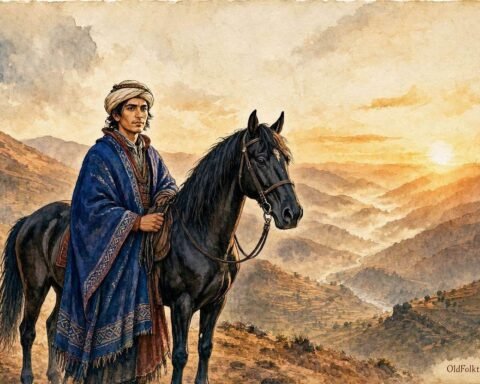
One year, during the hottest season, a young trader named Amar set out across the Sahara with a caravan carrying woven carpets, silver ornaments, spices, and leather goods.
Unlike many merchants, Amar was neither wealthy nor famous.
He hoped that successful trade would allow him to provide a better life for his widowed mother and younger sisters.
The journey began peacefully.
For several days, the caravan crossed endless dunes beneath clear blue skies.
But on the seventh afternoon, a powerful sandstorm swept across the desert without warning.
The wind howled like a thousand voices.
The sky turned dark as swirling sand hid the sun.
Camels scattered in different directions.
The merchants shouted to one another, but their voices disappeared beneath the roaring storm.
Amar held tightly to his camel until the fierce wind finally settled.
When silence returned, he found himself completely alone.
There was no sign of the caravan.
No footprints remained upon the sand.
Only endless dunes surrounded him.
For two days Amar wandered through the desert, carefully rationing the little water he had left.
Although frightened, he refused to surrender to despair.
Each evening he prayed for guidance before resting beneath the stars.
On the morning of the third day, he noticed something impossible.
Far ahead, rising from the shimmering heat, stood tall white walls surrounded by palm trees and flowing fountains.
At first Amar believed it was another desert mirage.
Yet as he walked closer, the palace remained.
Its carved gates stood open as though awaiting his arrival.
Inside, graceful servants dressed in flowing robes welcomed him with smiles.
They offered him cool water, fresh dates, warm bread, and a place to rest.
Their kindness surprised him.
No one asked his name.
No one questioned why he had arrived alone.
When he had recovered his strength, one of the attendants bowed respectfully.
“Our queen wishes to receive you.”
Amar followed the servant through beautiful gardens where fountains flowed despite the surrounding desert.
At the center stood a magnificent hall unlike anything he had ever seen.
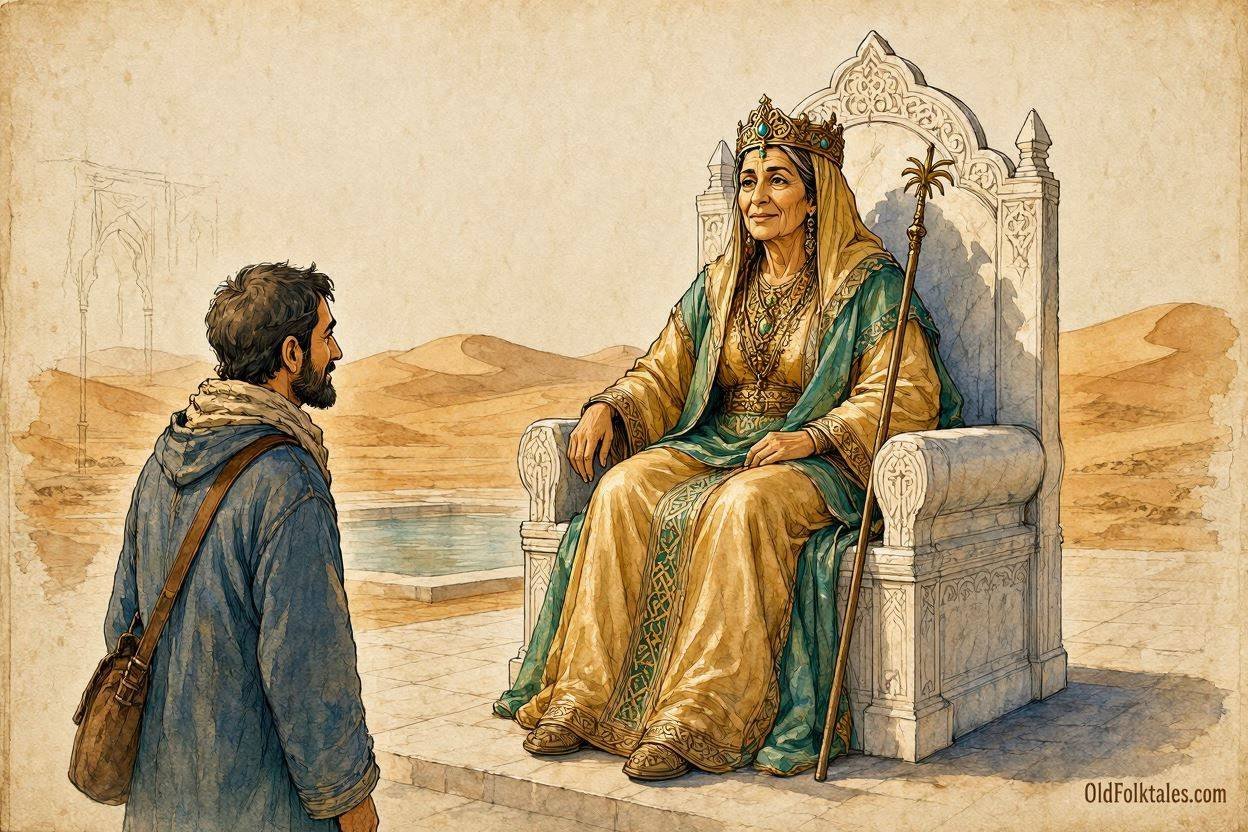
Upon a throne carved from white stone sat a woman whose calm presence filled the room with quiet dignity.
She wore no crown of gold or precious jewels.
Instead, a simple silver circlet rested upon her head.
Her eyes reflected both kindness and wisdom.
Without asking about his wealth or family, the queen smiled gently.
“Welcome, traveler.”
“You have come farther than you realize.”
Amar bowed respectfully.
“I thank Your Majesty for your kindness.”
The queen studied him for a moment before speaking again.
“In this court,” she said softly, “no traveler is judged by the riches he carries.”
“Only the truth within his heart is weighed.”
The great hall fell completely silent.
Amar sensed that he had entered no ordinary palace.
Whatever happened next would determine far more than the end of his journey.
The Desert Queen rose from her throne and descended the polished stone steps.
Her attendants stepped aside without a word.
She looked at Amar with calm, thoughtful eyes.
“You have crossed the desert,” she said. “Now you must cross three tests. They will not measure your strength or your wealth. They will reveal your character.”
Amar bowed.
“I am ready.”
The Queen led him into a quiet courtyard where a purse filled with gold coins rested on a stone bench.
“There is no one here but us,” she said. “Take as much as you wish.”
Amar looked at the purse but did not touch it.
“It is not mine,” he replied. “A gift freely given is a blessing. Wealth taken without permission is a burden.”
The Queen smiled but said nothing.
She led him to the second test.
An old traveler sat beneath a date palm, exhausted and thirsty.
Nearby stood a single water jar.
The Queen said, “You have enough water for only one person until sunset. What will you do?”
Without hesitation, Amar carried the jar to the old man.
“You need it more than I do,” he said.
The traveler drank gratefully.
To Amar’s surprise, the old man suddenly stood upright, no longer weak.
His worn clothing disappeared, revealing one of the Queen’s trusted advisers.
“The second test is complete,” he announced.
Finally, the Queen guided Amar into a magnificent hall filled with merchants, nobles, and finely dressed strangers.
Each person claimed to be important.
Each demanded the finest seat and the richest meal.
Only one poorly dressed woman stood quietly near the doorway, ignored by everyone.
The Queen whispered, “Choose the person you wish to honor as your guest.”
Amar walked past the wealthy visitors and greeted the quiet woman with respect.
He offered her the seat beside his own.
“My mother taught me,” he said, “that dignity belongs to every person, whether rich or poor.”
The woman smiled warmly.
In an instant, the crowded hall vanished.
Amar found himself once again standing before the Queen.
“You have passed every trial,” she said.
“You refused dishonest wealth.”
“You placed another person’s need before your own.”
“And you honored someone whom others ignored.”
She raised her hand.
“The gates of this court open only to those whose hearts remain humble.”
The walls of the palace shimmered like sunlight upon water.
The Queen continued.
“Many travelers search for hidden treasure in the desert.”
“They leave empty handed because they seek gold instead of wisdom.”
She handed Amar a small silver ring engraved with the image of a desert spring.
“This ring carries no magical power,” she explained.
“It is simply a reminder that justice begins with character, not possessions.”
The next morning, Amar awoke beneath the shade of a lone acacia tree.
The palace had disappeared.
There were no walls, no fountains, and no footprints upon the sand.
Only the silver ring rested in his hand.
Soon afterward, a passing caravan found him and guided him safely home.
When Amar returned to his village, many people asked how he had survived alone in the desert.
He never boasted about the hidden palace.
Instead, he shared the lessons he had learned.
As the years passed, Amar became one of the most trusted leaders among his people.
Whenever disputes arose, he listened carefully before speaking.
He treated strangers with the same respect as lifelong friends.
He never judged a person by fine clothing or great wealth.
Those who knew him often wondered where he had gained such wisdom.
Amar would simply look toward the desert and smile.
“The greatest journeys,” he would say, “are the ones that change the heart.”
Among the Amazigh people, the legend of the Hidden Court of the Desert Queen continued to be told from one generation to the next.
Many believed the invisible palace still appeared to travelers whose character was about to be tested.
Some searched for it with maps and caravans but never found it.
The elders would smile and remind them that the Queen’s court could never be reached by following a road.
It could only be found by those who walked the path of honesty, humility, and justice.
And so, The Hidden Court of the Desert Queen became one of the treasured supernatural legends of the Saharan Amazigh, reminding every generation that a person’s true worth is measured not by riches, but by the goodness of the heart.
Fascinated by this tale? Discover more North African folktales
Moral Lesson
This Moroccan folktale teaches that true character is revealed through honesty, compassion, and humility. Lasting honor belongs to those who value justice above wealth.
Knowledge Check
1. Why did Amar become lost in the desert?
A powerful sandstorm separated him from his caravan.
2. What was unusual about the Desert Queen’s palace?
It appeared only to travelers whose character was about to be tested.
3. What were Amar’s three tests?
He was tested for honesty, compassion, and humility.
4. Why did Amar refuse to take the gold?
He believed that taking what did not belong to him would be dishonest.
5. What gift did the Desert Queen give Amar?
She gave him a silver ring as a reminder that justice begins with good character.
6. What is the central lesson of this folktale?
The story teaches that true worth is measured by honesty, humility, and kindness rather than wealth.
Source: Adapted from Saharan Amazigh oral traditions preserved in Émile Laoust, Contes berbères du Maroc (1949).