Long ago, in a forest where animals lived in villages of their own, there lived a Leopard named Magéna and a Rat-Fouisseur named Kumbi. Their villages stood some distance apart, but the two animals had heard of each other many times.
One morning, Magéna decided to visit Kumbi. He set out early and walked through the forest until he reached the Rat-Fouisseur’s village. When Kumbi saw him approaching, he immediately went out to welcome him.
“Grand brother, I am happy to see you!” Kumbi said warmly.
The two animals embraced and sat together. They exchanged greetings, asked about one another’s families and discussed what had been happening in their villages.
Kumbi wanted his visitor to feel honoured, so he prepared a special meal. He chose one of the finest goats from his herd, had it slaughtered and cooked it whole in a large pot.
When the meal was ready, Kumbi served it to his guest.
Magéna was delighted.
The Leopard was naturally a great eater, and he ate as much as he could. When he had finished, he drank plenty of water from a calabash and leaned back, completely satisfied.
Don’t stop yet! See our complete East African folktales collection
After the meal, Magéna became serious.
“Little brother,” he said, “there is something important I want to tell you.”
Kumbi listened.
“You know that many of the animals in the forest hate and fear me. They say I attack them and sometimes hurt them with my claws. But you have treated me differently. You welcomed me into your home and gave me a wonderful meal. Because of this, I want us to become friends, friends who will remain together until death.”
Kumbi was pleased.
“I agree,” he replied.
From that day, the Leopard and the Rat-Fouisseur became close companions.
But friendship does not always remain good when one friend carries greed in his heart.
A few days later, Magéna returned to Kumbi’s home. After the usual greetings, he made a strange suggestion.
“Little brother,” he said, “I have been thinking about our mothers. They are both getting fat. If we cooked them, we would have enough meat for a wonderful feast.”
Kumbi immediately understood the danger behind the Leopard’s words.
He did not argue.
Instead, he calmly replied, “That can be done. But I have one condition. You must kill your mother first. After you have done that, I will kill mine.”
The Leopard agreed without hesitation.
He returned to his village and began looking for an opportunity to carry out the terrible plan.
His mother, Taba, was preparing food when Magéna came to her.
“I am hungry,” he demanded. “Give me food immediately.”
“Wait a little, my son,” she answered. “The food is still cooking. It will soon be ready.”
But the Leopard refused to wait.
“No! I want food now!”
His anger grew until he attacked his own mother and killed her.
He cut her body into pieces and prepared the meat for cooking. He even ate part of the liver before the rest of the meat was ready.
When everything had been prepared, Magéna sent a message to Kumbi.
“Come quickly! My mother is cooking over the fire. You should see the amount of fat melting from the meat. It is flowing like a stream. I have never seen so much fat in my life.”
Kumbi agreed to come.
But he did not believe the Leopard’s invitation was harmless.
Before leaving his home, he called his young ones together.
“Go into the forest,” he told them, “and collect plenty of ocoumé resin. Wrap it carefully in leaves and make several large packages. Then place them on the fire.”
His children obeyed.
Only after giving them these instructions did Kumbi set out for the Leopard’s village.
When he arrived, Magéna welcomed him enthusiastically.
“Come inside, little brother! Look at all this meat and fat.”
The Leopard was delighted with the meal. He uncovered one of the large packages, cut pieces of food and ate greedily.
Kumbi, however, ate very little.
He pretended to enjoy the meal while carefully watching his friend.
The Leopard noticed nothing.
When they finished eating, Kumbi stood up.
“Grand brother,” he said, “do not forget to come to my house tomorrow. By then, I will have my own mother cooked and ready.”
Magéna’s eyes brightened.
He was already imagining the feast.
The next morning, the Leopard arrived at Kumbi’s home very early.
“What a wonderful smell!” he exclaimed. “I can already tell that we are going to have a great meal today.”
Kumbi smiled.
“Yes, grand brother. There is plenty of meat and plenty of fat.”
He pointed toward several packages.
“I prepared many of them, but I ran out of leaves before I could finish wrapping everything.”
The Leopard became even more excited.
Kumbi opened one of the packages and pretended to admire the food.
“Look at this piece. It is especially good.”
The Leopard could hardly contain himself.
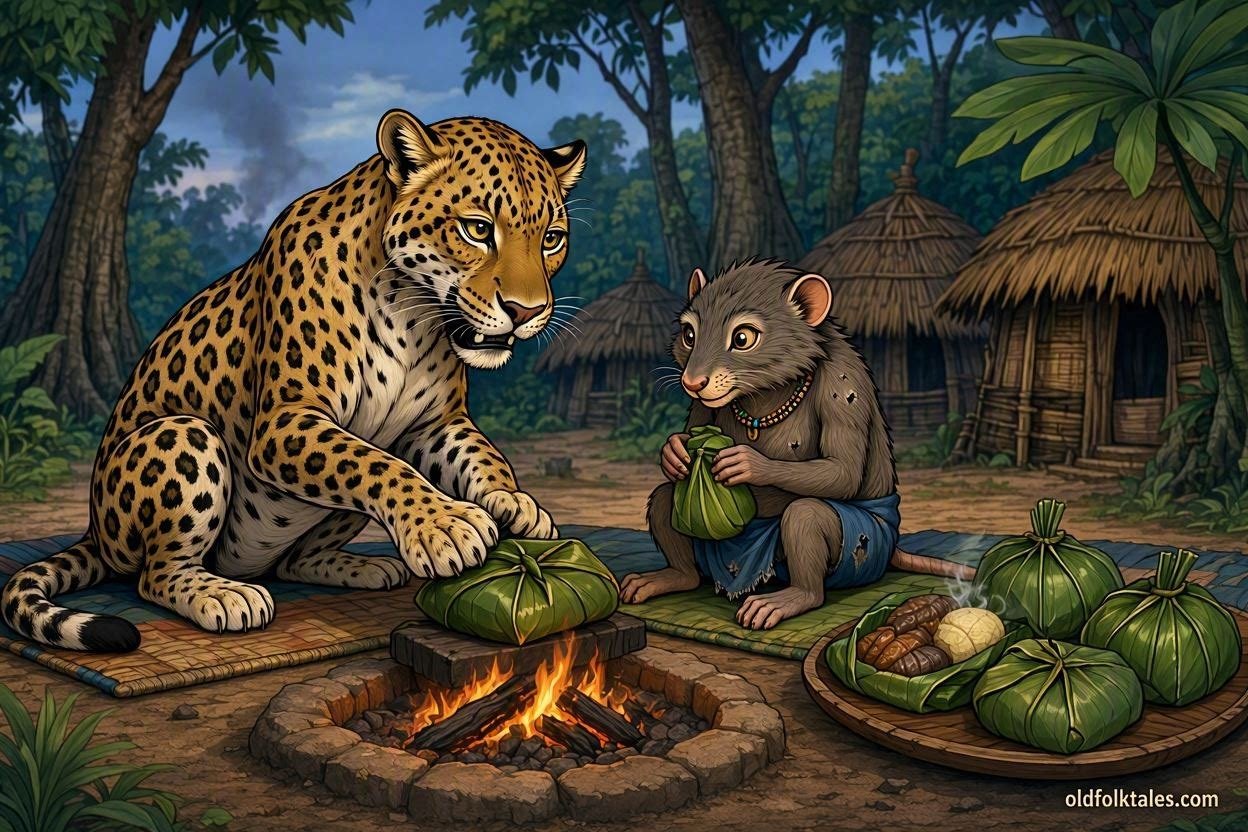
Kumbi placed a large package before him, opened it and served thick pieces of pounded banana alongside it.
Then he handed the Leopard a spoon.
“Grand brother, help yourself. Use the banana with the fat. You will enjoy it more that way.”
Magéna eagerly took the spoon.
He pushed it deep into the package and brought out a large spoonful of what he believed was melted fat.
He swallowed it.
Then he took another spoonful.
But the substance was not fat.
It was the hot ocoumé resin Kumbi’s children had prepared.
The Leopard soon discovered the truth.
The resin burned his mouth and caused him terrible pain. He jumped away from the table, realizing that the clever Rat-Fouisseur had tricked him.
Kumbi had never killed his mother.
He had known from the beginning that the Leopard intended to deceive him and had prepared a way to protect himself.
The Leopard rushed away in pain, while Kumbi remained safely behind.
The friendship that had begun with a generous meal had ended because Magéna allowed greed to overcome loyalty.
But Kumbi’s cleverness did not end there.
The Leopard had already shown that he could not be trusted. He had turned against his own mother and then expected his friend to do the same.
Kumbi understood that friendship with someone who had no respect for loyalty could become dangerous.
The Leopard had possessed greater physical strength, sharper claws and greater power.
Kumbi had none of those advantages.
What he possessed was intelligence.
And that intelligence saved him.
The animals of the forest would remember the story for generations. It showed that strength does not always defeat weakness. A powerful creature may still be defeated by someone smaller if that smaller creature knows how to think carefully.
Magéna believed that friendship gave him the right to manipulate Kumbi.
He was wrong.
Kumbi had welcomed him sincerely, fed him generously and accepted his friendship. But when the Leopard’s behaviour revealed his true character, Kumbi did not confront him with strength. He used patience and wisdom instead.
The Leopard’s greed had blinded him. He saw only the food he expected to eat and failed to question what was placed before him.
Kumbi, on the other hand, questioned everything.
He listened to the Leopard’s plan. He waited. He watched. Then he prepared his response.
That was how the smaller animal escaped from the trap set by the stronger one.
The story therefore became a warning about the kind of friends people choose. A friendship built on kindness can bring happiness, but a friendship with someone driven by greed and selfishness can eventually become dangerous.
And so, among the animals of the forest, the Rat-Fouisseur became remembered not because he was the strongest, but because he knew when to trust, when to be cautious and when to use his intelligence to protect himself.
Click here to explore more Central African folktales
Moral Lesson
True friendship requires loyalty and good character. Greed can destroy relationships, while wisdom and careful thinking can help the vulnerable overcome those who misuse their strength.
Knowledge Check
1. Who were Magéna and Kumbi?
Magéna was the Leopard, while Kumbi was the Rat-Fouisseur.
2. How did the Leopard and Rat-Fouisseur become friends?
The Leopard visited Kumbi, who welcomed him warmly and prepared a generous meal for him.
3. What terrible plan did the Leopard suggest?
He suggested that they kill and cook their mothers so they could eat them.
4. How did Kumbi respond to the Leopard’s plan?
He agreed on the condition that the Leopard should kill his own mother first.
5. How did Kumbi protect himself?
He instructed his children to collect ocoumé resin and prepare it to look like food.
6. What lesson does the story teach?
The story teaches that greed and betrayal can destroy relationships, while intelligence and caution can protect a person from danger.
Source
Adapted from André Raponda-Walker’s Contes gabonais (1967), from the narrative “Le Léopard lie amitié avec le Rat-Fouisseur.”