In the heart of Fanti-land, where the tropical sun filtered through dense canopies of ancient trees and village life moved to the rhythm of ancestral traditions, there lived a man unlike any other. This was Father Anansi, a figure both revered and feared throughout the region, for he possessed something more precious than gold, more valuable than the finest kente cloth, and more sought-after than the sweetest palm wine. Father Anansi owned all the wisdom in the world.
From dawn until the deep hours of night, a steady stream of people made their way to Father Anansi’s dwelling. They came from villages near and far, carrying their troubles like heavy burdens on their shoulders. Farmers sought his counsel when their crops failed to flourish. Mothers brought their concerns about wayward children. Elders consulted him when disputes arose between families. Young lovers asked for guidance in matters of the heart. Chiefs and common people alike bowed before his superior knowledge, for Father Anansi’s wisdom seemed limitless and his advice never failed to solve even the most perplexing problems.
Father Anansi’s home reflected his status as the keeper of all knowledge. The walls were adorned with symbols and artifacts representing every field of human understanding. Scrolls of ancient wisdom filled carved wooden shelves. Clay tablets bore the secrets of medicine, agriculture, and craftsmanship. The very air seemed to hum with intellectual energy, and visitors often left feeling as though they had glimpsed the mysteries of the universe itself.
For many seasons, Father Anansi dispensed his wisdom freely, taking satisfaction in his role as the great teacher and advisor. He enjoyed the respect and gratitude of those he helped, and his reputation spread like ripples across the vast expanse of Fanti territory. However, wisdom without humility can be a dangerous thing, and Father Anansi’s pride grew alongside his reputation.
One fateful day, the harmony between Father Anansi and his people was shattered. The exact nature of the offense committed by the men of the country has been lost to the mists of time, but its consequences would echo through the ages. Perhaps they questioned one of his pronouncements, or failed to show proper respect, or made decisions without seeking his counsel first. Whatever the transgression, it struck at the very core of Father Anansi’s enormous pride.
The wise man’s reaction was swift and decisive. His eyes blazed with indignation as he contemplated the ingratitude of those he had served so faithfully. “If they do not appreciate the gift of wisdom,” he muttered to himself, “then they shall have none at all.” His anger transformed into cold determination, and he began to formulate the most severe punishment he could imagine.
After much deliberation, pacing back and forth in his chamber filled with the treasures of knowledge, Father Anansi conceived his revenge. He would gather back every fragment of wisdom he had ever shared, collect it all into one place, and hide it where no human being could ever reach it again. Let them stumble through life in ignorance, he thought bitterly. Let them face their challenges without his guidance and see how well they fared.
With methodical precision, Father Anansi began his work. He called back every piece of advice he had given, every solution he had provided, every insight he had shared. Like a fisherman gathering his nets, he drew the wisdom from the minds and hearts of those who had received it. The process was exhausting and time-consuming, requiring him to use powerful techniques known only to himself.
When he was satisfied that he had reclaimed every morsel of wisdom from the world, Father Anansi carefully placed it all into a single, enormous pot. This was no ordinary vessel, but a great clay container crafted specifically for this purpose, its surface decorated with intricate patterns that seemed to shift and dance in the firelight. The pot grew heavy with the weight of all human knowledge, understanding, and insight compressed into its rounded belly.
With great ceremony, Father Anansi sealed the pot using methods passed down through generations of wisdom-keepers. He wrapped it in protective cloths and secured it with strong ropes, creating a package that could be worn around the neck like a massive pendant. The container was now ready for transport to its permanent hiding place.
Throughout these preparations, Father Anansi believed himself to be working in complete secrecy. However, he had not accounted for the sharp eyes and curious mind of his own son, Kweku Tsin. This boy, though young in years, possessed the kind of natural intelligence that could not be hidden or suppressed. Something in his father’s behavior—the secretive glances, the mysterious activities, the sudden change in demeanor—aroused his suspicion.
Kweku Tsin resolved to discover what his father was planning. With the patience of a hunter and the stealth of a forest creature, he began to watch his father’s every movement. He noted the careful way Father Anansi handled the great pot, the furtive looks toward the door, and the unmistakable signs of someone preparing for a clandestine journey.
The next morning, Kweku Tsin’s vigilance was rewarded. He watched from a hidden vantage point as his father emerged from the house in the early dawn light, the enormous pot suspended from his neck by strong cords. Father Anansi moved with purpose but also with stealth, clearly believing that his mission would go unobserved.
Maintaining a safe distance, Kweku Tsin followed his father through the winding paths that led away from their village. They traveled deeper and deeper into the forest, where the canopy grew so thick that even the bright morning sun could penetrate only in scattered beams. The sounds of village life faded completely, replaced by the calls of exotic birds and the rustling of small creatures in the undergrowth.
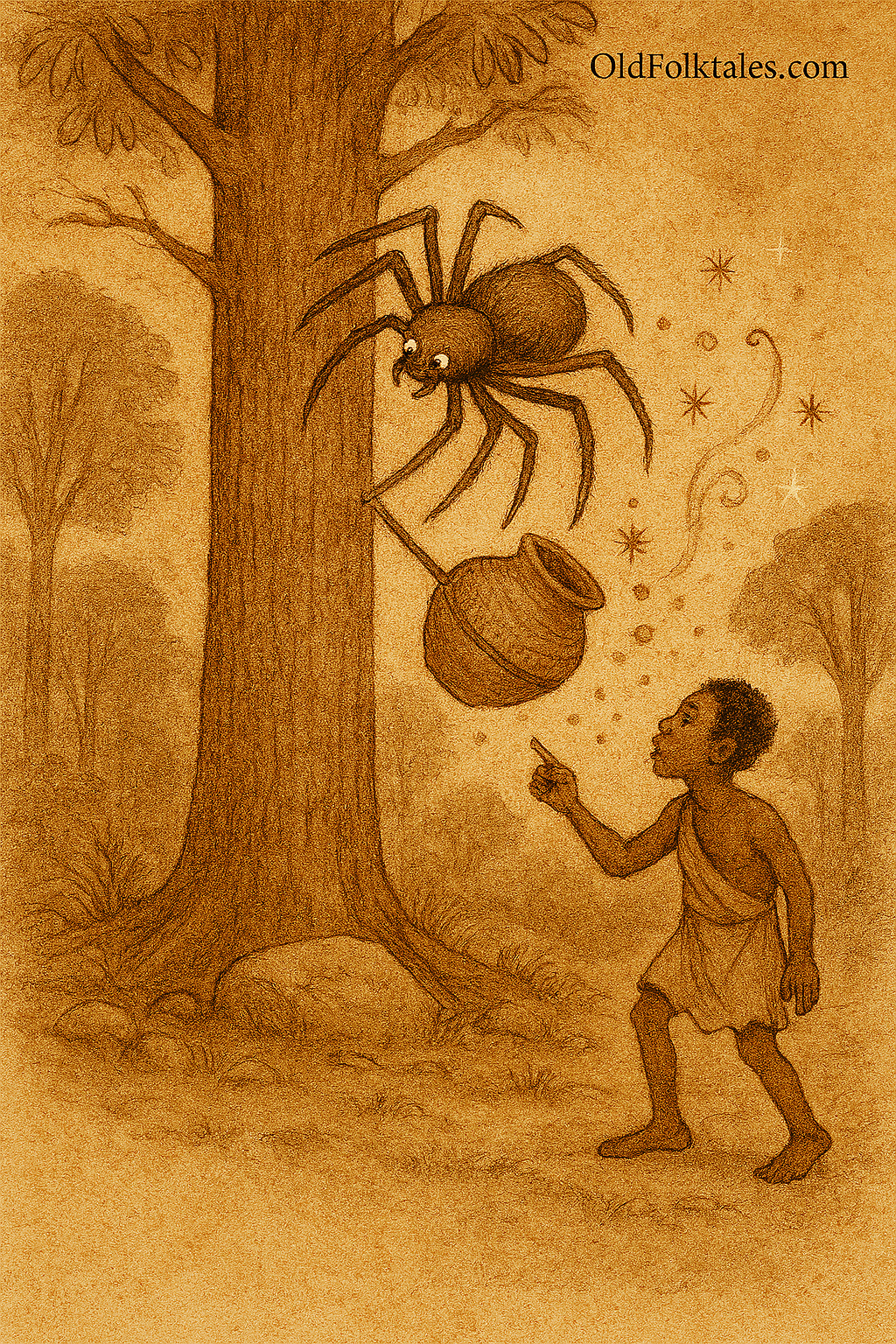
Finally, in a clearing far from any human habitation, Father Anansi stopped before the most magnificent tree Kweku Tsin had ever seen. It was a giant of the forest, its trunk so wide that it would take twenty men holding hands to encircle it, its crown reaching so high that the top was lost among the clouds. The bark was smooth and offered few handholds, making it appear virtually unclimbable.
This, Father Anansi decided, would be the perfect hiding place for all the world’s wisdom. At the very top of this impossible tree, he would secure the pot where no human being could ever reach it. There it would remain for all eternity, a monument to his wounded pride and the ingratitude of those he had once served.
Father Anansi began his ascent, but immediately encountered a problem he had not anticipated. The great pot, hanging heavily in front of his body, made climbing extremely difficult. Every time he tried to pull himself upward, the vessel swung against the tree trunk, throwing him off balance. When he attempted to reach around the pot to grasp higher handholds, its bulk prevented him from getting close enough to the tree.
Again and again, Father Anansi made valiant attempts to reach the upper branches. Sweat poured down his face as he struggled against the unwieldy burden. His hands grew raw from gripping the bark, and his muscles ached from the repeated efforts. Yet with each attempt, the same problem arose: the pot’s position made climbing impossible.
From his hiding place, Kweku Tsin watched his father’s futile struggles with growing amazement. The solution to the problem seemed so obvious to the boy that he could barely contain himself. After witnessing numerous failed attempts, his natural desire to help overcame his caution.
“Father!” Kweku Tsin called out, stepping from his concealment. “Why do you not hang the pot on your back instead of in front? Then you could easily climb the tree!”
Father Anansi froze on the trunk, stunned by his son’s sudden appearance and even more shocked by the simple wisdom of the suggestion. In all his vast knowledge and careful planning, he had failed to see such an elementary solution. Yet his young son, with no special training or accumulated learning, had immediately identified the answer.
The realization hit Father Anansi like a thunderbolt. He stared down at Kweku Tsin, seeing in the boy’s innocent face a truth that shattered his entire worldview. “I thought I had collected all the world’s wisdom into this pot,” he said slowly, his voice filled with wonder and dismay. “But I find that you possess more wisdom than I do. All my accumulated knowledge was insufficient to show me what to do, yet you have been able to tell me the answer immediately.”
In that moment, Father Anansi understood the foolishness of his plan. Wisdom could not truly be hoarded or hidden away, for it springs naturally from the human spirit itself. His son’s simple observation had demonstrated that intelligence and insight belong to all people, not just to those who claim to possess them.
Overcome by a mixture of anger at his own pride and amazement at this revelation, Father Anansi made a decision that would change the world forever. In a moment of passionate frustration, he hurled the great pot downward with all his strength.
The container struck a massive rock at the base of the tree and shattered into countless pieces. As it broke open, all the wisdom that had been so carefully collected and sealed within began to pour out like water from a broken dam. But instead of pooling on the ground and being lost, the wisdom took wing on the morning breeze.
Like seeds on the wind, the fragments of knowledge and understanding spread in all directions. They floated over villages and forests, across rivers and mountains, reaching every corner of the world. Each piece of wisdom found its way to a human heart or mind ready to receive it. Some people received knowledge of healing, others gained understanding of craftsmanship, still others discovered insights into human nature or the mysteries of the natural world.
From that day forward, wisdom was no longer the exclusive property of any one person. It became distributed among all members of the human race, with each individual possessing their own unique portion of understanding and insight. Some became wise in the ways of farming, others in the art of storytelling, still others in the skills of leadership or the mysteries of the spirit world.
Father Anansi climbed down from the tree a humbled man. Though he had lost his monopoly on wisdom, he had gained something far more valuable: the understanding that true wisdom comes not from hoarding knowledge, but from recognizing that every person has something valuable to contribute to the collective understanding of humanity.
Moral Lesson
This profound tale teaches us that wisdom cannot be owned or hoarded by any single individual, no matter how knowledgeable they may be. True understanding often comes from the most unexpected sources, and even children can possess insights that escape the most learned adults. The story warns against the dangers of intellectual pride and shows us that wisdom is meant to be shared, not hidden away. When we try to monopolize knowledge or punish others by withholding understanding, we ultimately harm ourselves and deprive the world of the collective benefit that comes when wisdom is freely distributed among all people.
Knowledge Check
Q1: Who is Father Anansi in Fanti folklore, and what role does he play in West African storytelling traditions? A: Father Anansi is the spider trickster figure in Fanti (Akan) folklore, representing wisdom, cunning, and the complex relationship between knowledge and power. In this tale, he serves as both the keeper of all wisdom and the one whose pride leads to wisdom’s distribution among humanity, making him central to origin stories about human knowledge.
Q2: What does Kweku Tsin represent in this Fanti folktale about wisdom and human nature? A: Kweku Tsin represents natural intelligence and the wisdom that comes from fresh perspective rather than accumulated learning. His ability to solve his father’s problem demonstrates that insight and understanding can emerge from anyone, regardless of age or formal education, challenging assumptions about who possesses true wisdom.
Q3: What is the significance of the pot in this African folktale about the distribution of wisdom? A: The pot symbolizes the attempt to contain and control wisdom, representing how knowledge becomes useless when hoarded rather than shared. Its breaking and the subsequent scattering of wisdom illustrates that understanding is meant to be distributed among all people rather than monopolized by individuals.
Q4: How does this Fanti folktale explain the origin of human wisdom and knowledge? A: The story provides an origin myth explaining how wisdom became distributed among all humans rather than being possessed by a single person. It suggests that human intelligence and understanding exist because of Father Anansi’s failed attempt to hoard wisdom, resulting in its accidental but beneficial spread throughout the world.
Q5: What does Father Anansi’s punishment attempt reveal about the relationship between pride and wisdom? A: Father Anansi’s desire to hide wisdom as punishment reveals how pride can corrupt even the wisest individuals, leading them to use knowledge as a weapon rather than a gift. His failure demonstrates that true wisdom includes humility and the recognition that understanding belongs to all humanity, not just the learned few.
Q6: What cultural values does this West African folktale promote regarding knowledge sharing and community wisdom? A: The tale promotes African cultural values of communal knowledge sharing, respect for collective wisdom, and the understanding that intelligence can emerge from any member of the community. It emphasizes that wisdom serves its highest purpose when distributed freely rather than being controlled by individuals, reflecting traditional African concepts of shared responsibility and collective benefit.