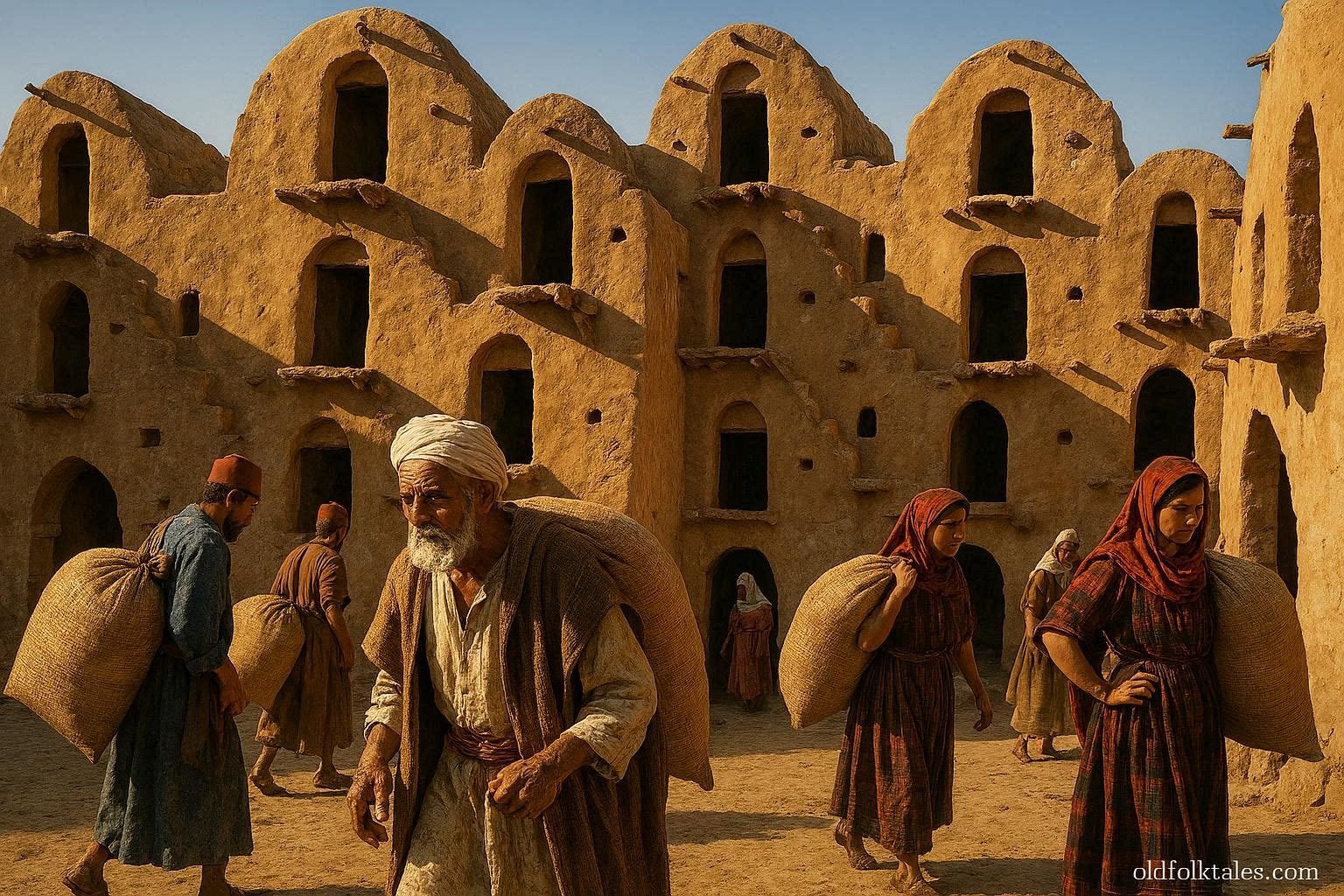
In the arid landscapes of southern Tunisia, where rocky hills meet the vast Sahara, Amazigh communities learned long ago that survival depended upon careful planning. Rain did not fall every season, harvests could vary from year to year, and long journeys often separated villages. To protect their families during uncertain times, the people built remarkable fortified granaries known as ksour.
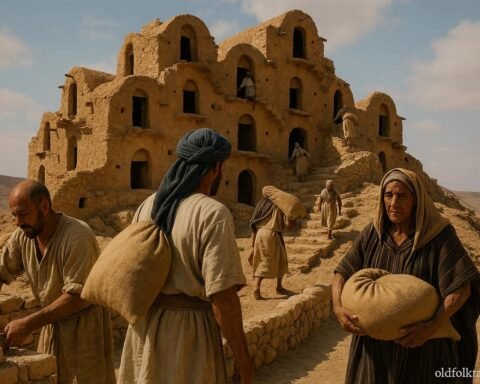
Among the finest of these is Ksar Ouled Soltane, a towering complex of multi-story storage chambers built from earth and stone. Each family owned one or more small vaulted rooms, called ghorfas, where grain, olive oil, dried dates, and other valuable supplies were safely stored.
The ksar was more than a storehouse.
It was a symbol of trust.
Every chamber represented the hard work of a family, while the entire structure reflected the strength of the community working together.
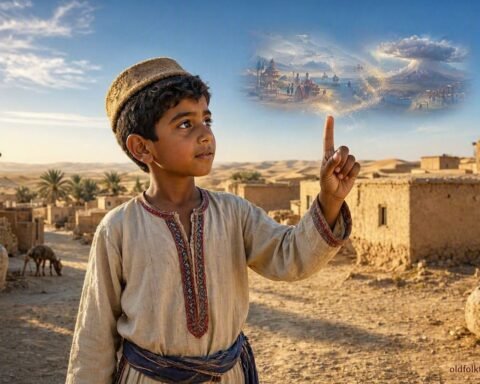
In one nearby village lived a curious young boy named Yusef.
Each autumn, he watched his parents prepare sacks of barley and wheat for storage after the harvest.
Although he helped carry baskets from the fields, he wondered why the elders treated the granary with such great respect.
Don’t stop yet! See our complete East African folktales collection
One morning, his grandfather Hamid invited him to accompany him to Ksar Ouled Soltane.
As they approached, Yusef gazed in amazement.
Rows upon rows of vaulted storage rooms rose several stories into the bright desert sky.
Narrow stairways and passageways connected the chambers, while thick earthen walls protected the precious harvest from heat, wind, and thieves.
“It looks like a fortress,” Yusef whispered.
Hamid smiled.
“It protects food instead of soldiers.”
Inside the ksar, families carefully placed sacks of grain into their ghorfas.
Others stored olive oil in clay jars, dried figs, almonds, and dates gathered from nearby oasis groves.
Each storage room was marked so every family knew its own supplies.
Nothing was wasted.
Nothing was carelessly handled.
Hamid explained that storing food properly ensured that every household could survive poor harvests or difficult seasons.
“Our ancestors built this place,” he said, “not because they feared tomorrow, but because they prepared for it.”
During the following weeks, Yusef noticed something unusual.
Whenever an elderly widow or a family struggling after a poor harvest needed help, neighbors quietly shared part of their stored grain.
The ksar protected more than food.
It strengthened generosity.
One afternoon, travelers arrived after crossing the desert.
They had exhausted much of their food during the journey.
Without hesitation, village elders welcomed them with bread, dates, and olive oil taken from the communal reserves.
Hospitality, Hamid explained, was another tradition protected within the granary’s walls.
“Prepared communities,” he said, “are able to help others.”
As winter approached, a fierce desert storm swept across the region.
Strong winds buried paths beneath drifting sand.
For several days, families remained close to their homes.
Because their harvest had been carefully stored inside the ksar, no one feared hunger.
The granaries had fulfilled the purpose for which they had been built generations earlier.
After the storm passed, Yusef joined the elders in inspecting the structure.
Although sand covered the entrance, the thick walls and vaulted chambers remained secure.
The builders had understood the harsh desert environment and designed the ksar to endure it.
Yusef admired their wisdom.
Years later, Hamid entrusted his grandson with one of the family ghorfas.
Before handing him the key, he offered simple advice.
“Fill this room with honest work.”
“But remember that what you store here is never yours alone.”
“It is part of the strength of the whole community.”
Yusef accepted the responsibility with humility.
As he grew older, he taught younger villagers how to care for the granaries, repair weathered walls, and preserve the customs surrounding the annual harvest.
Visitors often came to admire the remarkable architecture of Ksar Ouled Soltane.
Its rows of beautifully stacked storage chambers attracted travelers from many countries.
Yet Yusef always reminded them that its greatest achievement was not its appearance.
It was the spirit of cooperation that had built it.
Today, Ksar Ouled Soltane stands as one of Tunisia’s best-preserved fortified granaries and an outstanding example of Amazigh architectural heritage. It reflects centuries of practical knowledge, community organization, and resilience in the face of desert life. Its distinctive ghorfas continue to symbolize foresight, cooperation, and the enduring traditions of southern Tunisia.
The story of Ksar Ouled Soltane Granaries reminds us that true security is built not only through strong walls but through communities that prepare wisely, share generously, and care for one another.
Fascinated by this tale? Discover more North African folktales
Moral Lesson
Communities grow stronger when they prepare wisely, work together, and share their blessings with others.
Knowledge Check
1. What is Ksar Ouled Soltane?
A fortified Amazigh granary made up of many storage chambers called ghorfas.
2. What foods were commonly stored in the granaries?
Grain, olive oil, dates, dried figs, almonds, and other valuable harvests.
3. Why did Amazigh communities build ksour?
To protect food supplies and prepare for difficult seasons.
4. How did the granary strengthen the community?
It encouraged cooperation, generosity, and shared responsibility.
5. What did Hamid teach Yusef about the family ghorfa?
That it should be filled through honest work and used with the community’s well-being in mind.
6. What is the main lesson of the story?
Foresight, cooperation, and generosity help communities overcome hardship.
Source
Adapted from Amazigh oral traditions, studies of southern Tunisia’s ksour, and documentation on Ksar Ouled Soltane preserved through UNESCO cultural heritage resources and Tunisian architectural heritage research.