Far beyond the busy villages of the Songye people, where dense forests gave way to rolling hills and clear streams fed a quiet lake known as Lake Boya, there existed a place few dared to visit after sunset.
The lake was unlike any other.
Its waters remained calm even during fierce storms, and every dawn a light mist rose gently from its surface, hiding the opposite shore from view.
The elders often said that Lake Boya was more than a body of water.
It was a doorway between the living and the ancestors.
Children were warned never to wander there alone.
Hunters paused to offer respectful greetings before passing its shores.
Fishermen cast their nets only after thanking the spirits believed to watch over the lake.
For generations, these customs were faithfully observed.
Yet as time passed, many young people dismissed the old stories as little more than legends.
Among them was a curious traveler named Kisenga.
Want more? Read more West African folktales now
Unlike the other youths of his village, Kisenga dreamed of seeing distant lands.
He believed that true wisdom could be found only by traveling beyond the places his ancestors had known.
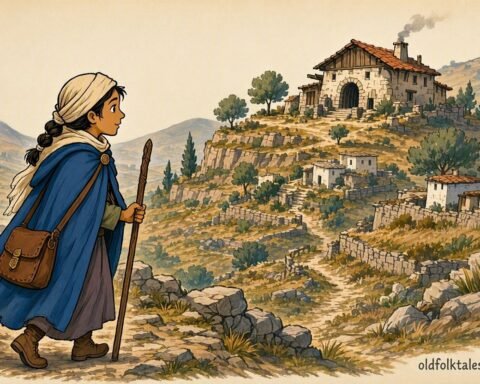
One evening, as he prepared for another journey, his grandfather handed him a beautifully carved walking staff.
“This belonged to your great grandfather,” the old man said.
“It has guided many members of our family.”
Kisenga accepted the gift respectfully but smiled.
“I thank you, Grandfather,” he replied, “but I believe my own judgment will guide me better than the wisdom of those who lived long ago.”
The old man said nothing more.
Instead, he simply watched his grandson disappear along the forest path.
After several days of travel, Kisenga found himself standing beside the quiet waters of Lake Boya.
The lake was even more beautiful than he had imagined.
The water reflected the evening sky like polished glass.
Tall reeds swayed gently in the breeze.
Birdsong echoed across the shoreline before slowly fading into silence.
As darkness approached, Kisenga remembered the warnings he had heard since childhood.
Most travelers would have continued to the nearest village before nightfall.
Instead, curiosity persuaded him to remain.
“I have crossed forests and mountains,” he said to himself.
“Surely there is nothing to fear from an old story.”
He built a small fire beside the shore and settled beneath a large tree.
As the moon climbed into the night sky, the surface of the lake began to change.
The mist thickened.
Soft ripples spread across the water although no wind was blowing.
Then Kisenga heard something that made him sit upright.
Voices.
They were quiet at first.
Not angry.
Not frightening.
They sounded like elders speaking gently from somewhere beyond the mist.
One voice called his name.
“Kisenga.”
Another followed.
“Grandson.”
He looked around quickly.
There was no one on the shore.
The voices continued.
“You seek wisdom in distant places.”
“But have you first listened to those who walked before you?”
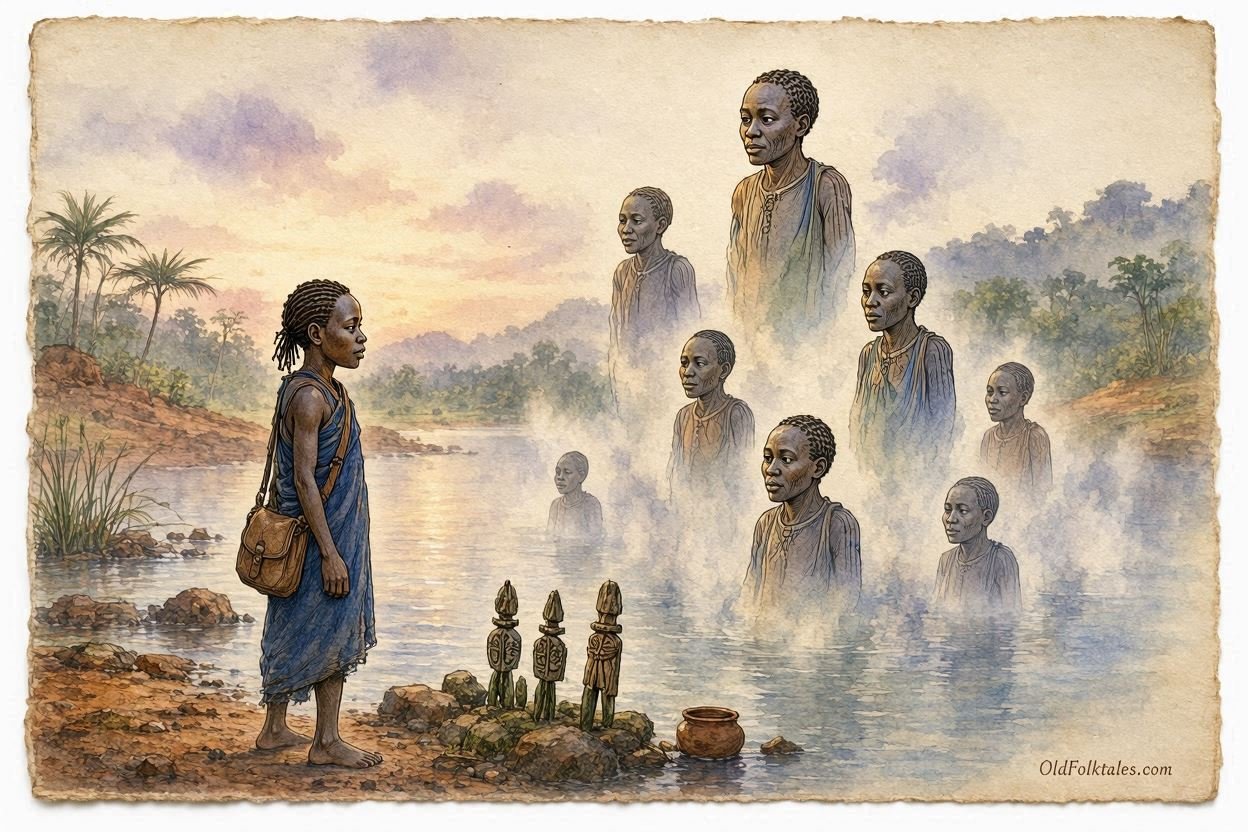
The mist slowly parted.
Shapes began to emerge upon the still waters.
They resembled elderly men and women dressed in ancient Songye garments, their faces calm and filled with quiet dignity.
Kisenga’s heart pounded.
He realized that he was no longer alone.
Kisenga slowly rose to his feet.
Although fear filled his heart, he remembered the respect his grandfather had always shown when speaking of the ancestors.
He bowed his head.
“I greet you,” he said quietly.
The figures upon the water smiled.
One elderly man stepped forward until he seemed to stand upon the surface of the lake itself.
“You have traveled far in search of wisdom,” he said. “Tell us, what have you learned?”
Kisenga thought carefully.
“I have learned the names of distant rivers and mountains. I have seen villages unlike my own. I have met many people.”
The elder nodded.
“These are valuable experiences. But tell us, have your travels made your people stronger?”
Kisenga remained silent.
He had never considered that question.
Another ancestor stepped forward.
She carried a woven basket filled with seeds.
“Every traveler receives gifts,” she said. “Some keep them for themselves. Others return home and plant them where future generations may benefit.”
She handed the basket to Kisenga.
The seeds shimmered like tiny drops of light.
“These are not seeds for the earth,” she explained. “They are seeds of responsibility.”
Before Kisenga could ask their meaning, the lake changed once more.
The calm waters became like a mirror.
Within them, he saw images of his own village.
He watched children struggling to fetch water during the dry season.
He saw elders repairing broken paths without help.
He watched farmers losing part of their harvest because no one had organized the community to work together.
Then he saw himself.
He was walking farther and farther away, searching for wisdom in distant places while his own people faced difficulties without him.
Tears filled his eyes.
“I understand,” he whispered.
The oldest ancestor smiled.
“Knowledge is a gift,” he said. “But wisdom is measured by what you do with it.”
As dawn approached, the mist slowly began to disappear.
The ancestors spoke one final time.
“Return home, Kisenga.”
“Honor those who came before you.”
“Serve those who walk beside you.”
“And prepare those who will come after you.”
The figures gradually faded into the morning light.
Only the quiet waters of Lake Boya remained.
Kisenga looked down at his hands.
The basket of glowing seeds had vanished.
In its place rested the carved walking staff his grandfather had given him.
For the first time, he understood why it had been entrusted to him.
He returned to his village before the next harvest.
His grandfather welcomed him with a warm embrace.
“I see that your journey has changed you,” the old man said.
“It has,” Kisenga replied. “I left searching for distant knowledge. I returned carrying the wisdom of home.”
From that day forward, Kisenga devoted himself to serving his community.
He organized the young people to repair roads and bridges before the rainy season.
He worked beside the elders instead of waiting for their instructions.
He encouraged children to learn the history of their ancestors alongside new skills for the future.
As the years passed, the village flourished.
Travelers admired its peaceful spirit and strong sense of community.
Whenever someone praised Kisenga for his wisdom, he simply smiled.
“I did not discover wisdom alone,” he would say. “I listened to the voices that had always been there.”
The people believed that the ancestors beneath Lake Boya continued watching over those who honored their traditions with humility and responsibility.
And so, The Ancestors Beneath Lake Boya became one of the treasured legends of the Songye people, reminding every generation that true wisdom is not measured by how far one travels but by how faithfully one serves family, community, and the legacy of those who came before
Keep reading: Discover more Central African folktales
Moral Lesson
This Congolese folktale teaches that true wisdom comes from honoring the knowledge of our ancestors and using what we learn to serve our communities with humility and responsibility.
Knowledge Check
1. Why did Kisenga travel far from his village?
He believed true wisdom could only be found in distant places.
2. Who appeared to Kisenga at Lake Boya?
The ancestral spirits of his people appeared and spoke to him.
3. What did the basket of glowing seeds represent?
It symbolized the responsibility to use knowledge for the benefit of future generations.
4. What did Kisenga see in the lake’s reflection?
He saw his village struggling while he searched for wisdom elsewhere.
5. How did Kisenga change after returning home?
He dedicated himself to serving his village, helping the elders, and teaching the younger generation.
6. What is the central lesson of this folktale?
The story teaches that wisdom becomes meaningful only when it is used to strengthen one’s family, community, and future generations.
Source: Adapted from Songye oral traditions preserved in the Royal Museum for Central Africa (Tervuren) oral tradition archives.