Nestled among the forested mountains of northwestern Tunisia lies the region of Ain Draham, a land known for its cool climate, rolling hills, and majestic cedar and oak forests. For generations, the people of the Kroumirie Mountains lived close to nature, relying on the forests, springs, and fertile valleys that surrounded them.
Life in the mountains was often peaceful, but not always.
Neighboring villages traded goods, shared celebrations, and helped one another during difficult times. Yet disagreements sometimes arose over grazing lands, water sources, and trade routes. Most disputes were eventually resolved, but a few grew into long-standing rivalries that affected entire communities.
Among the stories passed down through the region, one of the most cherished was the legend of the Cedar Flute of Ain Draham.
Keep reading: Discover more Central African folktales
According to tradition, the flute was carved from the wood of an ancient cedar tree that had stood in the mountains for centuries. Elders said its music possessed a remarkable gift. Whenever it was played with sincerity and good intentions, anger softened, misunderstandings faded, and people found the wisdom to seek peace.
Whether the flute truly possessed magical powers or simply reminded people of their shared humanity was a matter of debate.
Yet the story endured.
Many years ago, during a period of growing tension between two neighboring mountain villages, the legend took on new importance.
The villages of Tazrout and El-Kef El-Jabal had once enjoyed a strong friendship.
Families visited one another regularly.
Merchants traded freely.
Festivals were celebrated together.
Over time, however, disagreements over access to a valuable mountain spring created resentment between them.
What began as a minor dispute gradually worsened.
Accusations replaced cooperation.
Trade declined.
Old friendships weakened.
By the time this story begins, many villagers had grown accustomed to mistrust.
In a small settlement located between the two communities lived a young woodcarver named Sami.
Sami was known for his skill and patience.
He spent much of his time crafting tools, household items, and musical instruments from wood gathered in the surrounding forests.
Unlike many people influenced by the rivalry, Sami maintained friendships in both villages.
He often wondered why communities that shared so much history found it so difficult to reconcile.
One autumn morning, while searching the forest for suitable wood, Sami ventured farther into the mountains than usual.
The forest was quiet.
Sunlight filtered through towering trees.
Birdsong echoed between the hills.
As he explored, he discovered an enormous cedar tree unlike any he had seen before.
Its trunk was massive.
Its branches stretched high above the forest floor.
Though ancient, the tree appeared healthy and strong.
Near its roots lay a large branch that had recently fallen during a storm.
Sami examined the wood carefully.
Its grain was beautiful and unusually smooth.
Believing it would make an excellent musical instrument, he carried part of the branch home.
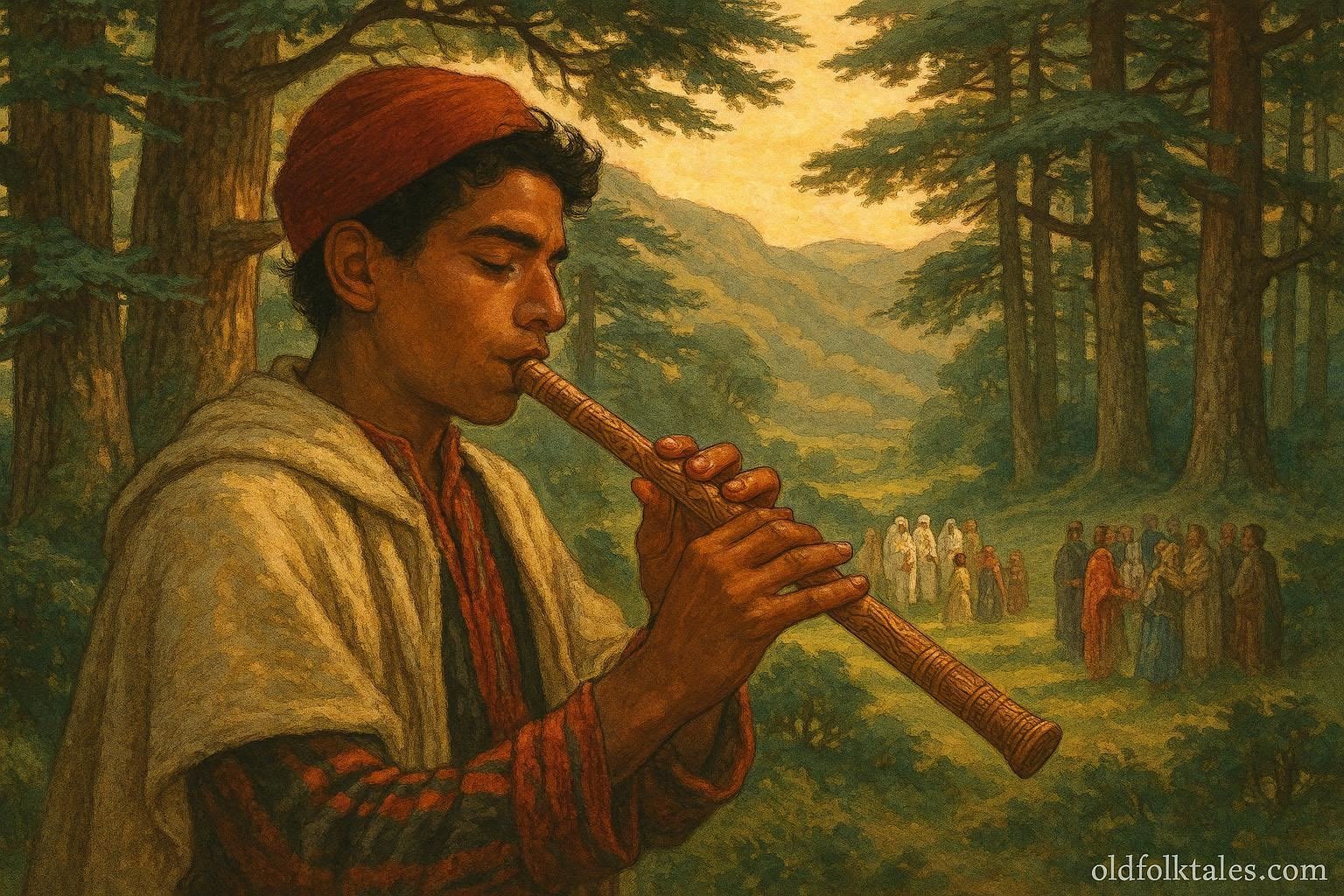
Over the following weeks, he carefully carved a flute from the cedar wood.
The process required patience and precision.
Every detail mattered.
When the instrument was finally complete, Sami lifted it to his lips and played its first notes.
The sound astonished him.
The flute produced a rich and soothing melody unlike anything he had ever heard.
Its tones seemed to blend effortlessly with the sounds of the mountains.
Word of the beautiful instrument quickly spread.
People from nearby villages visited to hear Sami play.
Many described the music as calming and uplifting.
Some listeners claimed it helped them forget their worries.
Others simply enjoyed its beauty.
One evening, an elderly traveler stopped at Sami’s workshop.
After listening to the flute, he smiled knowingly.
“Do you know what you have made?” he asked.
“A flute,” Sami replied.
The traveler laughed softly.
“Perhaps more than that.”
He then shared an old story.
According to local tradition, a sacred cedar tree once stood deep within the Kroumirie Mountains. Elders believed the tree symbolized unity because its roots spread widely beneath the earth, connecting different parts of the forest.
Legend said that any instrument carved from its wood would carry a message of harmony.
Sami listened with interest but remained uncertain whether the tale was true.
Soon afterward, severe weather struck the region.
Dark clouds gathered over the mountains.
Strong winds swept through the valleys.
Heavy storms threatened crops and homes.
Concern spread throughout the communities.
As the storm intensified one evening, Sami sat inside his home listening to the wind.
Without fully understanding why, he picked up the cedar flute and began to play.
The melody drifted through the darkness.
Its notes echoed across the hills.
To Sami’s surprise, the wind gradually seemed less fierce.
The atmosphere felt calmer.
Although the storm eventually passed naturally, many villagers later remarked that the flute’s music had brought them comfort during the frightening night.
Stories about the instrument grew.
Some claimed its music could calm storms.
Others believed it encouraged peace among those who heard it.
Regardless of the explanation, the flute became increasingly respected.
Several months later, tensions between Tazrout and El-Kef El-Jabal reached their highest point.
A disagreement over water access threatened to divide the communities completely.
Leaders attempted negotiations, but discussions repeatedly failed.
Frustration mounted on both sides.
Fearing the situation would worsen, elders organized a gathering in a neutral valley between the villages.
Representatives from both communities agreed to attend.
Sami was invited to provide music for the occasion.
As the meeting began, the atmosphere remained tense.
People sat apart from one another.
Conversations were cautious.
Years of resentment lingered beneath the surface.
Before discussions started, Sami played the cedar flute.
The melody flowed gently through the valley.
Its sound blended with the rustling trees and distant mountain winds.
Gradually, something changed.
People relaxed.
Old memories resurfaced.
Many remembered the years when the villages had worked together rather than against one another.
The music did not solve the dispute by itself.
Yet it created an atmosphere in which people could listen more carefully and speak more respectfully.
Throughout the day, discussions continued.
For the first time in years, meaningful progress was made.
By evening, both communities agreed upon a shared plan for managing the spring and preserving access for future generations.
The agreement marked the beginning of renewed cooperation.
Trade resumed.
Friendships were restored.
Joint celebrations returned.
As peace spread throughout the region, the legend of the cedar flute became even more famous.
People traveled from distant communities to hear its music.
Some came seeking comfort.
Others hoped to learn its secret.
Whenever asked whether the flute truly possessed magical powers, Sami always gave the same answer.
“The music alone cannot create peace,” he would say.
“People must choose peace for themselves.”
Years later, after Sami had become an elder, he entrusted the flute to a younger musician known for wisdom and integrity.
The tradition continued.
Generation after generation, the flute remained a symbol of harmony and understanding.
Even today, stories of the Cedar Flute of Ain Draham are shared throughout northwestern Tunisia.
Some believe the instrument still exists somewhere in the mountains.
Others think the flute serves as a reminder that music has the power to bring people together.
Whatever the truth may be, the lesson remains clear.
Communities grow stronger when they seek cooperation instead of conflict.
And sometimes, the simplest melody can remind people of the bonds they share.
Want to dive deeper? Read more North African folktales today
Moral Lesson
Peace begins when people choose understanding over division and work together for the common good.
Knowledge Check
- Where is the story set?
It is set in the mountain region of Ain Draham in northwestern Tunisia. - Who was Sami?
He was a skilled woodcarver who created the cedar flute. - What was special about the flute?
It was carved from ancient cedar wood and was believed to inspire peace and harmony. - What conflict existed between the villages?
They were divided by a long-standing dispute over access to a mountain spring. - How did the flute help the communities?
Its music encouraged calm discussion and helped create an atmosphere for reconciliation. - What lesson does the story teach?
Unity and cooperation are stronger than conflict and division.
Source
Adapted from northwestern Tunisian mountain folklore traditions preserved in Kroumirie folklore archives and regional North African oral heritage studies.