Off the southeastern coast of Tunisia lies the island of Djerba, a place known for its gentle shores, ancient olive groves, and deep connection to the Mediterranean Sea. For centuries, its people lived in close relationship with the water, relying on fishing, trade, and diving as essential parts of daily life. The sea was not only a source of food and livelihood but also a keeper of stories, memories, and mysteries passed down through generations.
Among the many traditions of the island, pearl diving held a special place. Skilled divers would plunge into the sea in search of oysters, hoping to find pearls that could be traded or treasured. Yet beyond their material value, pearls were often surrounded by stories. Some elders believed that certain pearls carried meanings that could only be understood by those who respected the sea deeply.
In one coastal village lived a young diver named Salim.
Salim was known for his bravery and skill beneath the water. He could hold his breath longer than most men and navigate underwater rocks with ease. From a young age, he had learned the ways of the sea from his father, who taught him that the ocean must always be approached with respect and humility.
Unlike some divers who focused only on profit, Salim was curious about the sea itself. He often wondered what lay beneath its surface beyond fish and shells.
Don’t stop yet! See our complete East African folktales collection
One morning, while diving near a quiet stretch of coastline, Salim noticed something unusual resting among the seabed rocks. At first, he thought it was an ordinary pearl oyster. But when he opened it, he found a pearl unlike any he had ever seen.
It was not perfectly round like the others.
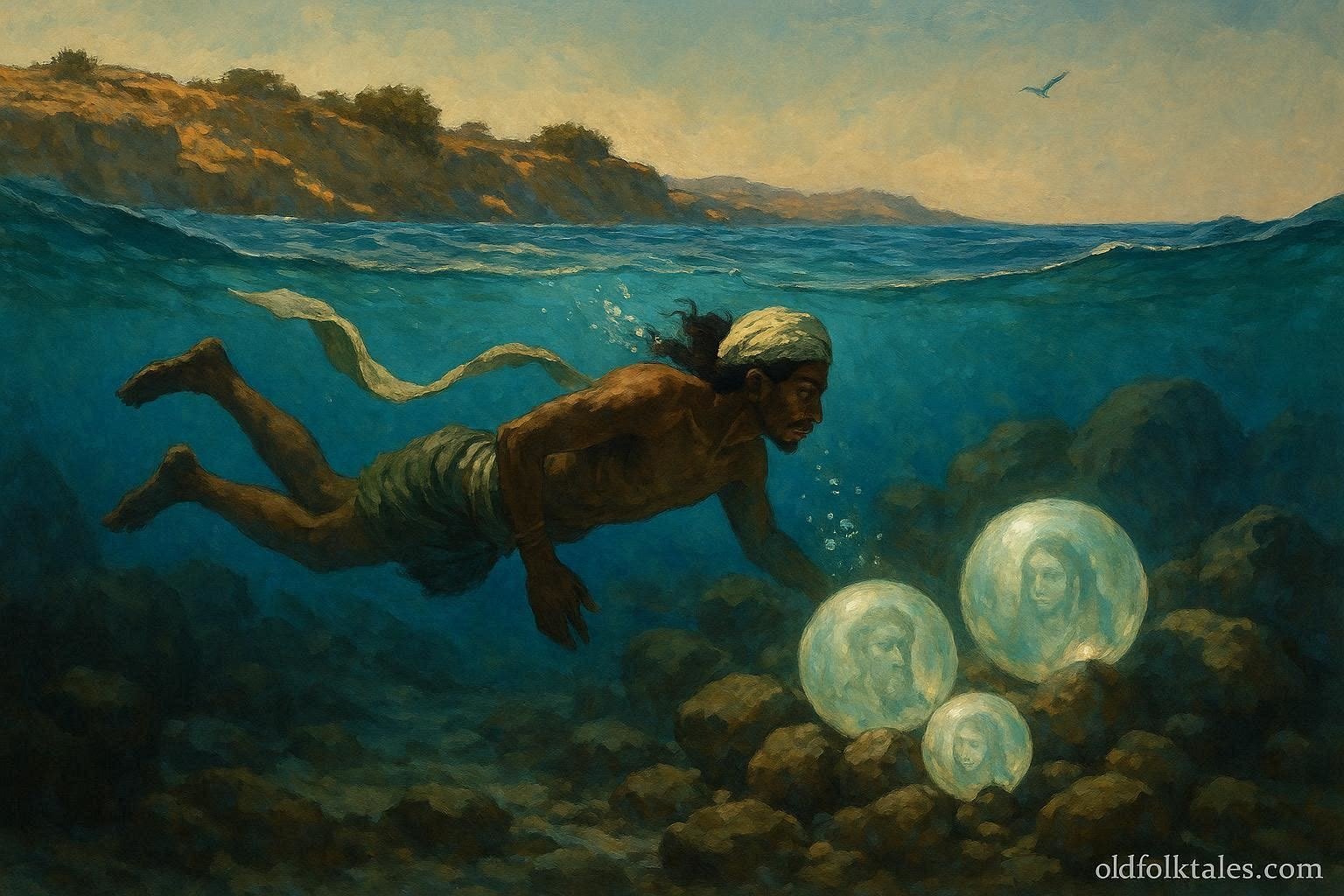
Instead, faint patterns seemed to shimmer within its surface, almost like images trapped inside.
When Salim brought it to the surface, the pearl appeared to glow softly in the sunlight.
The villagers who saw it were astonished.
Some believed it was simply rare and beautiful.
Others felt uneasy, saying they had never seen anything like it before.
Salim, however, felt a strange connection to the object. That night, he placed the pearl beside his sleeping mat. As he rested, he dreamed of unfamiliar scenes.
He saw boats sailing across ancient waters.
He saw fishermen speaking in languages he did not recognize.
He saw families living along shores that looked both familiar and distant.
When he awoke, he was deeply unsettled.
The following day, Salim returned to the sea, determined to understand what he had found. As he dived again, he discovered more unusual pearls hidden among the rocks. Each one contained faint imagery that seemed to shift when viewed closely.
Some showed scenes of storms over the sea.
Others revealed peaceful gatherings along the coast.
A few appeared to show people from generations long past, engaged in daily life on the island.
Word of Salim’s discoveries spread quickly across Djerba.
Elders came to examine the pearls.
Scholars studied them with curiosity.
Fishermen shared their own interpretations.
One elderly woman, known for her knowledge of oral traditions, looked closely at one of the pearls and became silent for a long time.
Finally, she spoke.
“These are not ordinary pearls,” she said softly.
“They carry memory.”
Her words puzzled many, but no one dismissed them entirely.
As Salim continued diving, his experiences grew more intense. He began to notice that the sea itself felt different whenever he descended. The water seemed quieter, almost as if it was waiting for him.
One afternoon, he descended deeper than ever before.
As he reached a rocky underwater formation, he saw something extraordinary. A cluster of pearls was arranged in a pattern that resembled a circle. In the center lay a larger pearl, glowing more brightly than the rest.
When he touched it, a powerful sensation passed through him.
In that moment, Salim saw visions not as separate fragments but as a continuous story.
He saw the history of his people.
He saw ancestors arriving on the island long ago.
He saw moments of hardship, migration, survival, and celebration.
He realized that the pearls were not simply objects.
They were reflections of memory preserved within the sea.
When Salim returned to the surface, he was no longer the same man.
He shared what he had experienced, but many struggled to understand his words. Some believed he had been affected by deep diving. Others thought he had become too imaginative.
Yet the elders listened carefully.
They understood something important.
The sea, they said, had always been part of the island’s identity. It carried the history of those who lived by it, even when written records did not exist.
The pearls, they concluded, were symbols of ancestral memory preserved through nature itself.
From that day forward, Salim no longer searched for pearls as a source of wealth.
Instead, he became a diver who respected the sea as a keeper of heritage.
He continued diving, but now each descent was done with reverence. Whenever he found a pearl, he would present it to the elders, who would interpret its meaning and share the stories it revealed.
Over time, the islanders began to see the sea differently. It was no longer only a source of livelihood but also a living archive of their collective past.
Children were taught to listen to the ocean.
Fishermen spoke more carefully about storms and tides.
And elders reminded everyone that memory could exist in places beyond human writing.
Years later, Salim became one of the most respected figures on the island. When young divers asked him about the glowing pearls, he would often smile before answering.
“The sea remembers what we forget,” he would say. “And if you are patient enough to listen, it will show you who you are.”
Even today, people in Djerba tell the story of the Pearl Diver. Some say the pearls still exist beneath the waters, waiting for those who approach the sea with respect rather than greed. Others believe the story is a reminder that history is never truly lost, only hidden in places we have yet to understand.
Explore the wisdom and wonder of North African folktales
Moral Lesson
True understanding comes from respecting nature and recognizing that heritage and memory can exist beyond written history.
Knowledge Check
1. Where is the story set?
It is set on the island of Djerba off the coast of Tunisia.
2. Who was Salim?
Salim was a skilled pearl diver known for his curiosity and respect for the sea.
3. What was unusual about the pearls?
They contained faint images and visions that seemed to reveal ancestral memories.
4. What did the pearls represent?
They were believed to represent the memory and history of the island’s ancestors.
5. How did Salim change after his discovery?
He stopped seeking pearls for wealth and began treating the sea as a keeper of heritage.
6. What is the main lesson of the story?
Heritage and memory can be preserved in nature, and understanding comes from respect and patience.
Source
Adapted from Tunisian coastal folklore traditions preserved in Djerba maritime oral history archives and North African Mediterranean folklore studies.