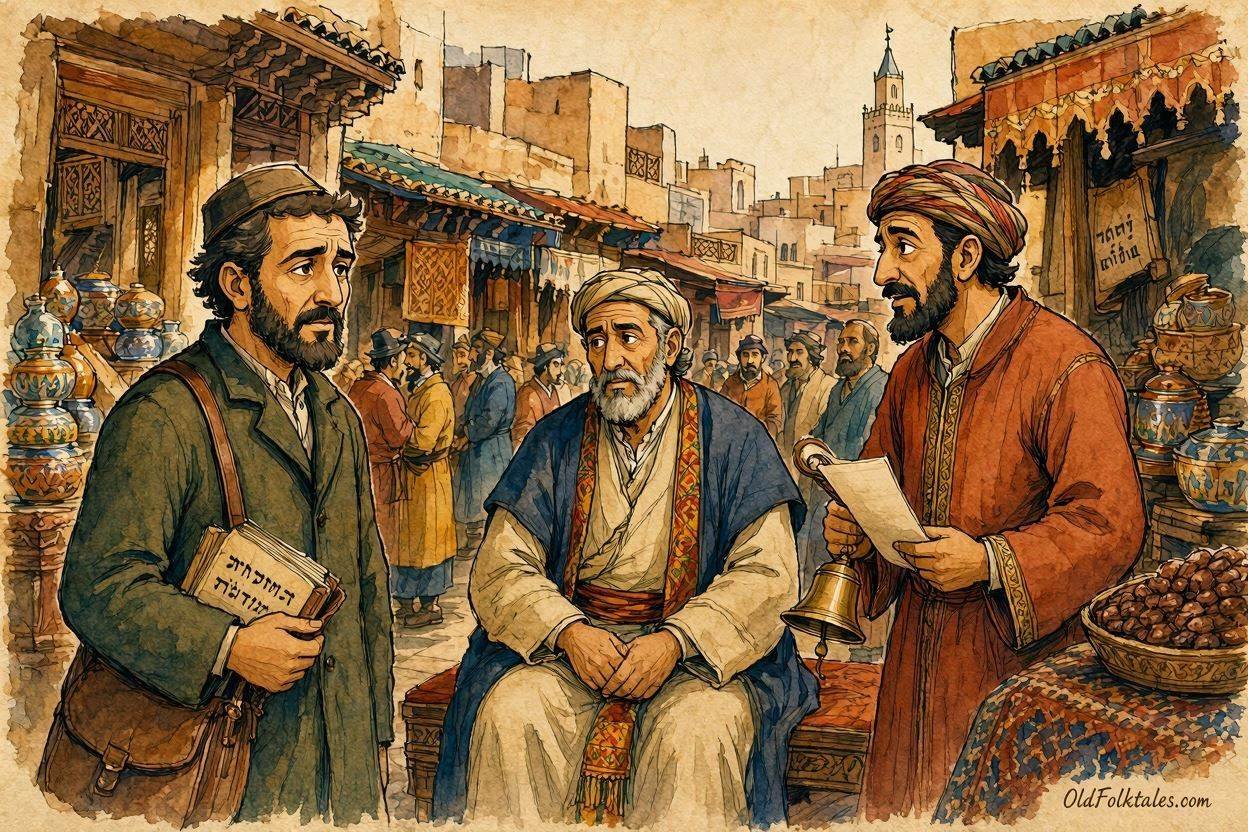
In a lively market town where merchants filled the streets with colorful fabrics, fragrant spices, and shining brass lamps, there lived a respected Jewish merchant named Yacoub.
Yacoub was known throughout the town for two things.
He never cheated a customer, and he always kept his promises.
People trusted him because his word was worth as much as a written contract.
Every market day, traders traveled from distant villages to buy and sell their goods.
Among the busiest people in the town was the Town Crier, whose loud voice carried important announcements through every street and marketplace.
Whenever the governor issued a new law or a merchant wished to spread important news, the Town Crier would ring his brass bell and proclaim the message for everyone to hear.
One autumn morning, Yacoub received a shipment of rare silk cloth that had arrived from a distant caravan.
The fabric was finer than anything the town had seen in many years.
Keep reading: Discover more Central African folktales
Believing that many customers would be interested, Yacoub hired the Town Crier to announce the arrival of the silk.
“I will pay you generously,” Yacoub said, “if you tell the people exactly what I ask.”
The Town Crier smiled confidently.
“You have my word.”
Yacoub carefully explained the announcement.
“Tell the people that fine silk has arrived at my shop and that every customer will be welcomed with fairness and honest prices.”
The Town Crier nodded and hurried into the marketplace.
Soon the sound of his bell echoed through the streets.
People gathered to listen.
But instead of repeating Yacoub’s words, the Town Crier decided to improve the announcement himself.
“Hear this!” he shouted.
“The merchant Yacoub has received the finest silk in the land, and today every piece will be sold for half its value.”
The crowd erupted with excitement.
Men and women rushed toward Yacoub’s shop before the announcement had even ended.
Yacoub was astonished.
Customers demanded silk at the impossible price they had heard.
When he explained that no such promise had been made, many believed he had broken his word.
Some left angrily.
Others accused him of dishonesty.
By sunset, the merchant’s good reputation had begun to suffer.
The following morning, Yacoub visited the Town Crier.
“You did not proclaim the message I entrusted to you,” he said calmly.
“You changed my words, and now people believe I deceived them.”
The Town Crier folded his arms.
“I only made your announcement more exciting,” he replied.
“Surely more customers came because of me.”
“They came,” Yacoub answered, “but they left believing I was dishonest.”
Neither man could convince the other.
Their disagreement soon spread throughout the marketplace until the governor ordered both of them to appear before the town judge.
The people filled the courtyard, eager to hear how the unusual dispute would be settled.
The judge listened carefully as Yacoub described the agreement.
Then he turned toward the Town Crier.
“Did you announce the merchant’s exact words?”
The crier hesitated.
“I improved them,” he admitted with a proud smile.
The judge leaned back thoughtfully.
“The matter is not as simple as it first appears.”
Everyone waited quietly for the wisdom that would decide the case.
The judge remained silent for a few moments.
Then he turned to the Town Crier.
“You say you improved the merchant’s announcement,” he said. “Tell me, if I asked you to deliver a letter to a distant village, would you also improve the words written inside it?”
The Town Crier lowered his eyes.
“No, Your Honor.”
“And why not?”
“Because the message would no longer belong to the person who wrote it.”
The judge nodded.
“The same is true of spoken words.”
He then addressed everyone gathered in the courtyard.
“A messenger is trusted because he carries another person’s words faithfully. The moment he changes them, he is no longer a messenger. He becomes the author of the message and must accept responsibility for its consequences.”
The crowd murmured in agreement.
The judge asked several customers what they had heard.
Each repeated the same promise of silk being sold for half its value.
It became clear that the confusion had not been caused by Yacoub but by the Town Crier’s own careless words.
The judge turned once more to the crier.
“You wished to make the announcement more exciting, but in doing so you damaged an honest man’s reputation.”
The Town Crier bowed his head.
For the first time, he understood the harm his pride had caused.
“I spoke without thinking,” he admitted. “I wanted the people to admire my skill, but I forgot that truth is more valuable than applause.”
The judge smiled gently.
“Then let the same voice that caused the misunderstanding restore the truth.”
The following morning, the Town Crier walked through every street carrying his brass bell.
At every marketplace and crossroads, he stopped and called out loudly.
“Hear the truth, people of our town! Merchant Yacoub never promised to sell his silk below its value. I changed his words, and I alone am responsible for the mistake. Let every person know that Yacoub has always traded with honesty and fairness.”
The townspeople listened carefully.
Many who had doubted Yacoub returned to his shop.
Some apologized for judging him too quickly.
Others praised him for seeking justice without anger or revenge.
Yacoub welcomed each customer with kindness.
He held no bitterness toward the Town Crier.
Instead, he said, “An honest apology restores trust more quickly than endless arguments.”
Ashamed of his mistake, the Town Crier became far more careful in his work.
From that day forward, he repeated every announcement exactly as it had been given to him.
Whenever someone asked why he spoke so carefully, he would smile and reply, “Words belong first to the person who speaks them. My duty is not to improve the truth but to preserve it.”
The judge’s decision was remembered long after both men had grown old.
Parents repeated the story to their children, teaching them that honesty in speech is just as important as honesty in action.
Merchants told it to their apprentices before sending them to negotiate on behalf of the shop.
Even future Town Criers learned the tale before carrying their first public announcement.
And so, The Jew and the Town Crier became one of the treasured wisdom tales of the Maghrebi oral tradition, reminding every generation that trust is built upon truthful words, and justice begins with speaking honestly.
Fascinated by this tale? Discover more North African folktales
Moral Lesson
This Moroccan folktale teaches that words carry responsibility. Honesty in communication preserves trust, while changing the truth for personal gain can harm innocent people.
Knowledge Check
1. Why did Yacoub hire the Town Crier?
He wanted the crier to announce the arrival of his fine silk to the townspeople.
2. What mistake did the Town Crier make?
He changed Yacoub’s message by falsely announcing that the silk would be sold for half its value.
3. Why did customers become angry with Yacoub?
They believed he had broken the promise announced by the Town Crier.
4. What did the judge say about a messenger’s duty?
A messenger must deliver another person’s words faithfully without changing their meaning.
5. How did the Town Crier correct his mistake?
He publicly admitted his error and announced the truth throughout the town.
6. What is the central lesson of this folktale?
The story teaches that honesty in speech builds trust, while careless words can cause great harm.
Source: Adapted from “Le Juif et le Crieur public” in René Basset, Nouveaux contes berbères (1897).