In the far southern reaches of Morocco, where the Draa Valley stretches like a green ribbon through harsh desert stone, life has always depended on balance. The river gives, the desert takes, and those who live between them learn early that survival is never guaranteed.
Among the palm groves and scattered trading paths lived a struggling date merchant.
Looking for more? Explore the magic of East African folktales here
He was not a wealthy man. His goods were simple, bundles of dates carefully packed, traded from one village to another along dusty routes where caravans passed like slow-moving shadows. He worked hard, traveled far, and earned little.
Yet he endured.
Because in the Draa Valley, endurance itself is a kind of wealth.
The Journey Through the Valley
One season, when trade was poor and water scarcer than usual, the merchant set out deeper into the valley than he had ever gone before. He hoped to find better markets beyond the familiar routes, where goods might sell at higher value.
The journey was difficult.
The sun pressed heavily against the earth, and the wind carried fine dust that clung to cloth and skin. Even the palm trees seemed tired, their fronds hanging low as though weighed down by the heat.
Still, he continued.
One afternoon, as he rested near a rocky outcrop where the valley narrowed, something unusual caught his attention.
Half-buried in the sand was an old clay jar.
It was cracked with age, its surface etched with faded markings that did not resemble any script he knew. It seemed ordinary at first glance, discarded, forgotten, unimportant.
But something about it felt… deliberate.
As though it had been placed, not lost.
The Release
The merchant hesitated.
Curiosity and caution wrestled within him.
Finally, he knelt and brushed the sand away. He lifted the jar carefully, feeling its unusual weight.
There was a stopper sealed tightly at its mouth.
Against his better judgment, he loosened it.
At once, the air changed.
A low sound, like a long-held breath being released, filled the space around him. The jar trembled in his hands, then smoke began to rise from within it.
Dark at first.
Then swirling.
Then expanding.
The smoke thickened, stretching upward until it formed a towering shape above him.
A djinn.
The merchant stumbled back, his heart racing.
The figure loomed, vast and shifting, as if made of both shadow and flame.
The Djinn’s Offer
The valley grew still.
Even the wind seemed to pause.
The djinn looked down at the merchant, its presence both immense and unsettling.
“You have freed me,” it said.
The merchant said nothing.
“I was bound within that vessel for many ages,” the djinn continued. “And I do not forget the hands that release me.”
The air felt heavier with each word.
“In gratitude,” the djinn said, “I will grant you wealth beyond what you have ever imagined.”
The merchant’s breath caught.
“Your trade will prosper,” the djinn continued. “Your dates will be sought after in every market. Gold will follow your path as though it recognizes you.”
The merchant’s mind flickered with images he had never allowed himself to dream too deeply about, full markets, overflowing stalls, security, comfort.
Then the djinn spoke again.
“But there is one condition.”
The warmth in the air shifted slightly.
“You must never share your wealth with anyone.”
Silence followed.
The merchant frowned.
“Never?” he asked carefully.
“Never,” the djinn confirmed.
The condition was simple.
And absolute.
The Rise of the Merchant
The merchant accepted.
At first, nothing seemed to change.
But soon after returning to the valley’s trading routes, his fortunes shifted in ways that defied explanation.
His dates sold quickly.
At higher prices.
In greater quantities.
Customers who once overlooked him now sought him out. Traders who once dismissed him now waited for his arrival.
His wealth grew steadily, then rapidly, then overwhelmingly.
Yet he kept the djinn’s condition.
He shared nothing beyond trade.
No gifts.
No charity.
No assistance beyond transactions.
As his wealth increased, so did his isolation.
He moved into better lodgings.
Then larger homes.
Then properties of his own.
But something subtle began to change.
People no longer approached him with ease.
His success created distance.
And distance became silence.
The Famine in the Valley
Years passed.
Then the valley suffered.
Rain failed to come.
The river weakened.
The palms grew thin, and the once-fertile land began to dry.
Famine spread slowly but surely.
Villages struggled.
Families rationed what little they had.
The merchant, however, remained untouched by scarcity. His stores were full. His wealth secure.
He watched as others suffered from afar.
At first, he told himself it was not his burden.
He had followed the djinn’s condition.
He had kept his part of the bargain.
But as the famine deepened, something in the valley began to weigh on him.
Children grew weaker.
Markets emptied.
Voices that once filled the air grew faint.
And still, he remained alone in his abundance.
The Inner Conflict
One evening, as the wind carried dust across his courtyard, the merchant stood still for a long time.
He thought of the djinn’s words.
Never share your wealth.
He had obeyed.
But now, the condition no longer felt like protection.
It felt like confinement.
His wealth had grown, but so had his separation from the world he once belonged to.
And the valley, his valley, was breaking.
That night, he could not sleep.
The Breaking Point
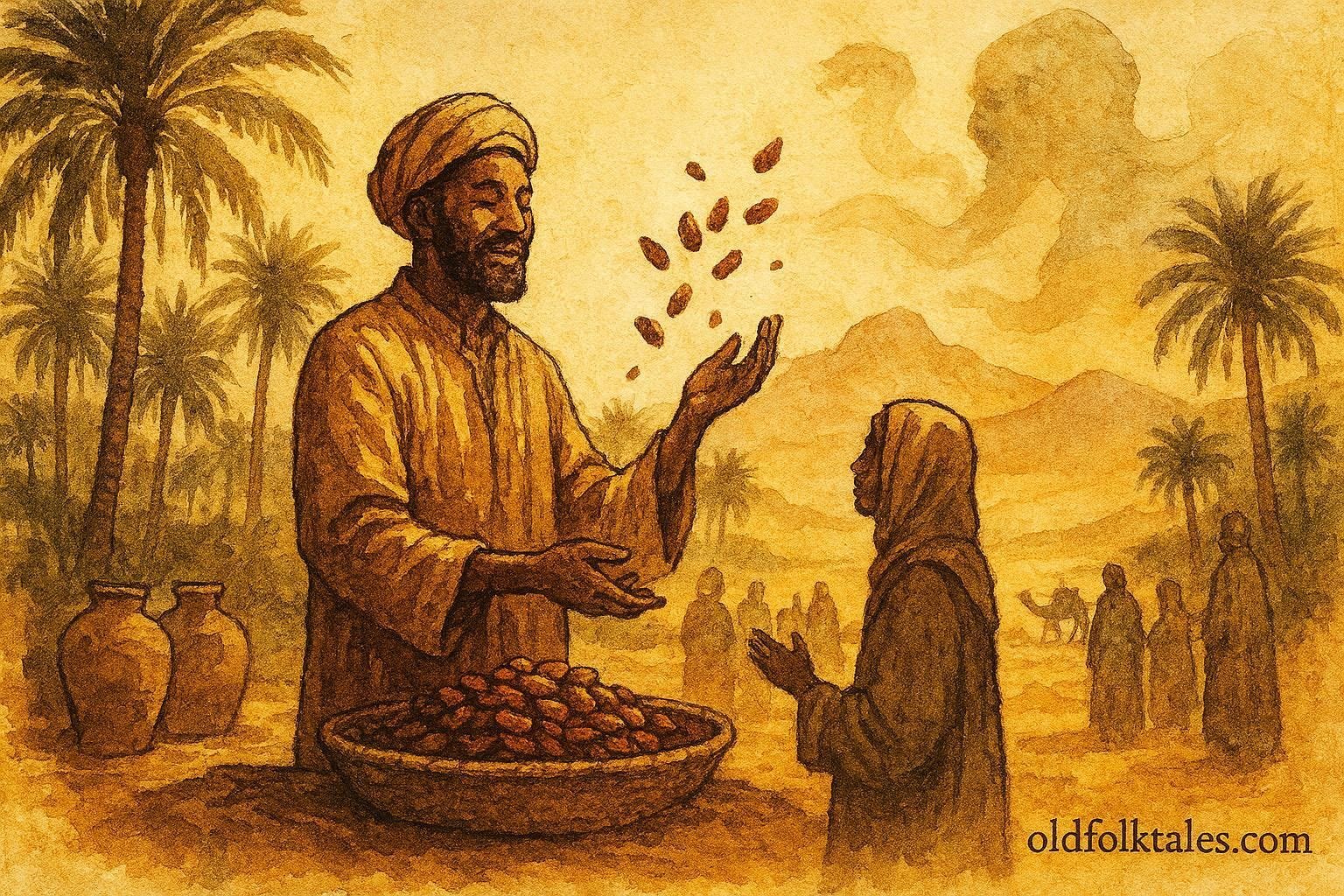
The next morning, he went to the edge of his storage rooms and opened the doors.
Inside were more dates than he could ever consume.
More than he could ever trade in time.
More than he could ever use alone.
He stood there for a long moment.
Then he made a decision.
He gathered the surplus.
And he went into the valley.
At first, he gave quietly.
To an old family struggling to feed their children.
Then another.
Then another.
Word spread quickly, not of his wealth, but of his generosity.
People were surprised.
Some were cautious.
Some were moved.
The valley, long starved of relief, began to feel something unfamiliar again.
Hope.
The Return of the Djinn
That night, as the merchant returned home, the air in his courtyard shifted.
He stopped.
He knew before he saw it.
The djinn had returned.
It stood where shadow met moonlight, its form less stable than before, but no less powerful.
“You broke the condition,” it said.
The merchant did not deny it.
“Yes,” he replied.
A long silence followed.
The djinn studied him.
“You chose them,” it said.
The merchant nodded.
“I chose people,” he said.
The wind moved gently through the valley.
The djinn’s form flickered.
“You understand what that means,” it said.
“I do,” the merchant replied.
Another silence.
Then, slowly, the djinn’s presence softened, not in anger, but in recognition.
“You have undone what I gave you,” it said.
“Yes,” the merchant said.
The djinn remained still for a long moment.
Then it spoke one final time.
“Then you will return to what you were.”
And with that, it faded into the night.
What Remained
The merchant’s wealth diminished over time.
Not instantly.
But steadily.
His stores emptied.
His fortune unraveled.
His status faded back into memory.
Yet something else remained.
The valley remembered what he had done.
The families he helped survived the famine.
The children he fed grew strong again.
And the merchant, though no longer wealthy, was no longer alone.
He had lost abundance.
But he had regained belonging.
Fascinated by this tale? Discover more North African folktales
Moral Lesson
Wealth that demands isolation strips away humanity. True prosperity is not measured by what one keeps alone, but by what one is willing to share when others are in need.
Knowledge Check
- What is the main lesson of “The Date Merchant and the Djinn of the Draa Valley”?
The story teaches that generosity and community responsibility are more valuable than isolated wealth. - Why did the djinn’s wealth come with a condition?
The djinn required the merchant not to share his wealth, testing his moral integrity and isolation under abundance. - What caused the merchant to break the condition?
A severe famine in the Draa Valley forced him to choose between obedience to the djinn and helping his starving community. - What does the djinn symbolize in the folktale?
The djinn represents temptation, conditional power, and the moral consequences of supernatural bargains. - How did the village respond to the merchant’s generosity?
The village benefited from his aid, surviving the famine and regaining hope through shared resources. - What cultural values are reflected in this Moroccan folktale?
The story emphasizes generosity, communal survival, moral duty, and the importance of sharing wealth in times of hardship.
Source: African folktale, Morocco. Inspired by Moroccan oral storytelling traditions recorded in Tales of the Draa Valley by Hassan Aourid (2005).
Cultural Origin: Southern Draa Valley, Morocco