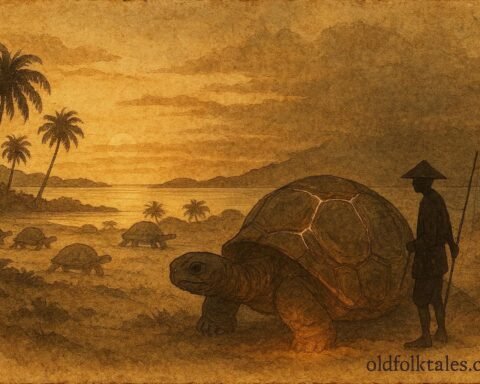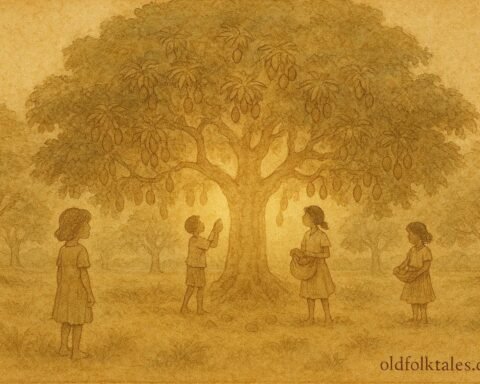
Deep within the lush, ancient forests of Praslin in the Seychelles, where towering palms sway slowly under humid island winds and sunlight filters through dense green canopies in shifting patterns, there is a grove unlike any other. It is the home of the coco-de-mer palm, one of the rarest and most mysterious trees in the world.
Among the people of the islands, especially in Creole oral tradition passed down through generations, the coco-de-mer is not seen as an ordinary plant. It is sacred. Its enormous double-lobed seeds, shaped in ways that seem almost human, have long inspired awe, respect, and caution. Because of this, the grove where these palms grow is believed to be protected, not only by law or tradition, but by something far older and unseen.
If you enjoyed this story, explore our full West African folktales collection
The villagers speak of a guardian spirit.
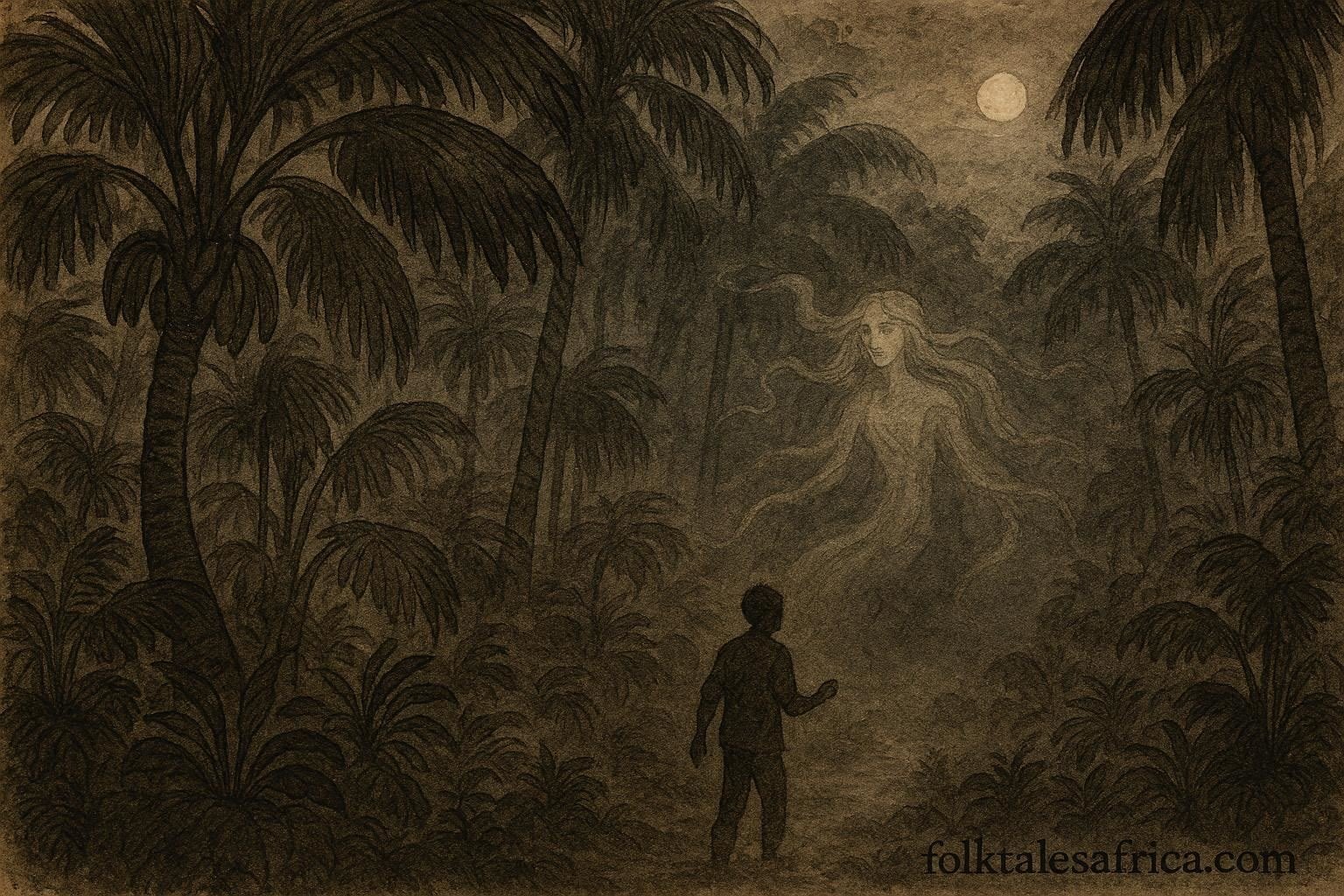
They do not give it a human name, nor do they describe it in complete physical form. Instead, it is understood as a presence, silent, watchful, and deeply connected to the forest itself. It is the Guardian of the Coco-de-Mer Grove.
According to oral folklore recorded from Praslin elders, this guardian has always existed alongside the trees. It is not something that arrived at a specific time, nor something that can be traced to a single origin. Rather, it is believed to be part of the grove itself, like the wind among the leaves or the roots beneath the soil.
Its purpose is simple, yet absolute: to protect the sacred palms from harm and ensure that they are not taken through greed or disrespect.
The coco-de-mer trees grow slowly, over decades, and their seeds are rare and valuable. Because of this, they have long attracted attention, not only from those who appreciate their natural wonder, but also from those tempted by their rarity. In earlier times, before stronger protections existed, some would attempt to harvest the nuts secretly at night, believing they could escape unnoticed into the darkness of the forest.
But the stories say otherwise.
Those who try to take the coco-de-mer without permission are said to encounter something unusual as soon as they step into the grove after sunset. The forest, which during the day feels familiar and navigable, begins to change. Paths that were clear become confusing. Trees that once marked direction seem identical. The sense of distance becomes unreliable.
Soon, the intruders realize they are no longer walking forward.
They are walking in circles.
No matter how far they move, or how carefully they try to retrace their steps, they always return to the same place, the grove of the coco-de-mer palms.
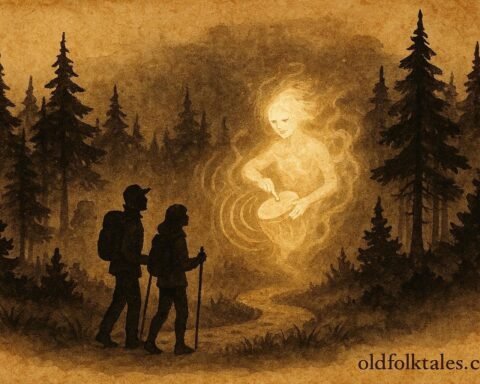
It is at this point that the presence of the guardian is felt most strongly.
Not seen directly, but experienced.
A silence falls over the forest that is deeper than ordinary night. The usual sounds of insects and wind seem to fade, leaving only the awareness of being watched. Some describe it as a pressure in the air, others as a feeling of being gently but firmly turned back, as though the forest itself refuses to allow further passage.
The guardian does not harm those who enter.
Instead, it corrects them.
The wandering continues until the intruders abandon their intent. Only when they let go of the desire to take what is not theirs do they begin to find their way again. Paths slowly realign. Familiar landmarks reappear. And eventually, they return to where they started, not injured, not punished, but changed.
Often, they find that the coco-de-mer nuts they attempted to take are no longer in their possession, as if the forest itself has reclaimed them.
The elders of Praslin do not describe this as magic in the theatrical sense. Instead, they speak of balance. The guardian represents the principle that nature is not passive. It responds to human intention, especially when that intention is driven by greed or disregard for sacredness.
Within Seychellois Creole tradition, shaped by Malagasy and East African spiritual understandings of nature, forests are often seen as living spaces with memory and awareness. Trees are not merely resources, but part of a larger spiritual ecosystem. The coco-de-mer grove, in particular, is treated with exceptional respect because of its rarity and its deep connection to island identity.
The guardian spirit is therefore not simply a story meant to frighten. It is a cultural expression of ecological respect. It teaches that certain parts of nature are not meant for uncontrolled use, and that there are consequences, sometimes subtle, sometimes profound, for ignoring that balance.
There is a well-known account often told among island communities to illustrate this belief.
A man, driven by curiosity and the hope of profit, once entered the forest at night intending to collect coco-de-mer nuts. He had heard the warnings, but dismissed them as superstition. Carrying only a small light, he believed he could move quietly through the grove and leave before anyone noticed.
At first, everything seemed normal. The forest was still, and the path he followed appeared clear. But as he moved deeper, the trees began to look identical. Landmarks that should have guided him forward no longer made sense.
He tried to turn back, but the direction felt wrong.
He walked faster, then slower, then stopped completely. Yet no matter what he did, he found himself returning again and again to the same cluster of coco-de-mer palms.
Hours passed. Then more.
Eventually, exhaustion set in, not only in his body but in his mind. The forest no longer felt like a place he could leave. It felt like a boundary he could not cross.
In the quiet that followed, he understood something he had not considered before, that the grove was not simply resisting him. It was holding him until his intention changed.
When dawn approached, something within him shifted. The desire to take faded, replaced by a growing sense of respect for the place he had entered without understanding. Only then did the forest release him.
He found the path home easily after that.
When he returned to his village, he did not bring coco-de-mer seeds. Instead, he brought a story.
And from that story, another generation learned caution.
Over time, the Guardian of the Coco-de-Mer Grove became more than a tale of punishment. It became a reminder of ecological responsibility. The forest was not a space for exploitation, but a living system that required respect. The coco-de-mer palms, rare and slow-growing, came to symbolize the fragile balance between human desire and environmental preservation.
Even in modern times, when conservation laws protect the groves and scientific understanding explains much about the forest, the legend still persists. It survives not because people reject science, but because stories carry meaning that facts alone cannot fully express.
In Praslin, the grove is still treated with quiet reverence. Visitors walk more carefully. Voices are softened. And even those who do not fully believe in spirits often admit that the forest feels different at night, more aware, more present, more alive than expected.
The guardian, whether understood as spirit, symbol, or memory, continues to serve its purpose.
It protects what is rare.
It corrects what is greedy.
And it reminds all who enter that nature does not exist to be taken without thought.
It exists to be respected.
Continue your journey: Read more East African folktales
Moral Lesson
Nature must be approached with respect and restraint. Greed and exploitation disrupt balance, while humility and awareness ensure harmony between humans and the environment.
Knowledge Check
- What is the Guardian of the Coco-de-Mer Grove?
It is a silent spirit believed to protect the sacred coco-de-mer palms in Praslin, Seychelles. - Where is the coco-de-mer grove located?
It is located in the forests of Praslin Island in the Seychelles. - What happens to those who try to steal the coco-de-mer nuts?
They become disoriented and wander in circles until they abandon their greed. - What does the guardian represent in the story?
It represents nature’s protection, balance, and resistance to exploitation. - How do the villagers view the coco-de-mer trees?
They see them as sacred and deserving of respect and protection. - What is the main lesson of the folktale?
It teaches ecological respect and warns against greed and environmental exploitation.
Source: Seychellois oral folklore compiled in regional ethnographic storytelling collections (late 1990s archival recordings of Praslin elders).
Cultural Origin: Seychelles (Praslin Island), Creole oral tradition influenced by Malagasy and East African spiritual nature beliefs.
Year of Documentation: 1998 (oral history folklore compilation archives)