Across the sweeping plains of the Somali lands, where herds move like drifting clouds and the horizon stretches without end, animals lived much like the people who told their stories, guided by survival, cooperation, and the quiet rules of balance.
In those lands, hunting alone was often dangerous. Prey was swift, the terrain unforgiving, and failure meant hunger. So, when the dry season tightened its grip and food became scarce, a group of animals came together with a shared idea:
Want more? Read more West African folktales now
They would hunt as one.
An Agreement in the Wild
The animals gathered beneath the sparse shade of an acacia tree. The air was dry, the ground cracked, and every creature present felt the same urgency.
There was the lion, strong, confident, and feared. There were others too: smaller hunters, each with their own skill, some swift, some clever, some patient.
It was the lion who spoke first.
“If we hunt together,” he said, his voice steady and commanding, “we will succeed where alone we may fail.”
The others listened.
His words made sense. Alone, each faced risk. Together, they could bring down prey too large for any single one of them.
“And when we succeed,” another animal asked carefully, “how will we share what we catch?”
There was a pause.
Then the lion replied, “We will share it.”
It was a simple answer. Clear. Reassuring enough.
The others nodded.
They did not press further.
The Hunt Begins
The group set out across the plains. The sun rose high, casting long waves of heat across the land. Dust clung to their fur and feathers as they moved in quiet coordination.
Each animal played its part.
Some flushed prey from hiding. Others circled wide, cutting off escape routes. The lion stayed poised, conserving his strength for the final moment.
After hours of effort, they found what they sought, a large, strong animal grazing alone, unaware of what approached.
The hunt unfolded with precision.
The smaller animals drove the prey forward. The swift ones closed in from the sides. And when the moment came, the lion leapt.
His strength ended the struggle.
The prey fell.
For a moment, there was silence.
Then relief.
They had succeeded.
The Gathering Around the Prize
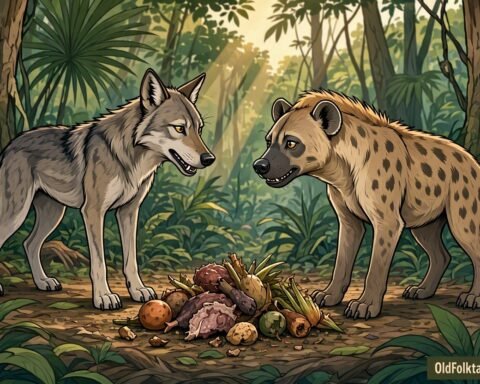
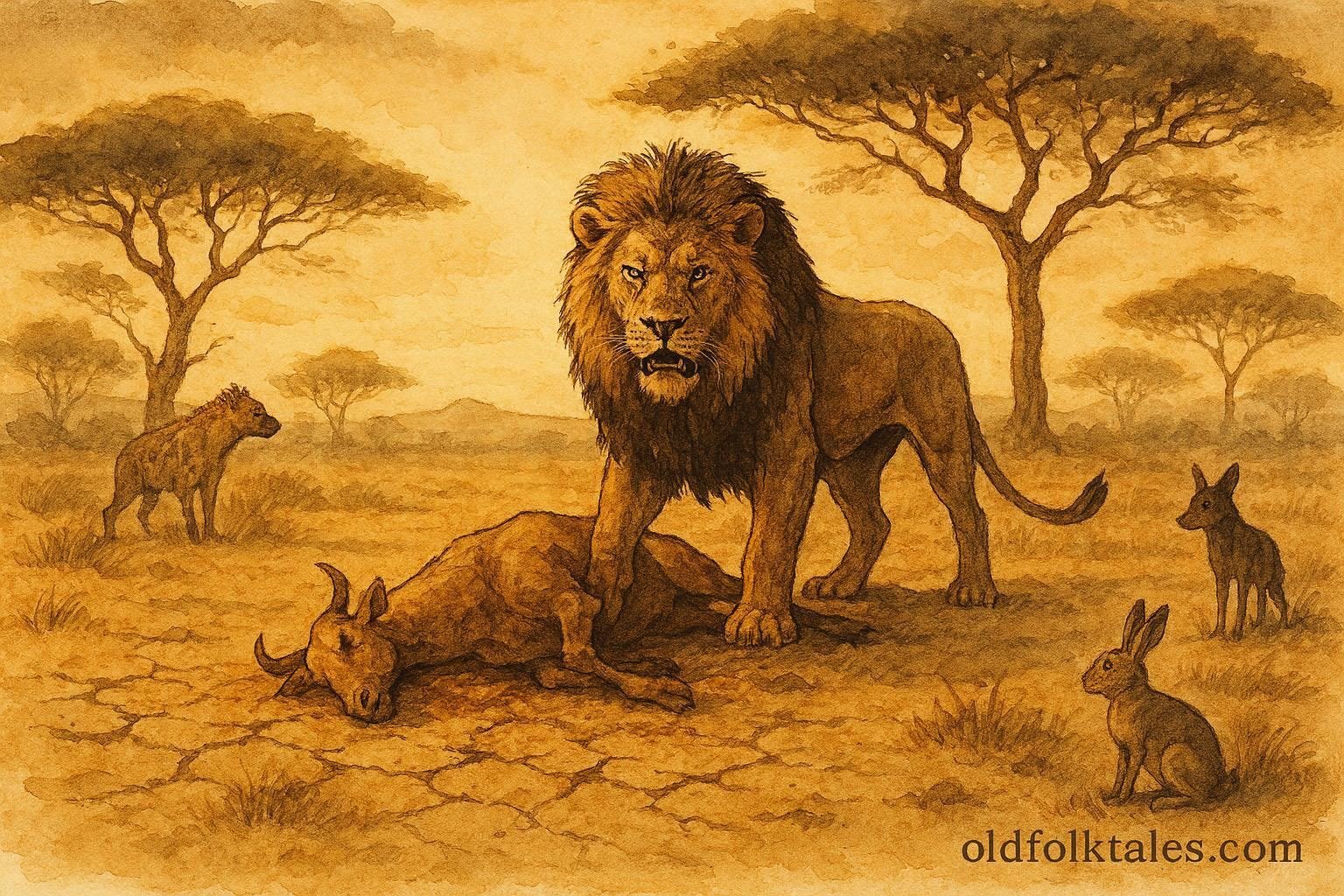
The animals gathered around the fallen prey, their bodies tired but their spirits lifted. Hunger sharpened their senses. The scent of fresh meat filled the air.
This was the moment they had worked for.
This was what they would share.
The lion stepped forward.
His presence shifted the mood immediately. The others instinctively made space for him. It was not a spoken rule, but one understood.
He looked at the prey, then at the others.
“Now,” he said, “we divide what we have earned.”
The animals watched closely.
The First Claim
“The first portion,” the lion declared, “belongs to me.”
No one spoke.
He continued, “I am the strongest. Without my power, the prey would not have fallen.”
There was truth in his words.
So, the others nodded.
It seemed fair.
The Second Claim
“The second portion,” the lion went on, “also belongs to me.”
A ripple of unease passed through the group.
“This,” he explained, “is because I am your leader. It was my idea that brought us together.”
Some shifted slightly, exchanging glances.
Again, there was truth, but something felt different now.
Still, no one objected.
The Third Claim
“The third portion,” said the lion, his voice firmer now, “is mine as well.”
This time, the silence was heavier.
“And why?” one animal asked, unable to hold back.
The lion’s gaze turned sharp.
“Because I took the greatest risk,” he replied. “I faced the prey directly.”
The question faded into the air.
No one challenged him further.
The Final Claim
The lion stepped even closer to the prey.
“What remains,” he said, “is also mine.”
Now, the stillness broke.
“But…” one of the animals began, voice uncertain, “we all hunted. We all worked,”
The lion turned slowly.
His eyes held no warmth now, only authority.
“If any among you believes they deserve a share,” he said quietly, “step forward and take it.”
No one moved.
The meaning was clear.
This was no longer about fairness.
It was about power.
Silence and Understanding
The animals stood frozen.
Hunger pulled at them, but fear held them in place.
They looked at the lion, at his strength, his position, his certainty, and understood what had changed.
The agreement they had made beneath the tree had not been equal.
It had only seemed that way.
One by one, the animals stepped back.
No words were spoken.
They turned and left, their efforts unrewarded, their trust broken.
Behind them, the lion remained.
Alone with the prey.
Aftermath in the Plains
The story of that hunt spread quickly across the land.
Animals spoke of it in low tones, sharing what had happened and what it meant.
Some spoke of the lion’s strength.
Others spoke of his greed.
But most spoke of the lesson.
Cooperation without fairness does not last.
Leadership without justice breeds silence, not respect.
And silence, born of fear, carries its own kind of truth.
The next time hunger came, the animals did not gather so easily.
They remembered.
Continue your journey: Read more East African folktales
Moral Lesson
Power without fairness leads to injustice. True leadership requires balance, respect, and the willingness to share what is earned together.
Knowledge Check
- What is “The Lion’s Share” in this Somali folktale?
It refers to the lion taking all the food after a group hunt, using power and intimidation. - Why did the animals agree to hunt together?
They cooperated to increase their chances of success during a time of scarcity. - How did the lion justify taking everything?
He claimed strength, leadership, and risk as reasons for taking each portion. - What theme does the story highlight about leadership?
It shows how power can corrupt fairness when leaders act selfishly. - Why didn’t the other animals resist the lion?
They feared his strength and authority, which prevented them from challenging him. - What lesson does this folktale teach?
It teaches that cooperation must be built on fairness, or it will fail.
Source: African folktale, Somalia.
Adapted from oral poetry and Somali folklore traditions (1964).
Cultural Origin: Somali nomadic storytelling tradition