Long before silence settled over the old trading routes of the western savannah, the city of Begho stood as one of the busiest places in the region. Merchants arrived from distant lands carrying salt, cloth, leather, beads, kola nuts, and gold. The roads leading into the city were rarely empty. Travelers moved in long caravans beneath the heat of the sun, while traders filled the crowded markets with voices from many different cultures and kingdoms. Every day brought movement, negotiation, celebration, and news from places far beyond the horizon.
Begho was more than a city of trade.
It was a place where memory lived through sound.
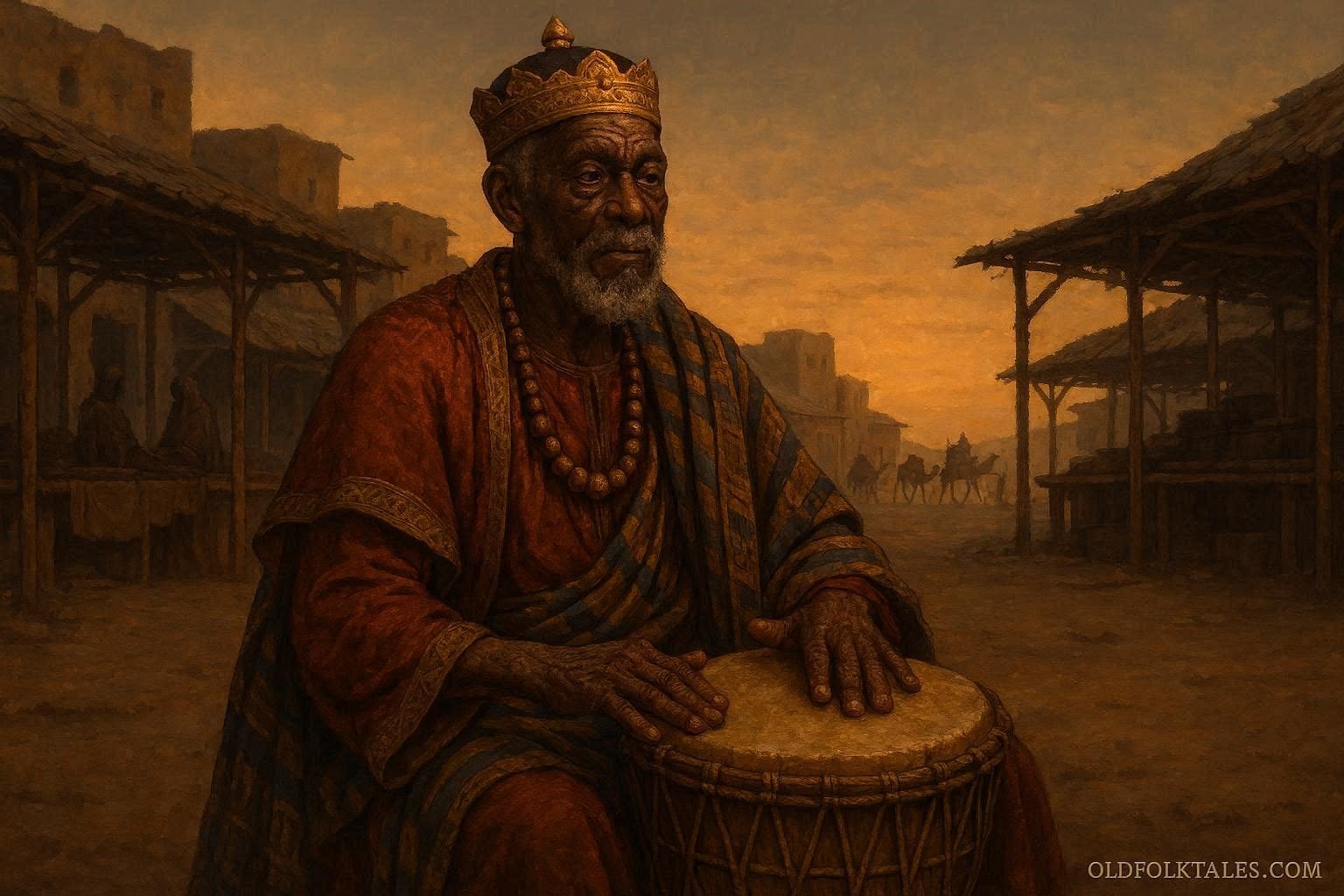
The royal court maintained historians, praise singers, and drummers whose duty was to preserve the stories of rulers, battles, agreements, migrations, and sacred traditions. Among them, none carried greater responsibility than the royal drummer. His drum was not merely an instrument for entertainment. It was a living archive. Each rhythm held meaning understood by the people of the court. Certain drum patterns announced victory, others mourned death, and some carried warnings that could travel farther than any messenger on foot.
For many years, the royal drummer of Begho was a man named Kwadwo.
Age had curved his back and slowed his steps, but his hands still carried remarkable precision whenever they touched the drumskin. People often said that Kwadwo remembered stories older than some villages themselves. Children gathered around him during festivals to hear tales of great journeys and ancient kings. Elders respected him because he carried knowledge that could not be found in written form.
But while the stories of the past remained strong inside Kwadwo’s memory, the city around him was beginning to weaken.
Fascinated by this tale? Discover more North African folktales
The first signs appeared gradually.
Trade routes became less secure. Conflicts between neighboring powers interrupted movement between regions. Some merchants stopped arriving entirely. Markets that once overflowed with goods began to thin. Families whispered concerns about shortages and uncertainty. The energy that had once defined Begho slowly began to fade.
Then came division within the leadership.
Arguments grew among influential families and court officials. Some blamed outside enemies. Others accused rival traders of disrupting the city’s prosperity. Distrust spread through the royal court like dry grass catching fire. Decisions became slower. Alliances weakened.
Kwadwo watched all of this quietly.
Each evening he sat beside the royal courtyard with his drum resting near him, listening carefully to conversations carried through the air. He understood something many others ignored. A city does not collapse all at once. It weakens slowly through fear, division, and forgotten responsibilities.
One evening, the chief summoned the court musicians.
The atmosphere inside the palace felt heavy. Torches burned low against the walls while advisors argued in tense voices. The chief looked exhausted.
“The people are afraid,” he admitted. “The city is changing.”
No one answered immediately.
Finally, the chief turned toward Kwadwo.
“You have seen more years than most of us,” he said. “Tell me what remains when a city begins to disappear.”
Kwadwo remained silent for a moment before speaking.
“Memory,” he replied quietly. “When wealth disappears, memory remains. When buildings fall, memory remains. If the people forget who they are, then the city truly dies.”
The room fell silent.
From that night onward, Kwadwo became increasingly determined to preserve the stories of Begho before they vanished forever.
He began traveling through different parts of the city, speaking with elders, traders, hunters, and craftsmen. He listened carefully as they shared accounts of migrations, old alliances, sacred customs, and forgotten conflicts. At night, he transformed these stories into drum rhythms and oral recitations, repeating them until they settled firmly into memory.
Some younger people questioned his efforts.
“What use are old stories when the city is struggling?” they asked.
Kwadwo answered patiently.
“A people who lose their memory become strangers to themselves.”
As conditions worsened, more families began leaving Begho. Some traveled south toward forest regions. Others joined distant trading settlements. Homes once filled with activity became abandoned. Market stalls stood empty beneath layers of dust.
Still, Kwadwo continued his work.
During one particularly difficult season, a fire spread through part of the market district, destroying valuable goods and several important meeting places. Panic moved through the city. Rumors spread that Begho had been cursed.
That night, Kwadwo carried his drum to the center of the city.
People gathered slowly around him beneath the dark sky. Fear and exhaustion could be seen on their faces.
Without speaking, Kwadwo began to play.
The rhythms moved steadily across the open space, deep and deliberate. Older listeners immediately recognized the patterns. They were ancient drum messages connected to endurance, migration, and survival. The rhythms reminded the people that their ancestors had survived wars, famine, displacement, and hardship long before Begho itself existed.
As the drumming continued, silence spread through the crowd.
Some elders lowered their heads in reflection. Others quietly repeated old proverbs connected to the rhythms. Younger listeners heard stories they had never fully understood before.
For the first time in many months, the people felt connected again.
Not through wealth or trade.
But through shared memory.
Years passed, and the decline of Begho continued. Eventually, much of the city emptied as trade networks shifted elsewhere. The great markets no longer carried the same influence they once held.
Kwadwo himself grew weaker with age.
Yet even in his final years, he refused to abandon the drum.
One morning, a group of children found him seated beneath a large tree near the old court grounds. His drum rested quietly beside him.
He looked toward the distant road where traders once arrived in endless numbers.
“The city may fade,” he told the children softly, “but your memory must not fade with it.”
He asked them to sit beside him one last time.
Slowly, he taught them the rhythms connected to the history of Begho. He explained the meanings behind each pattern and the stories carried within them. The children listened carefully, repeating the rhythms until they learned them correctly.
By sunset, the lessons were complete.
Not long afterward, Kwadwo died peacefully.
But his drum rhythms survived.
Long after Begho declined into memory, travelers and descendants carried fragments of those rhythms into new communities across the region. The stories of the old trading city continued through oral tradition, passed from generation to generation by those who understood the importance of remembering where they came from.
And though the markets of Begho eventually disappeared, its memory continued to live wherever the old rhythms were heard.
If you enjoyed this story, explore our full West African folktales collection
Moral Lesson
A people who preserve their history preserve their identity, even when everything else is lost.
Knowledge Check
- What was Begho known for?
Begho was known as a major trading city in West Africa. - Who was Kwadwo?
Kwadwo was the final royal drummer of Begho. - Why was the royal drum important?
The drum preserved history, messages, and traditions through rhythms. - What problems affected Begho?
Trade decline, political division, and social instability weakened the city. - What did Kwadwo fear most?
He feared the people would forget their history and identity. - How did Kwadwo preserve Begho’s memory?
He taught stories and drum rhythms to the younger generation.
Source
Ghanaian historical folklore. Adapted from oral histories surrounding ancient Begho trade settlements in West African historical archives.