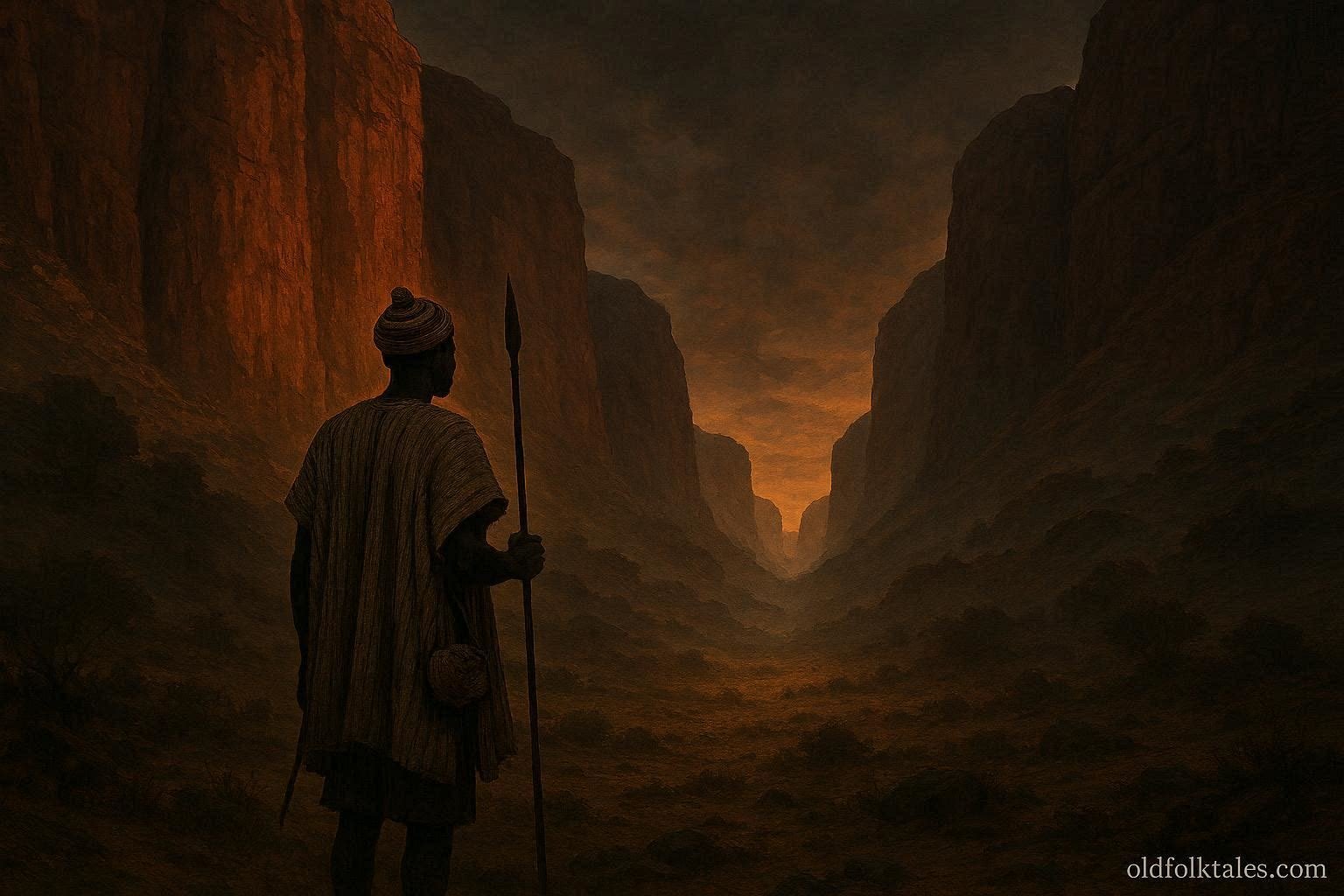
For generations, the people living near the Red Cliff Hills spoke carefully about the high rocky land beyond their farms and hunting paths. The cliffs rose sharply above the dry grasslands of northern Ghana, glowing deep red whenever the evening sun touched the stone. Travelers passing through the region often admired the beauty of the hills from a distance, but the local people treated the place with caution and respect.
The elders believed the hills carried ancient spiritual power.
Hunters were forbidden from entering the inner valleys hidden between the cliffs. According to old tradition, those sacred areas belonged to unseen forces connected to the ancestors of the land. Hunting animals there was considered a serious offense. Even gathering wood from the forbidden valleys was discouraged.
For many years, the taboo remained unquestioned.
The older hunters taught younger generations to avoid the inner hills completely. Whenever hunting groups approached the region, they stopped before crossing certain stone markers placed along the path. Offerings were sometimes left beside these markers as signs of respect.
Love this story? Discover our full Southern African folktales collection
Among all the hunters of the region, none was more admired than a man named Jantana.
Jantana was known for his remarkable skill and courage. He tracked antelope through difficult terrain, survived dangerous encounters with wild animals, and rarely returned from the forest empty handed. His name carried respect throughout nearby villages. Young boys hoped to become hunters like him one day.
But admiration slowly changed Jantana.
Years of praise filled him with growing pride. He began believing there was no place he could not enter and no danger he could not overcome. While other hunters respected the old warnings about the Red Cliff Hills, Jantana quietly dismissed them as stories meant to frighten inexperienced men.
“The hills are only stone and trees,” he once told a group of younger hunters. “Fear exists inside people, not inside the land.”
Some elders overheard his words and became troubled.
One evening, an elderly hunter named Wuro spoke privately with Jantana beside a fire.
“You are skilled,” Wuro admitted, “but skill does not make a man greater than tradition.”
Jantana smiled politely but remained unconvinced.
“Have you ever entered the forbidden valley yourself?” he asked.
Wuro immediately shook his head.
“That is exactly why I still live in peace.”
Jantana laughed softly.
To him, the warnings sounded like the fears of old men who no longer understood courage.
The dry season arrived several weeks later, bringing difficult hunting conditions across the region. Animals became harder to track as water sources shrank beneath the heat. Hunters traveled farther than usual searching for game.
One morning, Jantana discovered unusual tracks near the outer hills.
The prints belonged to a large antelope unlike any he had seen before. The tracks moved toward the forbidden valleys beyond the stone markers. Jantana paused briefly, staring at the path ahead.
He remembered the warnings.
But pride quickly silenced caution.
“This is my chance,” he thought. “No hunter has ever returned with prey from the inner hills.”
Ignoring tradition, Jantana crossed the stone boundary.
The atmosphere changed almost immediately.
The air inside the valley felt strangely still. Even the sounds of birds seemed distant. Tall grass moved gently in the wind, but the silence beneath the cliffs carried an unsettling weight. Jantana continued forward carefully with his spear and hunting bag.
As he followed the tracks deeper into the valley, he noticed something unusual.
There were no signs of ordinary animal movement.
No birds feeding on the ground.
No monkeys in the trees.
No insects humming through the grass.
The valley felt empty in a way that unsettled him, though he refused to admit fear to himself.
Hours passed.
At last, Jantana spotted the antelope standing near a rocky ledge beneath the cliffs. Its coat shimmered strangely beneath the sunlight, almost glowing against the red stone. The animal stood perfectly still, watching him.
Jantana raised his spear.
But before he could throw it, the antelope turned and disappeared behind the rocks with unnatural speed.
Determined not to lose it, Jantana followed.
As he rounded the cliff edge, he suddenly realized the animal had vanished completely.
There was nowhere it could have gone.
Confusion spread through him.
Then he heard drumming.
Faint at first.
Slow and distant.
Jantana froze.
The sound did not resemble festival drumming or village music. The rhythm felt older and heavier, echoing through the cliffs like something buried beneath the earth itself.
He turned quickly, searching for the source.
But the valley remained empty.
The drumming grew louder.
Panic slowly replaced his confidence.
Jantana attempted to retrace his steps, but the paths no longer appeared familiar. Every direction seemed identical beneath the towering cliffs. The sunlight itself appeared dimmer inside the valley.
As evening approached, strange whispers drifted through the wind.
Some sounded like voices.
Others resembled distant chanting.
Jantana’s heartbeat quickened.
For the first time in many years, the great hunter felt true fear.
Night fell rapidly across the hills.
Back in the village, concern spread when Jantana failed to return. Hunting trips could sometimes last longer than expected, but experienced hunters rarely remained out overnight without explanation.
The elders already suspected where he had gone.
Wuro sat silently near the fire, staring toward the dark outline of the Red Cliff Hills.
“He crossed the boundary,” he said quietly.
The following morning, several hunters organized a search party. Though reluctant, they followed Jantana’s tracks toward the forbidden valley.
At the stone markers, the tracks clearly continued inward.
But beyond that point, confusion began.
The footprints suddenly disappeared.
There were no signs of struggle.
No broken vegetation.
No blood.
Nothing.
The search party refused to continue deeper into the valley. Fear and tradition held them back. Instead, they called out Jantana’s name from a distance.
Only silence answered.
Days passed without any sign of him.
Eventually, the elders declared that the spirits of the hills had claimed the hunter for violating the ancient taboo. The story spread quickly through nearby villages. Many people mourned Jantana because he had once been respected and admired.
Wuro spoke during a gathering several weeks later.
“Strength without respect becomes destruction,” he warned the younger hunters. “Some boundaries exist for reasons older than ourselves.”
From that time onward, the story of Jantana became part of Gonja oral tradition. Hunters approaching the Red Cliff Hills repeated his story to younger generations before entering the wilderness. The forbidden valleys remained untouched, and the stone boundary markers continued to stand beneath the cliffs.
Even years later, travelers sometimes claimed they heard distant drumming echoing through the hills at sunset.
And according to the elders, whenever the wind carried those rhythms across the grasslands, the spirits were reminding people that pride can lead even the strongest person into danger.
Click here to discover more legendary tales from West Africa
Moral Lesson
Ignoring wisdom and tradition out of pride can lead to irreversible consequences.
Knowledge Check
- What were the Red Cliff Hills known for?
The hills were believed to contain sacred valleys protected by spiritual forces. - Who was Jantana?
Jantana was a respected hunter known for his courage and skill. - Why did the elders warn hunters about the inner valleys?
The valleys were considered spiritually protected and forbidden for hunting. - What caused Jantana to enter the forbidden area?
His pride and desire to prove himself pushed him to ignore tradition. - What strange things happened inside the valley?
Jantana heard mysterious drumming and became lost in the silent valley. - What lesson did the villagers learn from Jantana’s disappearance?
They learned that respecting tradition and sacred boundaries is important.
Source
Ghanaian folklore. Adapted from Gonja oral traditions preserved in Northern Ghana folklore archives.