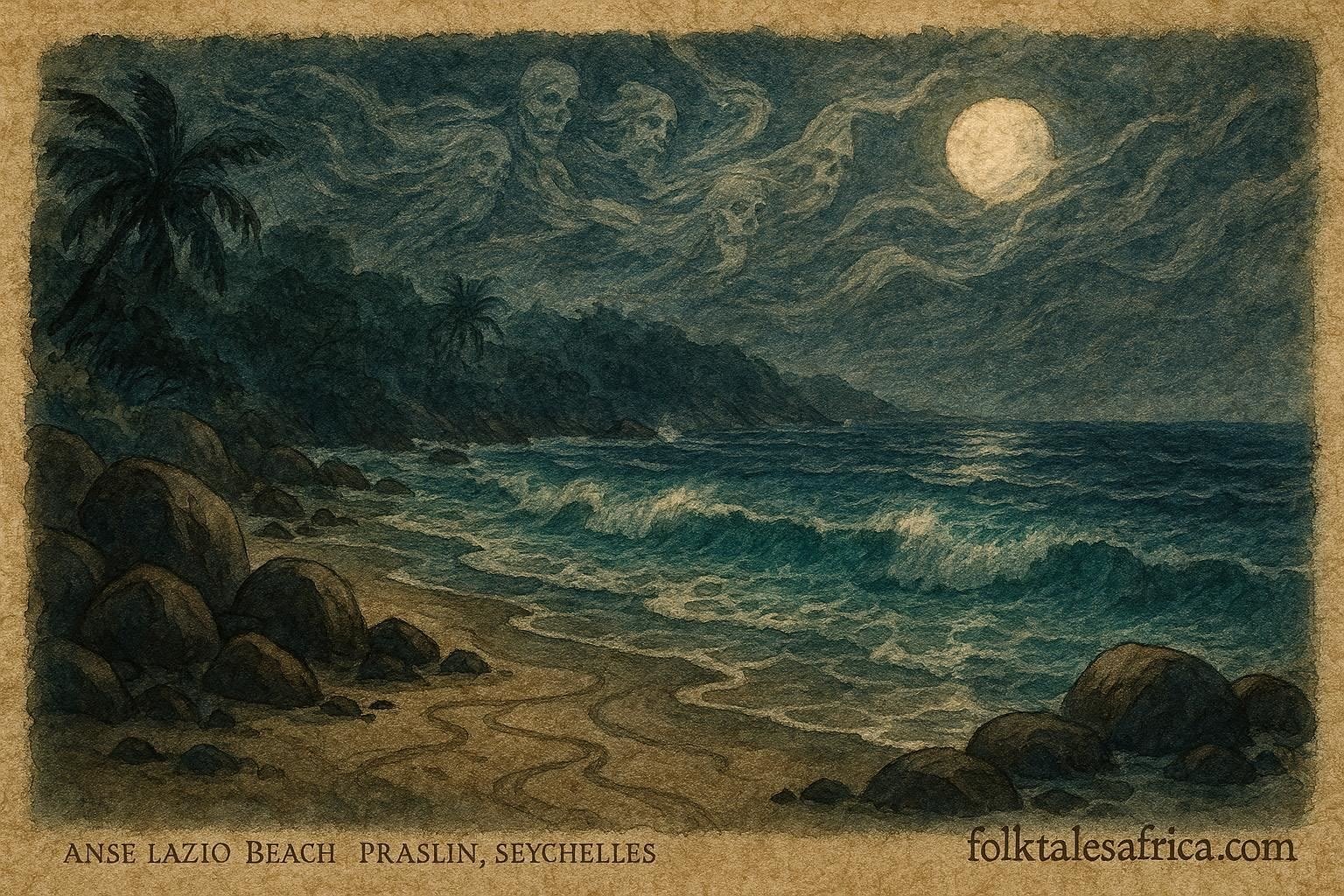
On the western shore of Praslin in the Seychelles lies Anse Lazio, a beach often described as one of the most beautiful in the Indian Ocean. Its soft white sand curves gently between granite boulders, and clear turquoise waters roll in with a calm rhythm that seems almost peaceful enough to erase all memory of danger or history.
But beneath that beauty, locals say, the sea remembers.
Want more? Read more West African folktales now
And sometimes, it speaks.
Among fishermen and coastal communities, there is an old maritime tale passed down through generations, a story of pirates, buried treasure, and whispers carried by the wind. It is called the Pirate’s Whisper of Anse Lazio.
Long ago, during the height of Indian Ocean piracy, when ships passed through these waters carrying spices, gold, and goods from distant lands, it is said that some pirates used hidden coves along the Seychelles islands to bury their stolen treasures. Praslin, with its secluded beaches and dense inland forests, became one of those rumored hiding places.
Over time, the pirates disappeared, but the stories of their buried gold did not.
Instead, something else remained.
On certain nights, especially when the wind moves strongly across Anse Lazio and the waves crash harder against the shore, locals claim you can hear voices carried through the air. These are not clear voices, nor are they loud. They are whispers, fragmented, faint, and always just out of reach of understanding.
At first, they sound like the wind passing through rocks or the distant rustling of palms. But for those who listen carefully, the whispers begin to form patterns. Words seem to emerge, directions, hints, fragments of instructions that suggest something is hidden nearby.
Treasure.
Gold.
Secrets buried beneath the sand or beyond the shoreline.
It is this illusion that has drawn many curious souls over the years.
The legend says that the whispers belong to the spirits of pirates who once hid their treasure along the coast. Bound by greed, regret, or unfinished business, they remain attached to the places where their wealth was buried. But instead of revealing the truth, they confuse those who seek it.
Because the treasure is not meant to be found.
Or so the story warns.
Those who follow the whispers too closely often find themselves walking in circles along the beach. Paths that should lead forward seem to bend back toward where they started. Familiar rocks appear unfamiliar. The shoreline shifts in ways that feel impossible when looked at in daylight.
Some believe this is simple confusion caused by wind and sound. Others insist it is something else entirely, a deliberate illusion created by the spirits of the pirates, who guard their hidden gold even in death.
The more someone searches, the stronger the whispers become.
But the clearer the illusion also grows.
There is a well-known story told among elders in Praslin to illustrate this phenomenon.
A young man, driven by stories of hidden pirate gold, once arrived at Anse Lazio during a particularly windy night. He had heard from others that treasure could be found if one listened carefully enough to the sea. Armed with nothing but determination and a belief in luck, he walked along the shore as darkness fell.
At first, there was nothing unusual. Only the sound of waves and wind.
Then, slowly, he began to hear it.
A faint whisper carried through the air.
At first, it sounded like nonsense. But as he continued walking, the words seemed to sharpen. He thought he heard directions, “follow the rocks,” “beyond the bend,” “beneath the sand.”
His heart quickened.
Convinced he was close, he followed the voice.
The beach, however, began to feel unfamiliar. Landmarks he had passed earlier seemed to reappear in different places. The ocean appeared closer, then farther, then closer again. Time itself felt uncertain.
Still, he continued.
The whispers grew stronger.
By the time exhaustion set in, he realized he had been walking for hours without reaching any clear destination. The treasure he imagined seemed both near and impossible at the same time.
When dawn finally arrived, the whispers faded.
And with daylight, everything became still again. The beach returned to its familiar shape. The rocks stood exactly where they always had. There was no sign of treasure, no hidden path, no secret entrance beneath the sand.
Only the memory of sound remained.
When he returned to the village, the elders listened quietly. They did not laugh at him. Instead, they nodded, as though they had expected his story.
“You heard them,” one of them said simply. “But you did not understand them.”
The lesson, they explained, was not about treasure at all.
It was about greed.
The Pirate’s Whisper is not believed to be a guide to wealth, but a reflection of human desire. It draws those who are already searching for more than they need, leading them into confusion shaped by their own expectations. The treasure they seek becomes less important than the act of seeking itself.
Within Seychellois Creole maritime tradition, influenced by African storytelling and the history of Indian Ocean piracy, the sea is often seen as a keeper of memory. It does not forget the actions of those who passed through it, whether traders, sailors, or pirates. And sometimes, memory becomes sound.
The whispers of Anse Lazio, then, are not just echoes of the past, but reflections of human ambition projected onto nature.
Over time, the story has become part of local identity. Fishermen and beachgoers treat it not as a literal map to treasure, but as a warning about illusion. It reminds people that not everything heard in moments of uncertainty is meant to be followed.
Even today, on especially windy nights when Anse Lazio is empty and the waves roll in under a dark sky, some claim to hear faint voices near the shore. Most ignore them. Some pause briefly, listening.
But very few follow.
Because those who know the story understand something important:
The sea may carry whispers of the past, but not all whispers are meant to be answers.
Don’t stop yet! See our complete East African folktales collection
Moral Lesson
Greed can distort perception and lead people into illusion. True wisdom lies in knowing when not to follow desire blindly, especially when it promises easy gain.
Knowledge Check
1. What are the Pirate’s Whispers at Anse Lazio?
They are mysterious sounds believed to be ghostly pirate voices luring treasure seekers.
2. Where is Anse Lazio located?
It is a famous beach on Praslin Island in the Seychelles.
3. What happens to people who follow the whispers?
They become lost in illusions and walk in circles without finding treasure.
4. What do the whispers represent in the story?
They represent greed, illusion, and human desire for hidden wealth.
5. What is the historical influence behind the legend?
It is influenced by Indian Ocean piracy history and Creole maritime folklore.
6. What is the main lesson of the folktale?
It teaches that greed can mislead perception and that not all desires should be followed.
Source: Seychellois maritime folklore collected from fishermen and coastal oral narratives, 1995 (maritime folklore oral archive collection).
Cultural Origin: Seychelles (Praslin Island maritime tradition), influenced by Indian Ocean piracy history and African storytelling traditions.