In the ancient kingdom of Old Calabar, there lived a wealthy man and his wife who had only one child, a daughter named Afiong. She was admired throughout the land for her extraordinary beauty. Her graceful manner, bright eyes, and elegant appearance made her the envy of many young women, while countless young men dreamed of winning her hand in marriage.
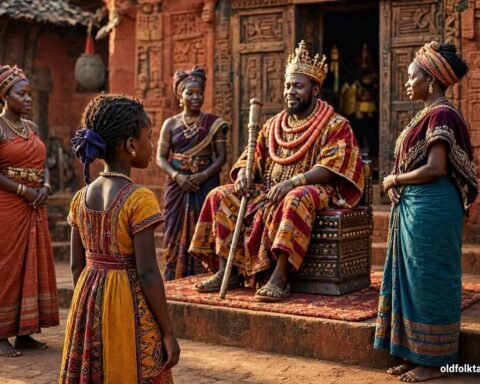
As Afiong grew older, news of her beauty spread far beyond her village. Suitors arrived from neighboring towns and distant settlements, each hoping to marry the young woman whose beauty had become the talk of the region. Some came from respected families, others were skilled hunters, successful farmers, wealthy traders, or brave warriors. Each brought gifts according to custom and approached her parents with respect.
Yet Afiong rejected them all.
No matter how kind, wealthy, or honorable a man appeared, she always found a reason to refuse him.
“This one is too short,” she would say.
“That one is too old.”
“Another is not handsome enough.”
Others, she believed, simply did not deserve someone as beautiful as herself.
Her parents listened patiently at first, believing that one day she would meet someone who pleased her. But as the years passed and more suitors were turned away, they became increasingly worried.
“My daughter,” her mother often said, “beauty alone does not make a happy marriage. A good heart and good character are far more valuable.”
Her father agreed.
“You cannot expect perfection in every person. One day you may reject the very blessing meant for you.”
Looking for more? Explore the magic of East African folktales here
But Afiong paid little attention to their advice.
She believed there must be a man somewhere whose appearance surpassed every other man in the land. She would marry no one until she found him.
One evening, after another group of disappointed suitors had left the family compound, Afiong quietly made a decision in her heart.
“I will wait,” she whispered to herself. “Only the most handsome man in the world is worthy of becoming my husband.”
Far away, beyond the villages and forests where ordinary people lived, mysterious spirits watched the affairs of humankind.
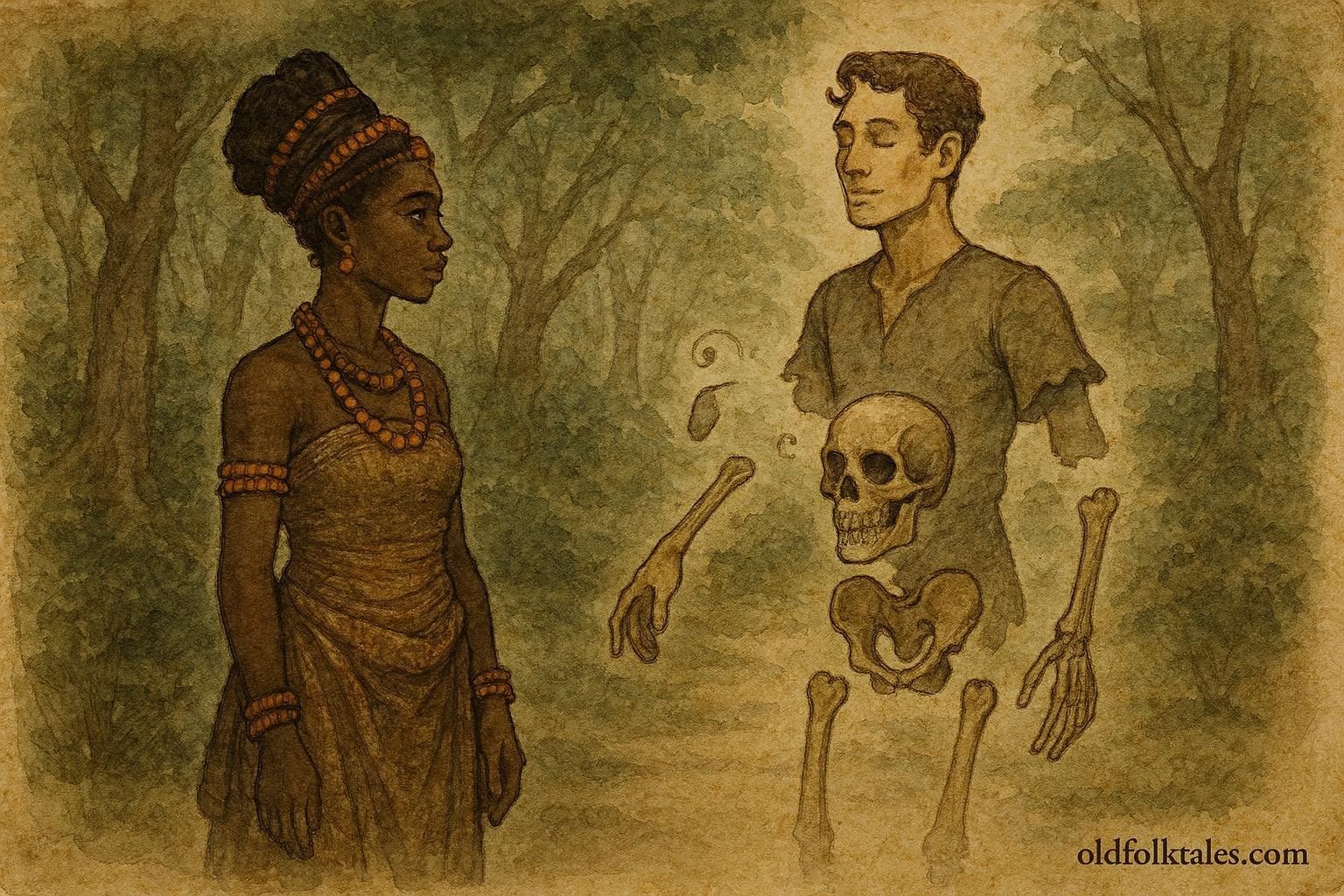
Among them was a skull that possessed neither flesh nor skin. Although it had no body of its own, it knew powerful magic.
When the skull heard people speaking of Afiong’s beauty and learned that she refused every suitor because none seemed handsome enough, it formed a dangerous plan.
Using its supernatural powers, the skull began borrowing different parts of the body from its spirit companions.
From one spirit it borrowed beautiful eyes.
From another it borrowed strong arms.
Another lent graceful legs.
Others gave it fine hair, smooth skin, shining teeth, and handsome features until it appeared to be the most striking young man anyone had ever seen.
No one looking at him could have imagined the terrible truth hidden beneath his borrowed appearance.
Dressed in magnificent clothing, the stranger set out for Afiong’s village.
When he arrived, people stopped their work just to admire him.
Women whispered among themselves.
Men wondered which great family he belonged to.
Children followed him through the village, amazed by his appearance.
When Afiong first saw the handsome stranger, she could scarcely believe her eyes.
“This,” she thought, “is the man I have been waiting for.”
For the first time in her life, she did not search for faults.
Instead, she smiled.
The stranger greeted her politely and spoke with great charm. Before long he asked for her hand in marriage.
Without hesitation, Afiong accepted.
Her parents, however, felt uneasy.
Although the stranger appeared perfect, no one knew his family or where he had come from.
Her father asked many questions.
“What village is your home?”
“Who are your parents?”
“Where are your relatives?”
The stranger answered every question so smoothly that even the elders found no reason to doubt him.
Still, Afiong’s parents remained troubled.
“My daughter,” her mother pleaded, “there is something unusual about this man. We know nothing of his people. Please wait before making such an important decision.”
But Afiong refused to listen.
“You warned me against rejecting good men,” she replied. “Now I have found the finest man in the land, yet you still object.”
Seeing that their daughter would not change her mind, her parents reluctantly agreed to the marriage.
Soon afterward, the newly married couple began their journey to the husband’s home.
They walked through familiar villages before entering a lonely forest unlike any Afiong had ever seen.
As they traveled farther, something strange happened.
A voice called from the bushes.
“My eyes.”
The handsome stranger calmly stopped walking.
He removed his beautiful eyes and tossed them into the forest.
Afiong stared in confusion.
Before she could speak, another voice echoed through the trees.
“My hair.”
Again the stranger stopped.
He removed his thick black hair and threw it into the undergrowth.
Afiong’s heart began to race.
They continued walking.
Another unseen voice called.
“My teeth.”
The stranger removed his shining white teeth.
A little farther on another voice cried,
“My arms.”
The stranger detached his strong arms and returned them.
Again another voice demanded,
“My legs.”
Piece by piece, every beautiful feature that had made him appear perfect disappeared.
With each step the truth became clearer.
The handsome man was not a man at all.
He had merely borrowed every part of his body.
By the time they reached the edge of the spirit land, nothing remained except a bare skull rolling along the path before her.
Afiong stood frozen with terror.
Afiong could hardly breathe.
The handsome stranger she had proudly chosen above every other suitor had vanished before her eyes. Standing where he had once been was nothing but a bare skull, grinning as it rolled slowly along the forest path.
Fear seized her heart.
She wanted to run, but her legs felt too weak to move.
The skull continued forward until they reached the land of the spirits. There, Afiong saw creatures unlike any she had ever imagined. Some had no heads, others had only one arm or one leg, while others appeared as skeletons. Strange voices echoed through the forest, and an eerie silence hung over the place.
Only then did Afiong realize the terrible mistake she had made.
She remembered every warning her parents had given her.
She remembered every good and honorable man she had rejected simply because she believed they were not handsome enough.
Now she understood that outward beauty could hide great danger.
The skull turned toward her.
“You wished to marry the most handsome man,” it said. “Now you have reached my home.”
Afiong’s heart filled with sorrow. She knew she had been deceived because she had judged people only by their appearance.
Meanwhile, back in her village, Afiong’s parents waited anxiously.
Days passed.
Then weeks.
Their daughter did not return.
Her mother wept every evening, while her father regretted allowing the marriage to take place despite his doubts.
Determined to discover what had become of her, they sought the help of friends and relatives, but no one knew where she had gone.
Fortunately, Afiong had not completely lost hope.
Remembering the songs and customs of her people, she found an opportunity to send a message home. Through those who still traveled between the world of humans and the mysterious places beyond, news of her suffering eventually reached her family.
When her parents learned the truth, they immediately sought help from powerful men who understood the ways of the spirits.
Following careful guidance, they journeyed toward the strange land where Afiong had been taken.
The journey was long and dangerous, but a parent’s love gave them courage.
At last they reached the place where the skull lived.
Using wisdom instead of force, they rescued their daughter from the spirit world and brought her safely back to Old Calabar.
The people rejoiced when Afiong returned home alive.
But she was no longer the proud young woman who believed beauty was life’s greatest treasure.
The experience had changed her forever.
She spoke kindly to everyone, listened carefully to the advice of her parents and elders, and no longer judged people by their outward appearance.
Whenever young people gathered, Afiong shared her story so that no one else would repeat her mistake.
She would say,
“A beautiful face may hide an evil heart, while an ordinary face may belong to the kindest person you will ever meet. Never let pride blind your judgment.”
The elders of the Efik people continued telling her story from one generation to the next.
Parents shared it with their children, reminding them that wisdom is far more valuable than beauty and that those who ignore good advice often learn painful lessons.
And so the tale of Afiong, the proud girl who refused every suitor until she followed a skull disguised as a handsome man, became one of the memorable folktales of Old Calabar, teaching that true worth is found in character rather than appearance.
If you enjoyed this story, explore our full West African folktales collection
Moral Lesson
This Efik folktale teaches that outward beauty should never be the only measure of a person’s worth. Pride and vanity can cloud good judgment, causing people to overlook honesty, kindness, and wisdom. Those who listen to wise counsel and value character above appearance are far less likely to fall into deception.
Knowledge Check
1. Who was Afiong in this Efik folktale?
Afiong was a beautiful young woman who rejected every suitor because she wanted to marry the most handsome man in the world.
2. Why did the skull disguise itself as a handsome man?
The skull borrowed body parts through magic to deceive Afiong into marrying it.
3. What mistake did Afiong make?
She judged people by their appearance instead of their character and ignored the wise advice of her parents.
4. What does the spirit land represent in the story?
It represents the danger and consequences of vanity, pride, and poor judgment.
5. What is the main lesson of The Proud Girl Who Refused Every Suitor?
The story teaches that good character is more valuable than physical beauty and that wise advice should not be ignored.
6. Where does this folktale originate?
The story comes from the Efik people of Old Calabar in Southern Nigeria.
Source: Efik folktale, Southern Nigeria. Adapted from “The Disobedient Daughter Who Married a Skull” in Folk Stories from Southern Nigeria by Elphinstone Dayrell (1910).