For centuries, the Lozi Kingdom has preserved a rich tradition of royal ceremonies, ancestral customs, and symbols of leadership. Among these traditions, elders speak of a mysterious drum kept near the royal Nalikwanda, the great ceremonial barge of the Litunga. According to legend, the drum possesses a spirit of its own. It remains silent through ordinary days but sounds without human touch whenever an important change is about to shape the future of the kingdom. Whether understood as a sacred mystery or a powerful symbol of unity, the legend continues to teach that true leaders prepare wisely for tomorrow rather than waiting for uncertainty to arrive.
Each year, when the floodwaters of the Zambezi began rising across the Barotse Floodplain, the people prepared for one of the kingdom’s greatest ceremonies.
Villages became busy with activity.
Women repaired colorful woven mats.
Men polished paddles and restored the great Nalikwanda.
Children gathered along the riverbanks, eager to witness the magnificent royal barge carrying the Litunga during the famous Kuomboka ceremony.
For the Lozi people, the Nalikwanda represented far more than transportation.
It symbolized unity.
Leadership.
The enduring strength of the kingdom.
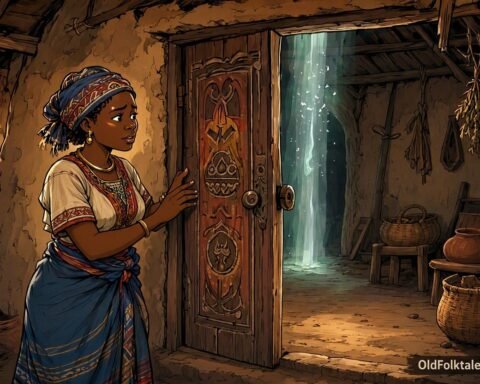
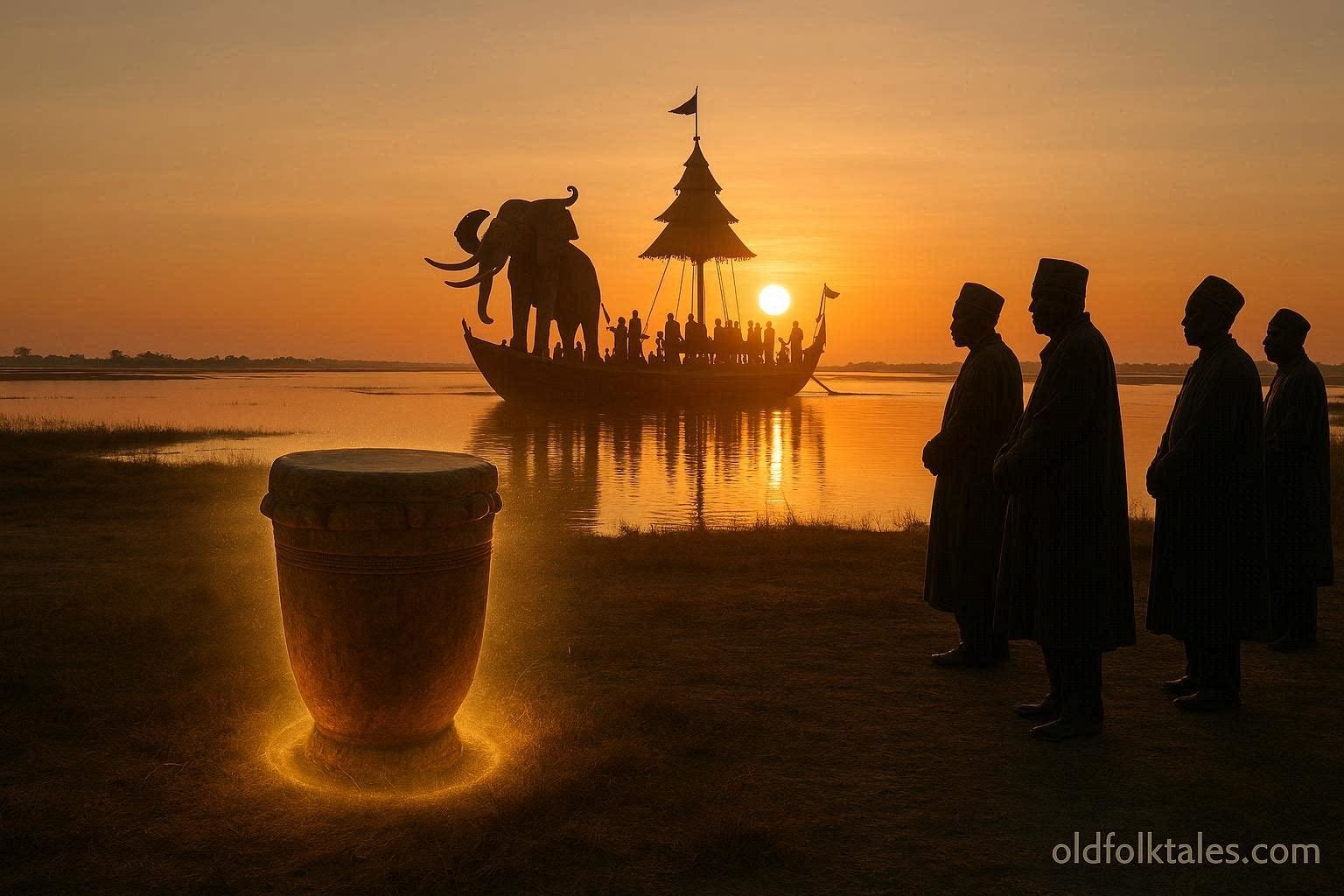
Near the royal storage house rested an ancient drum unlike any other.
Its polished wooden body had darkened with age.
If you enjoyed this story, explore our full West African folktales collection
Its leather surface remained carefully protected by generations of royal caretakers.
No one remembered exactly when it had first been made.
Some believed it had existed since the earliest days of the kingdom.
Others said it had been blessed by the ancestors themselves.
Whatever its true origin, everyone knew its name.
The Spirit Drum.
According to royal tradition, the drum was played only during important ceremonies.
Yet elders told of rare occasions when it sounded entirely on its own.
No hands touched it.
No drummer stood nearby.
Its deep voice echoed across the floodplain whenever great change approached the kingdom.
Young people often asked whether the stories were true.
The elders always gave the same answer.
“The drum speaks only when the kingdom needs listening ears.”
Among those fascinated by the legend was a respectful young boy named Imasiku.
His father served among the royal craftsmen responsible for maintaining the Nalikwanda.
Whenever repairs were needed, Imasiku eagerly accompanied him to the royal grounds.
Although he admired the enormous ceremonial barge, his eyes always wandered toward the ancient drum resting quietly nearby.
One afternoon he finally asked his father,
“Has the drum ever spoken while you were here?”
His father smiled.
“I have heard it once.”
“What happened?”
“The kingdom listened.”
That answer only deepened Imasiku’s curiosity.
One dry season, preparations for the coming floods began earlier than usual.
The royal craftsmen carefully examined every part of the Nalikwanda.
Carvers repaired the great elephant figure decorating its prow.
Paddlers practiced together upon the river.
Everything appeared peaceful.
Then, one quiet evening after sunset, something unexpected happened.
A single deep sound rolled across the royal grounds.
Boom.
Everyone stopped.
The sound came again.
Boom.
Boom.
No musicians stood nearby.
The drum rested exactly where it had always been.
Yet its powerful voice echoed through the night.
Villagers stepped from their homes.
Royal guards looked toward the storage house.
The Litunga himself emerged quietly.
No one spoke for several moments.
Finally one elderly adviser whispered,
“The Spirit Drum has spoken.”
The following morning the royal council gathered.
No one treated the mysterious sound as a reason for fear.
Instead, they discussed what changes might require wisdom and preparation.
Several experienced fishermen reported unusually rapid changes in the river’s current.
Hunters noticed wildlife moving toward higher ground earlier than expected.
Elders recalled similar signs from many years before.
The Litunga listened carefully to every voice.
Instead of waiting, he instructed village leaders to begin moving supplies, livestock, and vulnerable families toward safer areas well before the floodwaters arrived.
Some younger people questioned whether such early preparations were necessary.
“The floods have not yet reached us.”
“Why hurry?”
The older advisers simply replied,
“Wise leaders prepare before danger arrives.”
Several days later, heavy rains began falling far upstream.
News quickly reached the kingdom that the waters of the upper Zambezi were rising faster than anyone had expected.
Within a short time, the floodplain began filling more rapidly than in previous years.
Because the Litunga had acted early, the villages were ready.
Families had already moved their belongings to higher ground.
Livestock had been safely relocated.
Food stores had been protected from the rising waters.
The great Nalikwanda was fully prepared for the Kuomboka journey.
What might have become a season of hardship instead became a season of orderly preparation.
The people praised the wisdom of the Litunga.
The Litunga, however, praised something else.
“It was not the drum that saved us.”
“It reminded us to listen.”
“And because we listened, we acted.”
Imasiku never forgot those words.
Years passed, and he grew into one of the kingdom’s finest craftsmen.
Like his father before him, he helped maintain the Nalikwanda and the sacred objects entrusted to the royal household.
Whenever younger apprentices admired the ancient drum, they eagerly asked,
“Does it truly speak?”
Imasiku smiled.
“Sometimes.”
“What does it say?”
“It tells us that change is always coming.”
“The question is whether we are wise enough to prepare.”
One season, a disagreement arose between several villages over the use of fishing grounds as floodwaters shifted their boundaries.
The dispute grew more serious with each passing day.
Some demanded immediate action.
Others insisted on waiting.
The Litunga called together elders from every affected community.
Before anyone offered solutions, the council sat quietly for a long time, listening to each village explain its concerns.
Only after every voice had been heard did the Litunga speak.
Together they agreed upon a fair arrangement that allowed all communities to continue fishing peacefully.
When the meeting ended, one elderly adviser smiled.
“The Spirit Drum did not sound this time.”
The Litunga nodded.
“No.”
“Because its lesson had already been learned.”
The years continued to pass.
The ancient drum remained carefully protected within the royal grounds.
Most days it rested in complete silence.
Yet every generation continued telling its story.
Parents shared it with their children.
Grandparents repeated it beside evening fires.
Young paddlers heard it while preparing the Nalikwanda for the annual Kuomboka ceremony.
Some believed the drum truly carried the voice of the ancestors.
Others believed its greatest power lay in the lesson it represented.
Both understood the same truth.
Leadership is not measured by authority alone.
It is measured by wisdom, careful listening, and the courage to prepare before challenges arrive.
Today, the Nalikwanda remains one of the most recognizable symbols of the Lozi Kingdom, especially during the famous Kuomboka Ceremony, when the Litunga journeys from the flooded plains to higher ground. While the Spirit Drum belongs to legend rather than documented history, it reflects the Lozi values of responsible leadership, respect for tradition, and collective preparedness that have shaped the kingdom for generations.
The legend of The Spirit Drum of Nalikwanda reminds us that the wisest leaders do not wait for trouble before taking action. Like the quiet beat of an ancient drum, wisdom often calls gently before great change begins.
Don’t miss out: Read more Southern African folktales
Moral Lesson
True leadership begins with listening, preparing wisely, and serving the community with humility. Those who respect wisdom today are better prepared for tomorrow.
Knowledge Check
1. What was the Spirit Drum believed to do?
It was believed to sound on its own whenever great change was about to come to the kingdom.
2. Why was the Nalikwanda important to the Lozi people?
It symbolized leadership, unity, and the enduring traditions of the Lozi Kingdom.
3. How did the Litunga respond after the Spirit Drum sounded?
He listened to the advice of elders and ordered early preparations for the coming floods.
4. Why were the villages able to face the floods successfully?
They had prepared in advance by moving families, livestock, and supplies to safer ground.
5. What lesson did Imasiku teach the younger craftsmen?
He taught that the drum reminds people to prepare wisely because change is always coming.
6. What is the central message of the story?
Wise leaders listen carefully, respect tradition, and prepare for the future before challenges arise.
Source
Inspired by Lozi oral traditions, the cultural significance of the Nalikwanda and Kuomboka Ceremony, with reference to the Barotse Royal Establishment, Lozi oral history, and ethnographic studies of Zambia’s royal heritage.