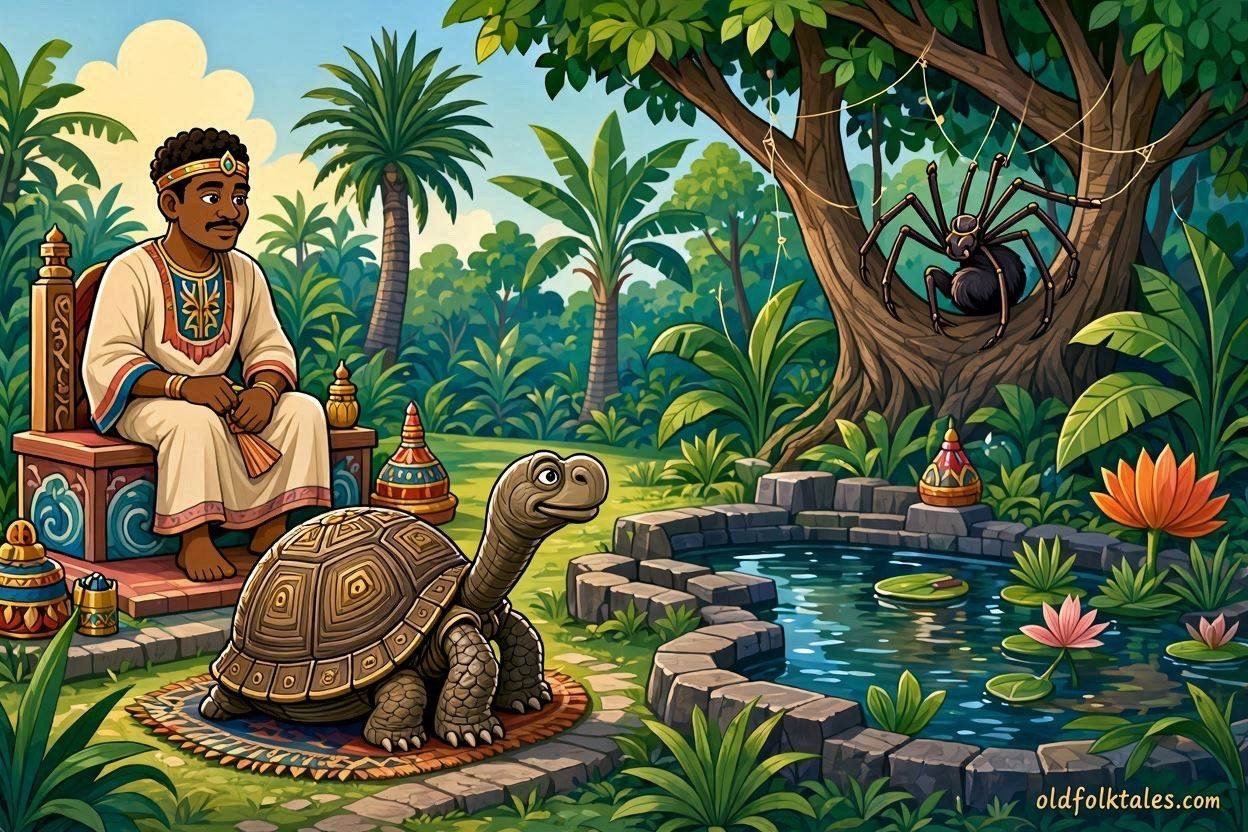
Long ago, in a flourishing kingdom on the island of Mauritius, there stood a magnificent royal pond beside the king’s palace. Its clear waters reflected the blue sky like polished glass, and every morning birds gathered to drink from its banks while travelers paused to rest beneath the nearby trees. The pond was more than a source of water. It was a symbol of the kingdom’s prosperity, and the people believed that as long as it remained full, peace and abundance would bless the land.
Then, without warning, the pond began to shrink.
Day after day, the water retreated until the muddy bottom lay exposed beneath the burning sun. Fish disappeared, birds flew elsewhere, and the once-green grass turned brittle and brown. The people whispered that some mysterious curse had fallen upon the kingdom.
The king summoned his council.
“My people are suffering,” he declared. “Find the cause of this disaster before the kingdom perishes.”
The wisest elders scratched their heads. Hunters searched the forests. Farmers dug new wells. Priests offered prayers. Yet nothing changed. The royal pond remained dry.
At last, an aged adviser stepped forward.
“Your Majesty,” he said, “there is one creature whose wisdom is older than the oldest trees. Deep within the forest lives Grandmother Spider. If anyone knows why the pond has dried, she does.”
The king immediately ordered the swift Hare to seek her counsel.
Fascinated by this tale? Discover more North African folktales
The Hare raced through the forest faster than the wind. Before long, he reached Grandmother Spider’s tiny home hidden beneath tangled vines.
“Grandmother Spider,” he cried impatiently, “the king’s pond is dry! What must we do?”
The old spider closed her eyes for a long moment before answering calmly.
“Tell your king to cut the colophane trees.”
The Hare thanked her and bounded back toward the palace.
But on his journey home he became distracted by ripe fruits, singing birds, and his own thoughts. By the time he reached the king, he frowned in confusion.
“Your Majesty,” he said, “Grandmother Spider advised that you should… plant more trees.”
The king ordered thousands of young trees planted around the pond.
Months passed.
The pond remained dry.
The king’s disappointment turned to frustration.
This time he sent the Monkey.
The Monkey was clever and confident.
“I shall remember every word,” he boasted.
Grandmother Spider listened patiently before repeating her answer.
“Tell your king to cut the colophane trees.”
The Monkey nodded.
On his return journey he stopped to entertain other animals with stories of his important mission. Each time he repeated the message, he changed it a little.
When he finally stood before the king, he proudly announced,
“Grandmother Spider says the pond will return if everyone clears the bushes.”
The king ordered the bushes removed throughout the kingdom.
Still, no water appeared.
One by one, other animals volunteered.
The Parrot believed his excellent memory would not fail him, but he became distracted by repeating the message aloud until he confused the words.
The Jackal thought he understood the advice better than Grandmother Spider herself and changed it to fit his own ideas.
The Hyena laughed at the old spider’s wisdom altogether and invented a different answer.
Every messenger returned with a new explanation.
Every solution failed.
The royal pond remained an empty basin of cracked earth.
At last, when hope had nearly vanished, a quiet voice spoke from the edge of the gathering.
“I will go.”
The animals turned to see the Tortoise.
Some laughed.
“The journey is too long.”
“You are far too slow.”
“You’ll never return before the rainy season.”
But the Tortoise paid no attention.
He began walking.
His steps were slow, yet steady.
When the sun burned overhead, he continued.
When rain soaked the forest paths, he continued.
When thorn bushes blocked his way, he patiently found another path.
Days later, he finally arrived at Grandmother Spider’s home.
The old spider smiled warmly.
“I wondered when someone would come who valued listening more than speed.”
The Tortoise bowed respectfully.
“Our king seeks your wisdom. Why has the royal pond dried?”
Grandmother Spider replied exactly as before.
“Tell your king to cut the colophane trees.”
The Tortoise repeated the words carefully.
“Cut the colophane trees.”
He repeated them again.
And again.
He thanked Grandmother Spider before beginning the long journey home.
Every few steps he quietly whispered,
“Cut the colophane trees.”
He refused invitations to stop and feast.
He ignored conversations that might distract him.
He did not alter a single word.
When he finally reached the palace, dusty and exhausted, the king welcomed him.
“What did Grandmother Spider say?”
The Tortoise looked directly at the king.
“Your Majesty, Grandmother Spider said only this: cut the colophane trees.”
Silence filled the royal court.
The king studied the Tortoise’s face.
Unlike the others, he had added nothing.
He had removed nothing.
His answer was simple.
The king trusted him.
The next morning, workers entered the forest where ancient colophane trees had spread their roots deep beneath the earth. The trees had silently diverted underground springs that once fed the royal pond.
With great care, they removed the trees exactly as Grandmother Spider had instructed.
For a moment, nothing happened.
Then a bubbling sound echoed beneath the ground.
Tiny streams burst from the earth.
Fresh water flowed across the dry basin.
The pond slowly filled once more.
Birds returned.
Fish leaped through the sparkling water.
Children laughed along the banks.
The kingdom celebrated for many days.
The king called every animal before his throne.
He thanked those who had tried to help but turned especially toward the Tortoise.
“Many were faster than you,” the king said.
“Many believed themselves wiser than you.”
“But only you listened carefully enough to carry wisdom without changing it.”
He presented the Tortoise with a place of honor beside the royal pond, where he would forever be welcomed as the kingdom’s most trusted messenger.
Grandmother Spider’s lesson spread throughout the land.
Parents taught their children that wisdom is not only found in speaking.
It is found in listening.
They learned that speed cannot replace patience.
Confidence cannot replace understanding.
And no message is more valuable than the truth carried faithfully from one heart to another.
Long after the king and his court were gone, travelers who stopped beside the clear waters of the royal pond still told the story of the patient Tortoise whose careful listening restored life to an entire kingdom.
Looking for more? Explore the magic of East African folktales here
Moral Lesson
True wisdom begins with careful listening. Those who faithfully preserve truth and communicate it honestly often accomplish far more than those who rely only on speed, pride, or cleverness.
Knowledge Check
1. Why did the king seek Grandmother Spider’s advice?
Because no one else could discover why the royal pond had dried up.
2. Why did the earlier messengers fail?
They forgot, altered, or misunderstood the message they were given.
3. Why was the Tortoise successful?
He listened carefully and delivered the message exactly as he received it.
4. What caused the pond to fill again?
The king followed Grandmother Spider’s advice and cut the colophane trees.
5. What lesson does the story teach about communication?
Truth should be passed on accurately without changing or exaggerating it.
6. Why is this story still meaningful today?
It reminds us that patience, careful listening, and honest communication solve problems more effectively than haste or assumptions.
Source
Adapted from “Histoire des Colophanes” in Le Folk-lore de l’Île-Maurice by Charles Baissac (1888), an early documented collection of Mauritian Creole folktales.