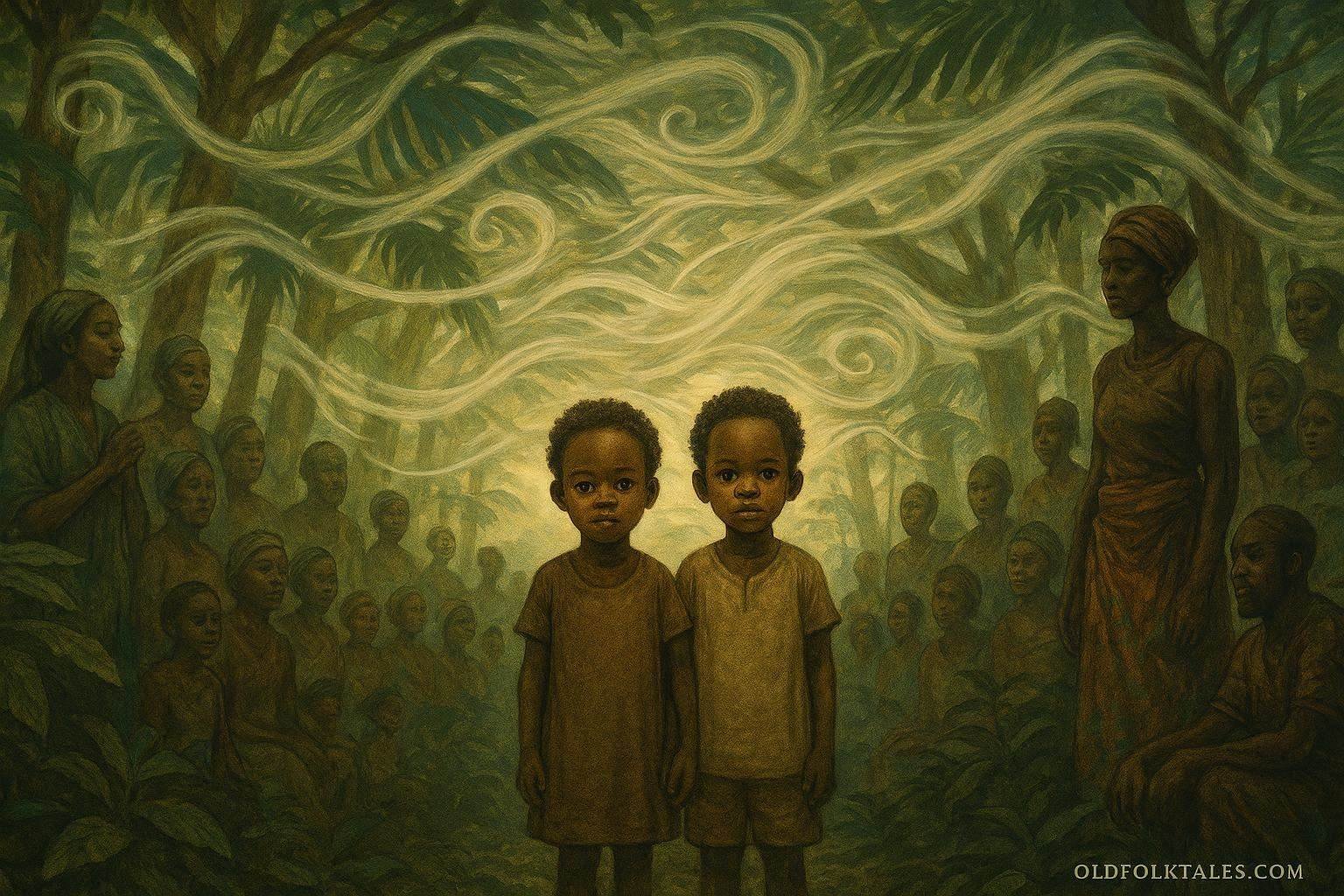
In the vast tropical forests of the central Democratic Republic of Congo, the Mongo people lived in close harmony with nature, guided by ancestral beliefs that shaped how they understood life, destiny, and the unseen forces of the world. The forest was not only their home but also a living presence filled with spirits, warnings, blessings, and mysteries that influenced daily existence. Among the many stories passed from generation to generation, none was more remembered than the tale of the twins born in the heart of the Mongo Forest.
It began during a season when the forest was unusually quiet. Hunters had noticed fewer animal tracks, rivers flowed with a strange stillness, and even birds seemed to sing less often than usual. The elders interpreted these signs as a shift in the balance between the visible world and the spiritual forces believed to govern the land. It was during this time that a young woman from a small forest settlement went into labor deep within the woodland while traveling with her family.
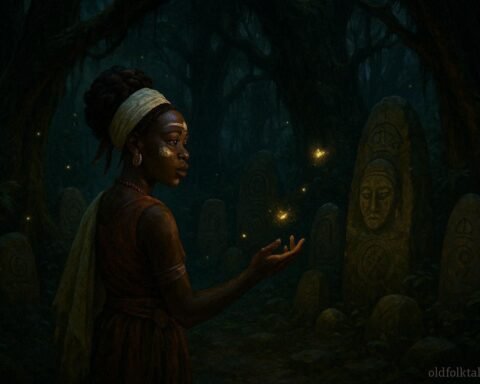
She gave birth to twin children under the canopy of towering trees. The birth itself was unusual, not because of difficulty, but because of what followed. According to those present, the forest seemed to react at the moment the children took their first breath. A sudden wind passed through the trees despite the absence of rain clouds. Leaves rustled in patterns that felt almost intentional, and distant animal calls echoed in unusual rhythm.
The twins were a boy and a girl, and from the beginning, elders believed they carried a shared destiny. In Mongo tradition, twins were often seen as spiritually significant, sometimes bringing blessings and sometimes signaling imbalance that required careful guidance. Because of this belief, the children were not simply raised as ordinary members of the community but were observed closely as they grew.
Fascinated by this tale? Discover more North African folktales
As the twins developed, it became clear that they were deeply connected in ways that went beyond ordinary sibling bonds. When one fell ill, the other would often show signs of distress even before being informed. When one was happy, the other seemed to reflect that emotion instantly. Their connection fascinated the community, and many began to see them as a sign that the forest itself had chosen to express something through their lives.
In the early years, the presence of the twins appeared to bring prosperity. The village experienced unusually successful hunting seasons. Crops planted near forest clearings grew more abundantly than expected. Even trade with neighboring communities improved, as travelers reported favorable conditions along forest routes. Many believed the twins had brought a blessing upon the land, and their parents were respected for raising children touched by spiritual favor.
However, as the twins grew older, changes began to emerge that unsettled the balance of the community. Alongside the prosperity came tension. Families began to disagree more frequently over land boundaries. Hunters argued over territories that had previously been shared without conflict. Even within households, disagreements became more intense and harder to resolve.
The elders observed that these changes often seemed to coincide with moments when the twins were emotionally distressed or in disagreement with each other. When the twins argued, storms would suddenly gather in the distance, even during dry seasons. When they remained calm and united, the forest seemed peaceful again. This pattern led to growing concern that their connection to the natural world was stronger and more unpredictable than anyone had realized.
As time passed, the community began to divide in its interpretation of the twins. One group believed they were a blessing whose power simply needed guidance and understanding. Another group believed they carried an unstable force that disrupted the natural balance of the forest. This disagreement slowly created tension within the village itself.
The turning point came during a severe conflict over hunting rights near a sacred part of the forest. Two families claimed ownership of the same territory, and neither was willing to уступ. The disagreement escalated into a confrontation that threatened to split the entire community. As the tension reached its peak, the twins were called upon by the elders, who hoped their presence might restore balance.
When the twins arrived at the gathering, the atmosphere in the forest clearing shifted. Witnesses said the air felt heavier, as if the forest itself was paying attention. The twins stood on opposite sides of the dispute, reflecting the division within the community. As they spoke to each other, their voices carried both emotion and uncertainty. The disagreement between them mirrored the conflict among the villagers, and it became clear that their bond was deeply tied to the harmony of the community.
As their argument intensified, a strong wind swept through the forest, bending branches and scattering leaves across the clearing. The elders quickly realized that the emotional state of the twins was directly influencing the environment around them. Recognizing the danger of allowing the conflict to continue, they intervened, urging both sides to pause and reflect.
An elder stepped forward and reminded the community that the twins were not the cause of division but a reflection of balance itself. He explained that the forest responded not to their existence alone but to the harmony or discord within the people who surrounded them. The twins, he said, were a mirror of the community’s own unity or fragmentation.
Hearing this, the villagers began to reconsider their actions. Slowly, discussions replaced arguments. The two families agreed to share access to the disputed land under agreed seasonal arrangements. As reconciliation began to take shape, the twins themselves became calm, and the wind that had stirred through the forest gradually faded.
From that moment onward, the twins were no longer seen as either a blessing or a curse, but as a reminder of the delicate balance between human relationships and the natural world. Their presence taught the community that harmony was not something given, but something maintained through understanding, patience, and cooperation.
As they grew into adulthood, the twins continued to live within the forest community, always respected but also carefully understood. The people learned to pay attention not only to the signs of nature but also to the state of their own relationships, recognizing that imbalance within the community could be reflected in the world around them.
Even in later generations, the story of the Twins of the Mongo Forest remained a powerful lesson about destiny, balance, and the unseen connections between human emotion and the natural world.
Click here to explore more Central African folktales
Moral Lesson
Balance in nature and community depends on harmony in human relationships.
Knowledge Check
- Where is the story set?
It is set in the Mongo Forest in the Democratic Republic of Congo. - Who are the main characters?
Twin children born in a forest community. - What was unusual about the twins?
Their emotions were strongly connected to changes in nature and community life. - How did the community first react to them?
They believed the twins brought prosperity and good fortune. - What caused conflict in the village?
Disputes over land and growing divisions linked to imbalance in the community. - What is the lesson of the story?
Harmony in human relationships maintains balance in nature and society.
Source
Central African folklore. Adapted from Mongo oral storytelling traditions documented in Democratic Republic of Congo ethnographic studies.