In a small village in the lands of Benin, there lived a man known for his cleverness and bold spirit. He was strong, quick of foot, and confident that he could solve any problem that came his way. His neighbors admired him, sometimes feared him, but all agreed he was a man who relied on his own wits above anything else.
One evening, as the sun dipped below the horizon and the sky turned a deep shade of crimson, a stranger arrived at the man’s hut. He did not announce himself, yet he spoke with a voice that made the man shiver.
“Tonight,” said the stranger, “Death comes for you. You must prepare, for no one escapes it.”
The man’s heart leaped into his throat. He had heard stories of Death walking the earth, but he had never believed they could be true. He looked the stranger in the eye, and though his hands trembled, he forced a smile.
“I do not accept this,” he said. “I will not die tonight. I am stronger and faster than Death itself.”
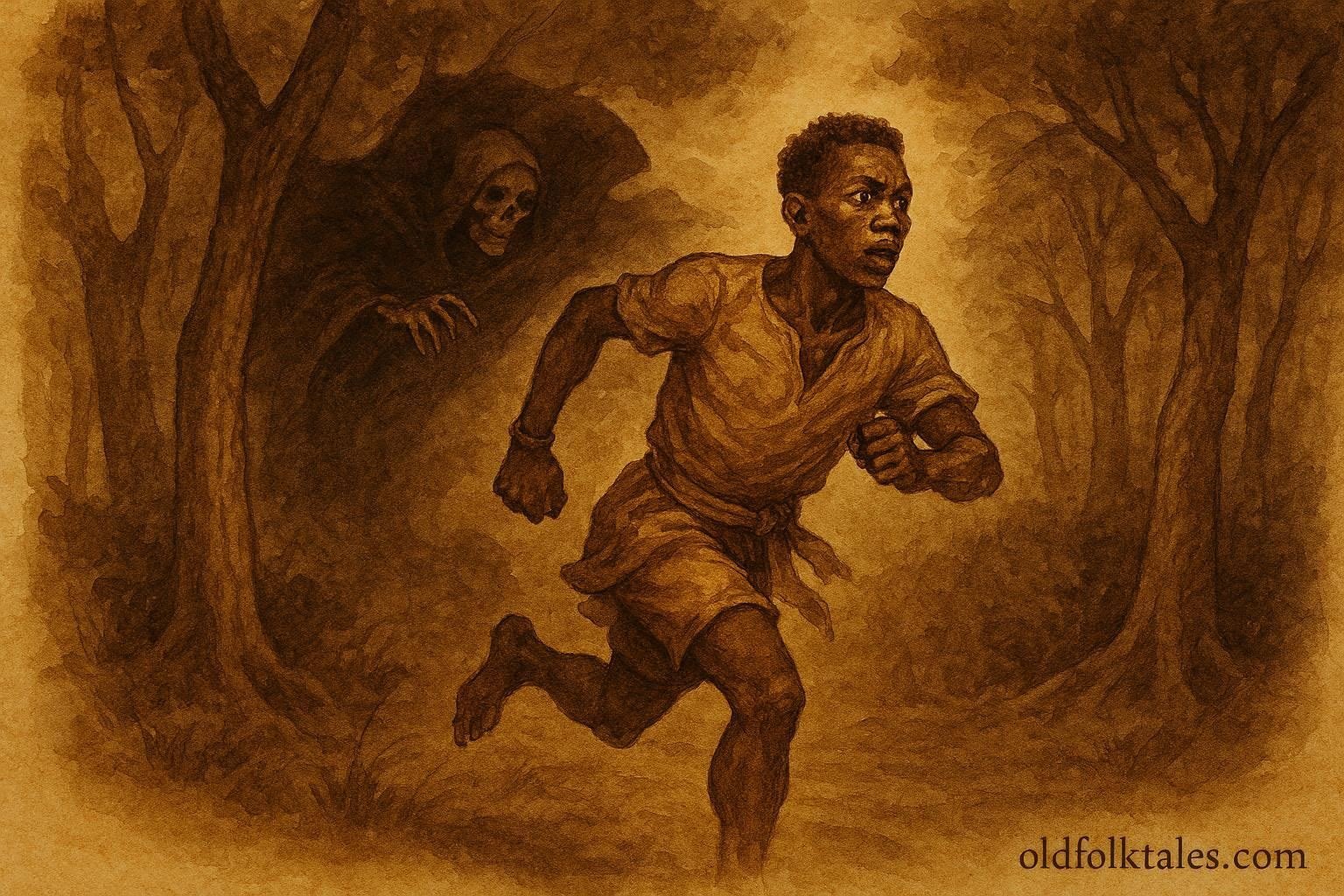
With that, he grabbed his walking stick, threw on his cloak, and ran from his home as the stranger vanished into the shadows.
The village lay behind him, quiet in the night. He ran along the familiar paths through the forest, over hills, and across streams. He ran faster than he had ever run before, thinking that distance alone could save him.
Want to dive deeper? Read more North African folktales today
For hours, he kept moving, panting and exhausted, yet determined. Every tree, every rock, every bend in the path seemed to mock him. He glanced behind him, expecting to see the dark figure of Death pursuing him, but the path remained empty.
“Surely I am safe,” he told himself. “Surely I can outrun what is meant for me.”
But fate has a way of following even the swiftest feet.
By dawn, he reached a small clearing, a place he had never noticed before. The air was still and heavy, and a strange silence hung over the trees. He slowed to catch his breath, unaware that the very place he had chosen was the path that led straight to his fate.
There, in the clearing, stood the stranger once more. This time, there was no warning, no voice. The man realized with horror that all his running had brought him directly to where Death waited.
He fell to his knees, pleading. “I ran, I ran as fast as I could. Is there no way to escape?”
The stranger shook his head slowly. “All may run, but no one outruns what is destined. Life and death are a path all must walk, and your time has come.”
The man closed his eyes, heart pounding, and finally understood. No cleverness, no speed, and no cunning could alter what the fates had decreed.
After that day, the villagers would speak of the man who tried to escape death. They told how he ran tirelessly through the night, thinking he could change what was meant to be. And though some whispered of fear, others told the story as a reminder: no matter how strong, clever, or fast a person may be, the time appointed for each life cannot be avoided.
From that moment on, people began to live with greater respect for the natural order. They remembered that every life had a beginning and an end, and that acceptance of fate was a lesson in wisdom and humility.
Click here to discover more legendary tales from West Africa
Moral Lesson
No one can escape destiny. Life and death follow their own path, and acceptance of what is inevitable brings wisdom and peace.
Knowledge Check
- What was the man trying to do in the story?
He tried to escape Death after learning it was coming for him. - Did running save him from his fate?
No, he unknowingly ran straight toward his destiny. - Who warned the man about Death?
A mysterious stranger informed him that Death was coming. - What lesson does the story teach about fate?
Fate cannot be avoided; acceptance is necessary for wisdom. - How did the villagers react to the story of the man?
They used it as a reminder to respect the natural order of life and death. - What cultural origin does this folktale have?
It is a Beninese (West African) folktale.
Source
West African folktale, Benin. Collected by Harold Courlander in A Treasury of African Folklore (1975).