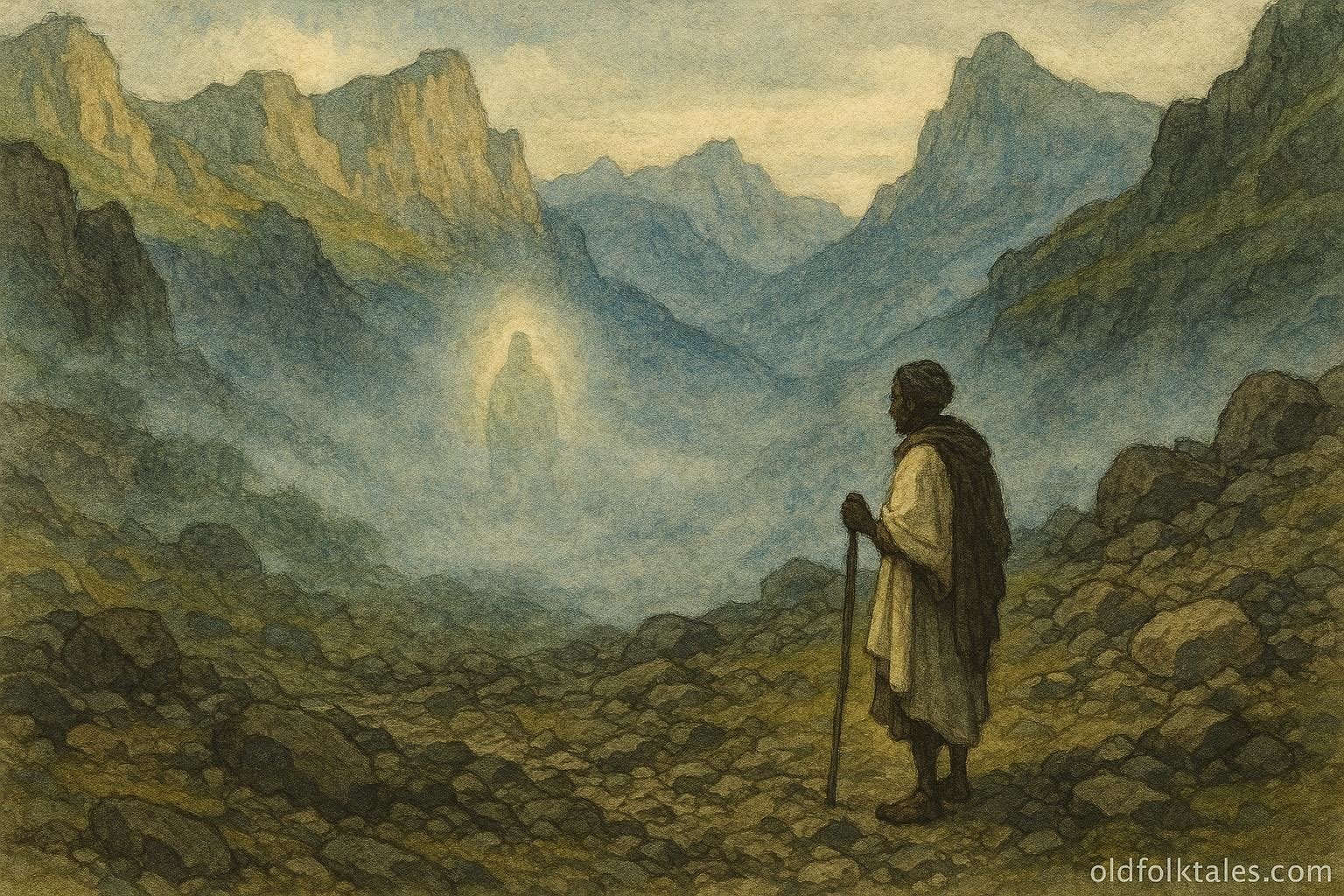
High above the villages, where the air grew thinner and the land turned rugged and quiet, there stood a mountain that few people dared to climb. Its slopes were steep, its paths narrow, and its silence deep. From a distance, it looked ordinary, but those who lived nearby spoke of it with a kind of respect that bordered on fear.
They believed someone lived there.
Not just anyone, but a holy figure. A saint who had chosen to leave the noise of the world behind and dwell in complete solitude. No one could say exactly when he had arrived. No one could describe him clearly. Yet his presence was felt in ways that could not be ignored.
Stories began to circulate.
A farmer once claimed that after losing his way in the hills, he found himself guided back home by a figure he could barely see. When he turned to thank the stranger, there was no one there.
A woman spoke of praying in distress, only to find that her situation changed overnight in a way she could not explain. She believed her prayers had reached the saint.
Fascinated by this tale? Discover more North African folktales
A shepherd told of seeing a faint light high on the mountain late at night, steady and unmoving, as though someone was keeping watch over the land below.
At first, many dismissed these stories.
But as time passed, more people began to share similar experiences. The details were never exactly the same, yet they carried a common thread. Help appeared when it was needed most. Guidance came without warning. Protection seemed to surround those who had no other support.
The village elders listened carefully.
They did not rush to conclusions, but they understood that such patterns were not easily ignored. They began to speak of the mountain with greater reverence, advising people not to approach it carelessly.
“The mountain is not empty,” they would say. “Respect it.”
Among those who heard these stories was a young man who found himself both curious and restless.
He had grown up listening to tales of the hidden saint, but unlike others, he wanted to see the truth for himself. He did not doubt that something was there, but he felt a strong desire to understand it directly.
One morning, before the village had fully awakened, he set out.
The journey was not easy. The path grew narrower as he climbed, and the air became cooler. The silence of the mountain was unlike anything he had experienced. It was not simply the absence of sound, but a presence of stillness that made him aware of every movement he made.
As he climbed higher, doubt began to settle in.
He wondered if he had made a mistake. The stories he had heard suddenly felt distant and uncertain. Yet something within him urged him to continue.
After many hours, he reached a point where the path seemed to disappear.
He stopped and looked around.
There was no sign of a dwelling. No sign of a person. Only rocks, wind, and the vast sky above him.
For a moment, disappointment took over.
He had come all this way, risking exhaustion and uncertainty, only to find nothing. He sat down, feeling the weight of his journey, and allowed himself to rest.
As he sat there, something changed.
It was not a sound at first, but a feeling. A quiet awareness, as though he was no longer alone. He looked up, expecting to see someone approaching, but the mountain remained still.
Then he heard a voice.
It was calm, steady, and without urgency.
“Why have you come?”
The young man’s heart raced. He stood up quickly, searching for the source of the voice, but there was no visible figure.
“I came to see the saint,” he replied, his voice unsteady.
There was a pause.
“And what do you expect to see?” the voice asked.
The young man hesitated.
He had imagined many things. A figure in robes. A man surrounded by light. Someone clearly different from ordinary people. But standing there on the mountain, those expectations began to feel uncertain.
“I do not know,” he admitted.
The voice seemed neither pleased nor displeased.
“Then why did you come?”
The question lingered in the air.
The young man thought carefully before answering.
“I wanted to understand,” he said.
Another silence followed.
Then the voice spoke again.
“Understanding does not always come from seeing.”
The words settled deeply within him.
He stood there, unsure of what to say next. He realized that he had come with expectations, but he had not fully understood what he was seeking.
“Return to your village,” the voice continued. “Live well. Help others. That is where your understanding will grow.”
The young man waited, hoping for more, but the voice did not speak again.
The presence faded.
The mountain returned to its stillness.
He remained there for a long moment, trying to make sense of what had happened. He had not seen the saint, yet he could not deny that he had encountered something real.
Slowly, he began his descent.
The journey down felt different. His steps were lighter, though his mind was full. He carried no physical proof of what had occurred, yet he felt changed in a way he could not fully explain.
When he returned to the village, people noticed the difference.
He did not speak immediately about his experience. Instead, he began to live differently. He became more patient, more attentive to others, more willing to help without being asked.
Over time, his actions spoke louder than any story he could have told.
Eventually, he shared what had happened.
Some believed him. Others remained uncertain. But no one could deny the change in him.
The elders listened and nodded.
“The mountain has its ways,” they said.
The stories of the hidden saint continued.
Some claimed to have seen signs. Others felt guidance in moments of need. But the saint himself was never fully revealed.
And perhaps that was the point.
For the people came to understand that the saint’s presence was not meant to be seen in the way they had imagined.
It was meant to be felt.
In acts of kindness.
In moments of quiet guidance.
In the unseen ways that faith moves through everyday life.
And high above them, the mountain remained, silent and watchful, holding its mystery as it always had.
Continue your journey: Read more East African folktales
Moral Lesson
True spiritual power is not always seen but is revealed through actions, humility, and quiet influence.
Knowledge Check
- Where did the saint live?
On a quiet mountain far from the village - Did people often see the saint?
No, they only felt his presence - Why did the young man climb the mountain?
To find and understand the saint - Did he see the saint physically?
No, he only heard a voice - What did the voice teach him?
That understanding comes through living well - What change happened after he returned?
He became kinder and more helpful
Source
Ethiopian folktale. Adapted from Gädl literature (Ethiopian saint traditions, 20th century documentation).