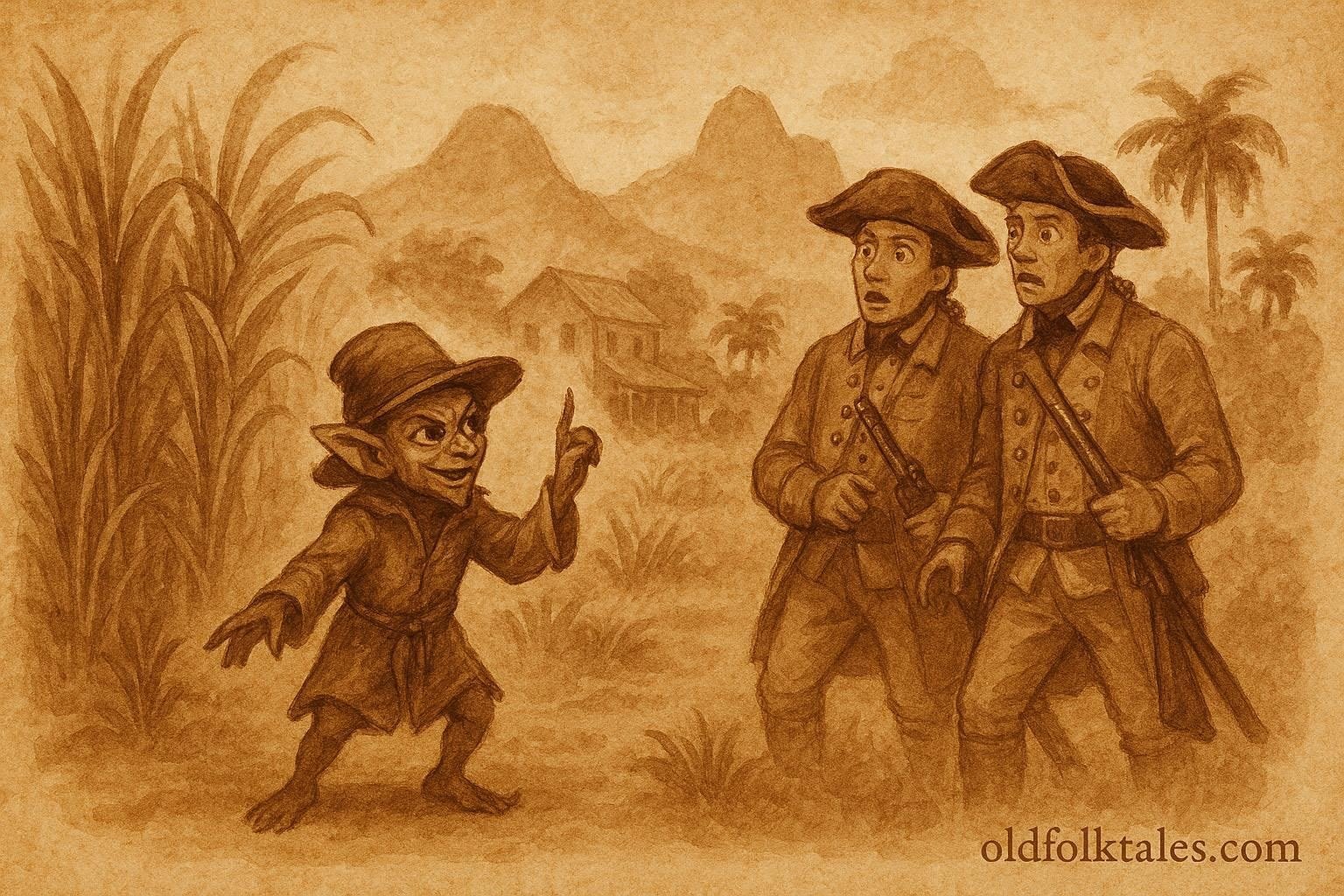
In the oral traditions of Mauritius, where African, Malagasy, Indian, and French influences blend into a rich Creole cultural memory, there is a figure who appears again and again in storytelling circles, spoken of with laughter, caution, and admiration all at once. His name is Tizan.
He is not a king. He is not a warrior. He holds no official power, no wealth, and no position of authority. In fact, he is often described as small in stature, quick in movement, and even quicker in thought.
Want more? Read more West African folktales now
But what Tizan lacks in status, he makes up for in intelligence.
And in a world shaped by inequality, intelligence becomes survival.
Tizan lives in the time of the sugar estates, an era marked by colonial systems where plantation owners and traders held authority over land, labor, and food. Life was structured by power that did not always account for fairness. In such a world, survival often depended not only on hard work, but on wit, observation, and the ability to navigate systems that were not designed for the vulnerable.
It is within this reality that Tizan becomes a trickster figure.
Not a villain.
Not a hero in the traditional sense.
But a survivor who uses his mind as his greatest tool.
Among the many stories told about him, one stands out in the memory of oral tradition.
It is the tale of famine, hunger, and disguise.
During a time when food became scarce, the pressure on the working people grew heavy. Hunger was not abstract, it was present in every household, every conversation, every empty stomach. In such conditions, survival instincts sharpen, and desperation becomes common.
It was during such a famine that Tizan found himself in trouble.
Food had been taken.
The details of the act are not emphasized in the story as much as its consequence: Tizan was caught, or at least accused, and punishment was certain. In a system where authority was strict and mercy was rare, escape seemed impossible.
For someone like Tizan, however, “impossible” is not the end of thought, it is the beginning of strategy.
He did not have strength to overpower those in authority.
He did not have influence to negotiate his release.
What he had was something far more flexible.
Imagination.
And so, Tizan devised a plan that would become one of the most remembered examples of his trickster intelligence.
He claimed to be a messenger of spirits.
In the worldview shaped by Creole oral traditions, where spiritual presence, ancestral communication, and unseen forces are part of cultural understanding—the idea of a spirit messenger was not easily dismissed. It carried weight. It demanded caution.
Tizan used this cultural space not with disrespect, but with precision.
He did not present himself as a leader or a rebel. He presented himself as a messenger—someone not acting on personal desire, but under spiritual instruction.
In doing so, he shifted the way he was perceived.
No longer just a man accused of wrongdoing, he became a figure surrounded by uncertainty, interpretation, and fear of spiritual consequence.
The story emphasizes this transformation carefully. It is not about deception for harm, but about survival within an unequal system where ordinary explanation would not have saved him.
Through humor, performance, and timing, Tizan creates enough doubt to escape punishment.
And just as quickly as he appears in the role of “spirit messenger,” he disappears from it, returning to his identity as a free man.
What makes this tale endure in Mauritian folklore is not simply the trick itself, but what it represents.
Tizan does not challenge authority through force.
He does not overthrow systems.
He survives them.
And in survival, he exposes something deeper about the world he inhabits.
Power is not only physical, it is narrative. It is belief. It is perception.
And Tizan understands how perception can be shaped.
In the sugar estate world, where colonial structures define who is heard and who is silenced, Tizan’s intelligence becomes a form of resistance. Not loud resistance, not organized rebellion, but subtle disruption of expectation.
He shows that authority can be questioned not only with confrontation, but with wit.
And that survival itself can be a quiet form of defiance.
Across generations, his story is retold not as encouragement for wrongdoing, but as a reflection of lived reality, where people under pressure often had to rely on creativity, humor, and quick thinking to navigate systems of inequality.
Tizan becomes a mirror of that reality.
He is not perfect.
He is not idealized as morally flawless.
But he is remembered.
And in oral tradition, being remembered means carrying meaning.
His cleverness is not just entertainment, it is instruction. It reminds listeners that intelligence can be a shield, that humor can be a tool, and that even in oppressive conditions, agency can still exist in unexpected forms.
At the heart of the tale is a simple but powerful idea:
When power is unequal, survival often depends on wit.
And Tizan, in his smallness and speed of thought, becomes larger than the structures that try to contain him.
Looking for more? Explore the magic of East African folktales here
Moral Lesson
Intelligence and wit can become tools of survival in unequal systems. While power may dominate physically, creativity and quick thinking can challenge authority, expose injustice, and help individuals endure difficult conditions.
Knowledge Check
- Who is Tizan in Mauritian folklore?
Tizan is a clever Creole trickster known for using wit and humor to survive oppressive colonial conditions. - What was Tizan accused of in the story?
He was accused of stealing food during a time of famine. - How did Tizan escape punishment?
He pretended to be a messenger of spirits, using cultural beliefs to confuse and avoid punishment. - What does Tizan symbolize in the tale?
He symbolizes intelligence, survival, and resistance through wit in unequal systems. - What cultural context shapes this folktale?
It reflects Mauritian Creole oral tradition influenced by African, Malagasy, Indian, and French colonial history. - What is the main lesson of the story?
That intelligence and creativity can help individuals survive and resist oppressive systems.
Source: Mauritian oral folklore documented in ethnographic collections and Creole studies such as Charles Baissac’s linguistic-cultural works (1880s) and later retellings in Mauritian folklore anthologies (1960s–1990s)
Cultural Origin: Mauritius Creole oral tradition, influenced by Afro-Malagasy and French colonial cultural interactions