In the island traditions of Mauritius, where land and sea are filled with stories older than written memory, there stands a mountain unlike any other.
It is called Pieter Both.
Fascinated by this tale? Discover more North African folktales
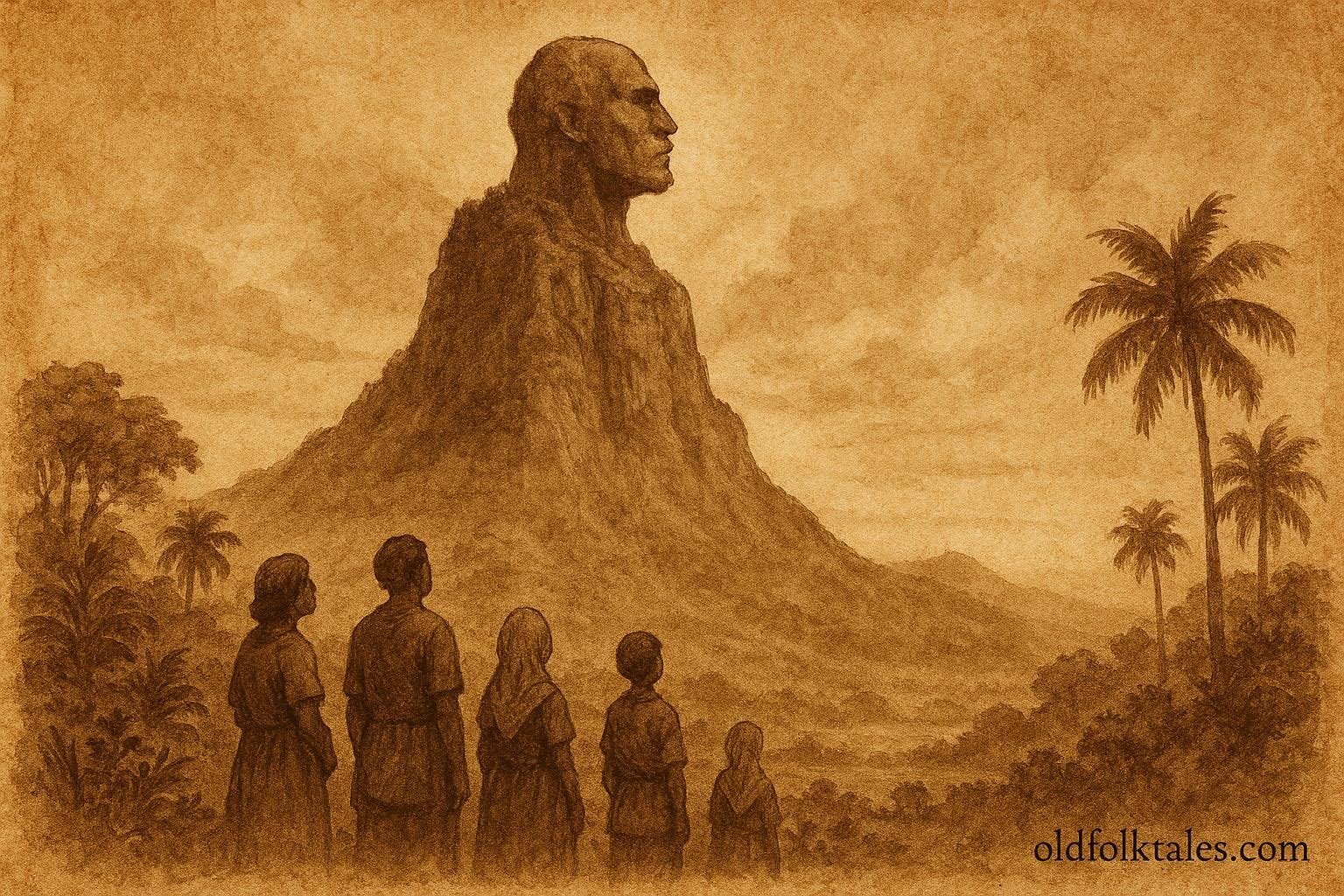
From a distance, its peak rises in a way that seems almost unnatural. At its summit rests a rounded formation that resembles a human head, balanced carefully upon the mountain’s body as if it were placed there deliberately rather than shaped by time.
For generations, people have looked upon it and felt that it was not simply a mountain.
It was something more.
In oral tradition, it is said that long ago, before the mountain became stone, there lived a giant.
He was not feared as a destroyer, but remembered as a helper.
The giant would walk through the land in times of need, assisting villagers with tasks too large for ordinary hands. He would clear paths, move heavy obstacles, and lend strength where human effort was not enough. In return, he asked for nothing more than respect and simple acknowledgment.
In many Mauritian folktales shaped by Creole oral tradition, such beings are not unusual. Giants, spirits, and nature-bound figures often exist between worlds, neither fully human nor fully divine, but deeply connected to the land they inhabit.
The giant of Pieter Both was one such being.
And for a time, harmony existed.
Villagers respected him. They honored his presence. And he, in return, continued to protect and assist them.
But in stories where balance is central, harmony is never permanent when promises begin to shift.
The giant made a sacred promise.
The exact nature of the promise is not described in detail in every retelling, but its meaning is consistent across versions: it was a vow tied to trust, respect, and restraint. A boundary between what should be done and what should never be broken.
At first, the promise was kept.
But over time, something changed.
Whether through forgetfulness, pride, or misunderstanding, the vow was broken.
And in the moral structure of this folklore, breaking a sacred promise is not a small act, it is a disruption of balance between human action and the forces that sustain the world.
The land responded.
The giant was not punished through destruction, but transformation.
His living form was taken from him, and his body was turned into stone. Not erased, not removed, but preserved in a permanent state that would outlast memory itself.
He became the mountain.
And where his body once stood, only stone remained.
But the transformation did not end there.
His head, distinct, visible, and shaped like a human face resting at the peak, became the most recognizable part of the formation. It was said to be his final expression frozen in time, watching over the land he once walked.
Thus, Pieter Both Mountain became more than geography.
It became memory in stone.
And memory in stone becomes warning.
Over generations, the people of Mauritius began to tell a caution attached to the mountain.
It was said that the head at the summit was not merely rock.
It was the giant himself.
Still aware. Still watching. Still bound by the consequence of his broken vow.
And within this belief came a strict taboo:
No one must whistle at Pieter Both.
To outsiders, this may sound like superstition. But in the logic of folklore, such warnings are never arbitrary. They exist to preserve respect for places believed to carry spiritual weight.
Whistling at the mountain was considered an act of disrespect, an attempt to provoke or challenge what should remain honored and undisturbed.
And the consequence, as the story warns, would be grave: the head would fall.
Not necessarily as physical inevitability, but as symbolic collapse of the balance the mountain represents.
Fear, in this tradition, is not meant as entertainment. It functions as moral protection.
It teaches boundaries.
It reinforces respect for sacred spaces.
And it reminds those who hear the story that not everything in nature exists for human testing.
Pieter Both Mountain, therefore, stands as both landscape and lesson.
It is a reminder that promises made to the world, whether spoken to people, land, or unseen forces, carry weight.
And that breaking them does not always result in immediate punishment.
Sometimes, it results in transformation that lasts forever.
The giant did not disappear.
He became part of the island itself.
And in that form, his presence continues to speak, not through movement or voice, but through stillness.
Through stone.
Through silence that carries meaning.
Even today, when the mountain is seen rising above Mauritius, its shape is more than natural formation in the eyes of folklore.
It is a memory of a being who once helped others, lost himself through broken promise, and became a permanent reminder of respect between humans and the world they inhabit.
And so the warning remains, passed down through generations:
Some places are not meant to be challenged.
Some stories are not meant to be forgotten.
And some stones were once living beings who still remember.
Don’t stop yet! See our complete East African folktales collection
Moral Lesson
Breaking sacred promises and disrespecting what is considered holy or natural leads to lasting consequences. Folklore uses fear not to harm, but to teach respect for nature, boundaries, and the unseen balance that sustains the world.
Knowledge Check
- What is Pieter Both in Mauritian folklore?
It is a mountain believed to be the transformed body of a giant who once helped villagers. - Why was the giant turned into stone?
He broke a sacred promise, which led to his transformation as a consequence of disrupting balance. - What does the “head” of Pieter Both represent?
It is believed to be the giant’s frozen head, still watching over the island. - Why is whistling at Pieter Both considered dangerous?
Folklore warns that it is a disrespectful act that could cause the mountain’s head to fall. - What cultural influences shape this legend?
It blends Dutch colonial naming with Afro-Creole oral traditions of Mauritius. - What is the main lesson of the story?
That sacred places and promises must be respected and breaking them carries lasting consequences.
Source: Recorded in Mauritian geographic folklore compilations and colonial-era travel writings, later preserved in 20th-century oral history archives (Mauritian Cultural Studies collections)
Cultural Origin: Mauritius island folklore blending Dutch colonial naming and Afro-Creole oral myth traditions
Approx. Documentation Period: Late 19th century colonial records; widely retold in 20th-century oral tradition