In the wide sugarcane plantations of Mauritius, where tall green stalks stretch endlessly toward the horizon and the wind moves through them like a restless breath, there is a story that has long been carried by workers across generations. It is a story told at the edges of exhaustion, when the sun begins to lower and the fields grow long with shadow. It is the story of Manza, the lazy spirit of the cane fields.
Among plantation workers of earlier times, especially during the harsh plantation era shaped by slavery and indentured labor, the fields were not only places of work but also places of endurance, struggle, and survival. The land demanded long hours, and the rhythm of labor often blurred the line between physical effort and mental fatigue. It is within this world that the legend of Manza took root.
Fascinated by this tale? Discover more North African folktales
Manza is not described as a violent spirit. He is something more subtle, more frustrating, and in many ways more dangerous to the mind than to the body. He is mischievous, unpredictable, and deeply associated with laziness, not as a human trait, but as a force that disturbs focus and weakens discipline.
The workers say Manza appears most often at dusk, when the light begins to fade and the cane fields become a sea of shifting shadows. At that hour, when tiredness settles into the bones and the desire to stop working grows stronger, strange things begin to happen.
Tools go missing.
Paths seem longer than they should be.
And sometimes, work that has already been completed appears unfinished again, as though time itself has reversed.
Manza is blamed for all of it.
According to the stories passed down in Creole oral tradition, Manza enjoys confusing workers who are already weary. He does not create problems out of anger, but out of playfulness, an unseen presence that tests patience and discipline. Some say he was once a worker himself, someone who avoided effort and became trapped between worlds as punishment. Others believe he is an older spirit tied to the land, formed from the collective exhaustion of plantation life itself.
Whatever his origin, his behavior is always the same.
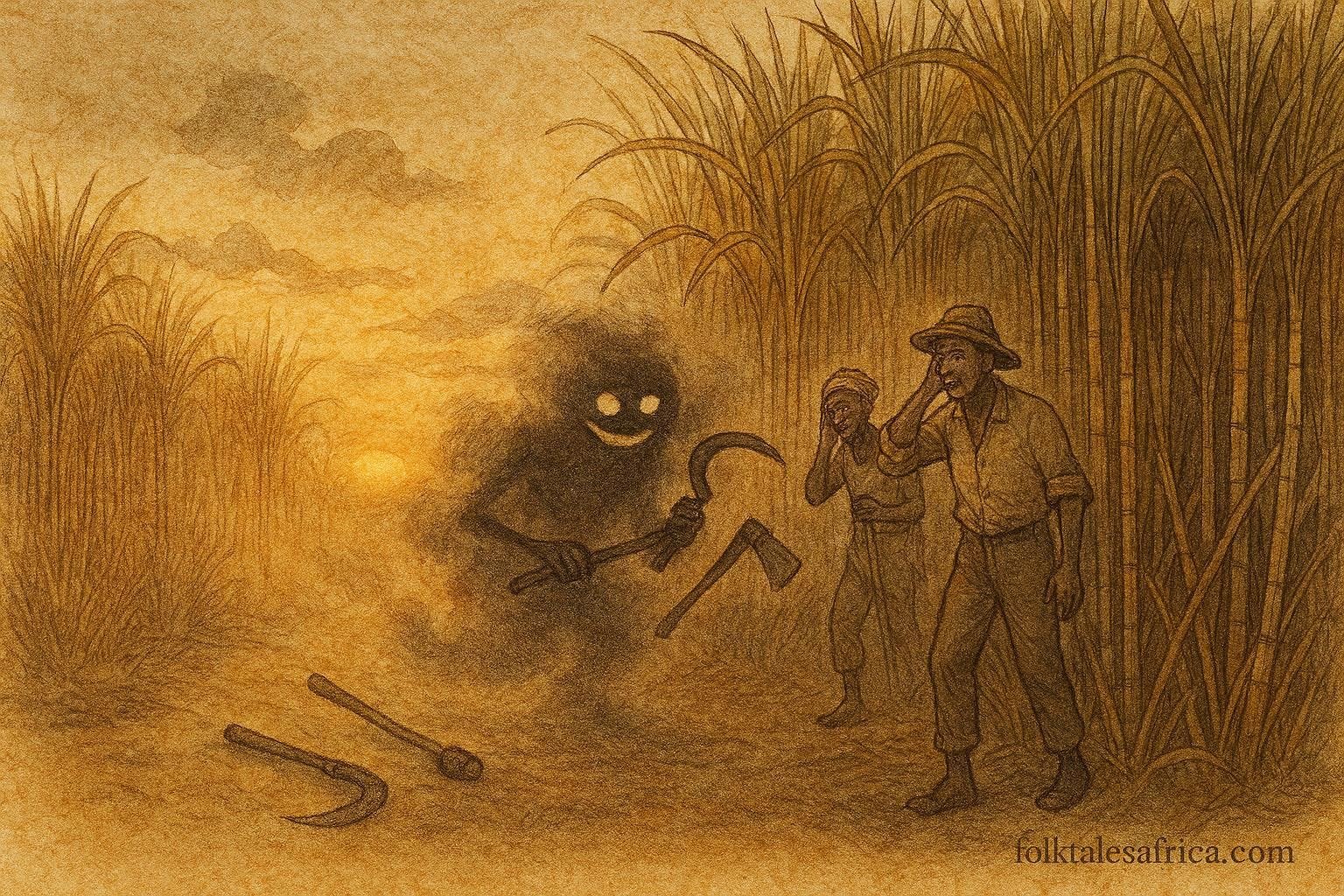
He hides tools in places that were just searched moments earlier. A cutlass left beside a cane row might suddenly be found several rows away, as if it had walked there on its own. Bundles of cane that were neatly arranged may appear scattered, forcing workers to redo tasks they swear were already completed.
Even more unsettling are the illusions.
Workers describe moments when they believe there is still much work left, only to realize later that the field had already been cleared. In other cases, they feel they have worked for hours when only a short time has passed. Manza, they say, bends perception so that exhaustion feels heavier and progress feels smaller than it truly is.
Because of this, plantation workers learned to be cautious, not only of physical fatigue, but of the mind’s vulnerability at dusk.
Yet Manza is not unstoppable.
The same stories that describe his tricks also describe the way to avoid him.
Only disciplined and focused workers are said to escape his influence.
Those who remain steady in their work, who keep clear awareness of their tools and surroundings, and who resist the urge to surrender early to tiredness, are believed to move through the fields without disturbance. Manza cannot easily confuse those who remain mentally sharp.
But those who drift into distraction, frustration, or impatience become easy targets for his illusions.
In older plantation communities, elders would warn younger workers about him not as a ghost to fear, but as a lesson to understand. Manza represented more than a spirit, he reflected the struggle between discipline and exhaustion, between persistence and surrender.
Life in the cane fields was not easy. The sun was harsh, the labor constant, and the expectation of productivity unrelenting. In such conditions, fatigue was not just physical; it was deeply mental. The story of Manza gave shape to that invisible struggle. It gave name to the moments when the mind falters and effort feels heavier than it should.
There is a common tale often told to illustrate his behavior.
A young worker, new to the fields, once prided himself on his strength. He believed he could complete his assigned rows faster than anyone else. On his first weeks, he worked tirelessly from morning until late afternoon. But as dusk approached one evening, he began to notice something strange.
The cane he had already cut seemed to stand again, untouched.
His tools, which he had placed carefully beside him, were suddenly missing.
And the more he searched, the more the field seemed to expand beyond its normal boundaries.
Frustration grew in him. He worked harder, convinced that the task had multiplied. Sweat blurred his vision, and exhaustion clouded his judgment. By the time he finally stopped, he believed he had worked far longer than anyone else that day.
When he returned, others told him the work had been completed hours earlier.
He had been walking through illusions.
From that day, he learned to slow his mind as much as his body. To remain aware, to check his progress calmly, and to resist the pressure of unseen confusion.
The elders told him simply: “You met Manza.”
Stories like this are not told to frighten workers, but to guide them. Manza represents a truth understood deeply in plantation life, that exhaustion can distort perception, and that discipline is not only about strength, but clarity.
Over time, Manza became a symbol woven into the cultural memory of Mauritian plantation communities. His presence explained not only lost tools and strange experiences, but also the emotional weight of labor itself. He became a way to speak about hardship without directly naming suffering.
Even after plantation systems changed and working conditions evolved, the story of Manza remained. It shifted from a warning into folklore, from lived experience into cultural memory. In storytelling circles, he is now remembered less as a threat and more as a reminder of focus and resilience.
Today, when the wind moves through sugarcane fields and dusk settles over the land, some still joke about him. A misplaced tool, a moment of confusion, or a sudden lapse in concentration might still be blamed on Manza’s tricks. But behind the humor lies an old respect for the story’s meaning.
Because Manza is not only a spirit of mischief.
He is a reflection of human endurance under pressure, of the struggle to remain focused in difficult conditions, and of the importance of discipline when the body and mind grow tired.
And so, in the rustling cane fields of Mauritius, his story continues to live, quietly reminding those who work the land that clarity of mind is as important as strength of body.
Looking for more? Explore the magic of East African folktales here
Moral Lesson
The story teaches that discipline and focus protect us from confusion and failure, especially during hardship. Laziness or loss of attention, whether internal or external, can distort reality and weaken performance.
Knowledge Check
- Who is Manza in Mauritian folklore?
Manza is a mischievous spirit believed to haunt sugarcane fields and confuse workers. - Where does Manza usually appear?
He is said to appear in sugarcane plantations, especially at dusk. - What tricks does Manza play on workers?
He hides tools, creates illusions of unfinished work, and confuses perception of time and progress. - Who can avoid Manza’s influence?
Disciplined and focused workers who maintain awareness and control can resist his tricks. - What does Manza symbolize in plantation folklore?
He symbolizes distraction, fatigue, and the mental struggle of hard labor. - What is the main lesson of the story?
It teaches discipline, focus, and resilience in the face of exhaustion and hardship.
Source: Mauritian plantation-era Creole folklore influenced by African spirit beliefs and colonial labor experiences. Preserved in oral plantation worker traditions and later recorded in 20th-century Mauritian ethnographic and labor history archives.
Cultural Origin: Mauritius (sugarcane plantation folklore), oral origin during slavery/indenture era; documented mid–20th century.