High in the volcanic highlands of Mauritius lies Grand Bassin, also known as Ganga Talao, a sacred crater lake surrounded by dense greenery, temple shrines, and quiet paths worn smooth by generations of pilgrims. The air there feels different, heavier with meaning, yet calm, as though the land itself is aware of its sacred duty.
For centuries, devotees have traveled to this holy place to offer prayers, light lamps, and seek blessings. The lake is not seen as ordinary water. It is believed to be deeply spiritual, connected to divine forces and ancestral reverence brought to the island through Hindu traditions, later blending naturally with local Creole beliefs and island mythology.
Click here to discover more legendary tales from West Africa
Among the many stories told about Grand Bassin, one stands apart for its quiet mystery. It is the tale of the White Goat.
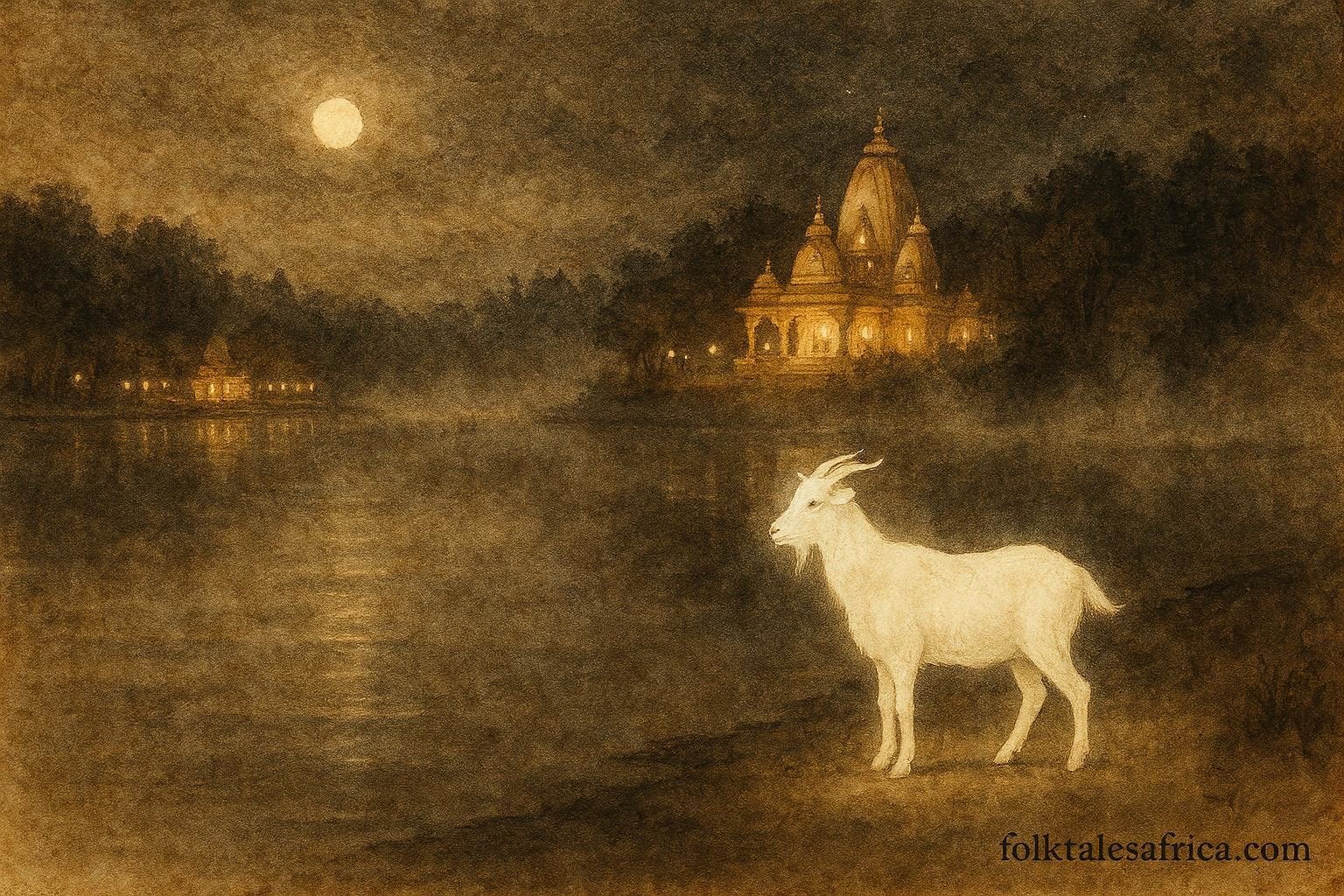
The villagers and pilgrims who speak of it describe a creature unlike any ordinary animal. It is said to appear only during the most silent nights, when the wind rests and the surface of the lake becomes perfectly still, reflecting the sky like a dark mirror.
At such moments, when even footsteps seem too loud against the sacred ground, a faint glow is sometimes seen near the water’s edge.
First, it is mistaken for mist or moonlight. But as it draws closer, it becomes clear that it is something else entirely.
A white goat.
But not just white in color. It is described as radiant, as though light itself rests upon its fur. Its presence is gentle, almost unreal, and it moves without sound, stepping lightly across stones and grass as if the earth beneath it is sacred and fragile.
The people believe this goat is not a normal creature. It is a divine messenger, a guardian spirit of Grand Bassin sent to watch over the holy waters and ensure that the sanctity of the lake is never disturbed.
According to tradition, the White Goat appears only when balance is needed, when the spiritual purity of the place is being tested, or when the intentions of those who come to the lake are unclear.
Those who approach Grand Bassin with respect often feel a deep sense of peace before they even see the goat. The air feels calmer. The water appears stiller. Some say prayers feel easier to speak, as though something unseen is listening.
But the legend carries a warning as well.
Those who come to the lake with disrespectful intentions, whether through impurity of thought, carelessness, or disregard for the sacredness of the space, are said to witness something very different.
They may glimpse the White Goat for only a moment.
And then it disappears instantly.
Not walking away. Not fading slowly. But vanishing as if it was never there at all.
This sudden disappearance is not seen as coincidence. In the stories passed down through generations, it is interpreted as judgment, not harsh or violent, but absolute. A reminder that sacred spaces cannot be approached without reverence.
Because of this belief, Grand Bassin is treated with deep care by those who know its stories. Pilgrims move with quiet respect, voices lowered, steps mindful. Even those who come out of curiosity often find themselves instinctively adjusting their behavior upon arrival, as if the place itself encourages humility.
There is a common story often told among elders to explain the nature of the White Goat.
A young visitor, unfamiliar with the traditions of Grand Bassin, once arrived at the lake with little understanding of its significance. The visitor admired the scenery but treated it as an ordinary place, speaking loudly, walking carelessly near the water’s edge, and showing little awareness of the spiritual importance held by others around.
As evening approached and the sun began to sink behind the hills, the atmosphere shifted. The sounds of birds faded. The surface of the lake became still, reflecting the first stars.
It was then that the White Goat appeared.
Standing near the water, glowing softly against the darkening sky.
The visitor noticed it and felt sudden surprise. For a moment, curiosity replaced disregard. But as the visitor took a step closer, the goat lifted its head.
Their eyes met.
And in that instant, everything changed.
The goat did not move aggressively. It did not make a sound. Instead, it simply vanished, so quickly that the visitor doubted whether it had been real at all.
But the silence that followed felt heavier than before.
The lake remained calm, yet something in the atmosphere had shifted. The visitor, now aware of the sacredness of the place, felt a deep sense of humility settle in.
From that moment onward, they treated Grand Bassin with respect.
In this way, the story is not told to instill fear, but to encourage awareness. The White Goat is not described as a creature of punishment, but as a symbol of presence, an embodiment of the idea that sacred spaces respond to intention, even when words are not spoken.
Within Mauritian Hindu-Creole tradition, Grand Bassin holds a unique place. It is both a physical site of pilgrimage and a spiritual center where faith, nature, and cultural memory meet. The legend of the White Goat reflects this blend of belief systems, combining Indian spiritual symbolism with local island interpretations of nature spirits and guardianship.
Some interpret the goat as a manifestation of divine protection. Others see it as a symbol of the lake’s own spiritual awareness, a way of expressing that nature itself holds memory and judgment. In both interpretations, the message remains the same: the sacred must be approached with purity of intention.
Even today, during pilgrimage seasons, when thousands gather at Grand Bassin to offer prayers and light lamps that float across the water like stars, the legend is still quietly present. It is not spoken loudly, but it is remembered in gestures, in behavior, in the careful way people move around the lake.
And sometimes, in the stillest moments of the night, when the crowd has thinned and the wind rests completely, a few pilgrims claim to see something pale near the water’s edge.
A shape that glows softly.
A presence that does not disturb the silence, but becomes part of it.
The White Goat of Grand Bassin.
Watching.
Guarding.
And reminding all who come that holiness is not only in the place, but in the intention carried into it.
Looking for more? Explore the magic of East African folktales here
Moral Lesson
Sacred places demand respect, not only through action but through intention. Purity of behavior and humility of heart determine how we experience what is holy and meaningful.
Knowledge Check
1. What is the White Goat of Grand Bassin?
It is a glowing spiritual goat believed to be a divine guardian of the sacred lake.
2. Where is Grand Bassin located?
It is a sacred crater lake in the highlands of Mauritius, also known as Ganga Talao.
3. When does the White Goat appear?
It appears during quiet, still nights when the lake is calm and the surroundings are peaceful.
4. What happens to those who disrespect the sacred site?
They are said to see the goat vanish instantly as a sign of spiritual judgment.
5. What does the White Goat symbolize?
It symbolizes divine protection, purity, and respect for sacred nature.
6. What is the main lesson of the story?
It teaches reverence for sacred spaces and the importance of pure intentions.
Source: Mauritian Hindu-Creole folklore blending Indian spiritual beliefs with local island mythology. Based on oral traditions surrounding the Grand Bassin pilgrimage site and documented in 20th-century Mauritian cultural and religious folklore studies.
Cultural Origin: Mauritius (Grand Bassin / Ganga Talao sacred site), oral tradition strengthened in 19th–20th century; documented mid–late 20th century.