Deep within the lush and mist-covered region of Black River in Mauritius, where dense forests stretch across rolling hills and streams cut quietly through ancient earth, there is a legend that has been carried through generations like a whispered secret. It is the story of a mystical object hidden far from human reach, the Bamboo Drum of Black River.
The people who speak of it do so with a sense of reverence, as though the very act of mentioning it might disturb something unseen in the forest. It is not simply a story of magic. It is a story of responsibility, of nature’s balance, and of the fragile line between human desire and respect for the natural world.
Want more? Read more West African folktales now
According to the legend, the bamboo drum is no ordinary instrument. It is said to have been crafted from sacred bamboo found deep within the Black River forests, where the trees grow taller than memory and the air carries the scent of damp earth and wild orchids. The drum itself is believed to have been shaped not by ordinary hands alone, but by spiritual forces tied to nature reverence, blending ancient Malagasy traditions with South Asian spiritual beliefs brought to Mauritius through centuries of cultural exchange.
No one agrees on exactly how it came into existence. Some say it was a gift from nature itself, formed when lightning struck bamboo during a sacred storm. Others believe it was created by a wise guardian of the forest who understood the language of weather and the rhythm of the land. But all versions of the story agree on one truth: the drum is alive in a way human-made objects are not.
The power of the bamboo drum is both extraordinary and dangerous. It is said that when struck, it can summon rain during times of drought, bringing relief to dry fields and restoring life to withering plants. But it can also silence storms, calming violent winds and protecting villages from destruction. In this way, it holds control over the balance of weather itself.
Yet this power does not respond to everyone.
The most important rule of the legend is simple but absolute: the bamboo drum only answers those whose intentions are pure.
Many have searched for it. Farmers desperate for rain, travelers curious about its power, and even those driven by ambition rather than need have ventured into the Black River forest hoping to find it. But the forest does not reveal its secrets easily.
Those who seek the drum for selfish reasons are said to become lost among the trees. The deeper they walk, the more the forest seems to shift around them. Paths that once seemed clear begin to twist. Familiar landmarks vanish. The sound of birds fades, replaced by silence that feels too heavy to be natural.
Some never return at all.
Others are found days or weeks later, wandering at the edges of the forest with no memory of how they got there, as though the jungle itself refused to let them carry knowledge they were not meant to keep.
Because of this, the bamboo drum is not spoken of as a treasure. It is spoken of as a test.
In the villages near Black River, elders tell children that the forest is not empty. It is aware. It listens. It remembers those who enter with greed in their hearts. And it protects what must not be misused.
Among the people who live closest to the forest, there is a deep understanding that nature is not separate from spirit. Rivers, trees, wind, and rain are all seen as part of a living balance. To disturb one part without respect is to disturb everything.
This belief shapes how the story of the bamboo drum is told. It is not presented as an object to be found, but as a lesson that reveals itself only to those who are ready to understand it.
There is a recurring figure in many versions of the tale, a traveler, sometimes described as a farmer, sometimes as a wandering seeker, who enters the Black River forest during a time of severe drought. The land is dry, crops are failing, and the sky has not released rain in many weeks. Desperation spreads through the villages, and hope becomes thin.
The traveler, moved by the suffering of the people, decides to search for the legendary drum. Unlike others, this seeker is not driven by desire for control, but by a wish to restore balance.
As the traveler enters the forest, the air feels different. The heat of the sun fades beneath thick canopy, and the sound of dry leaves crunching underfoot becomes the only companion. Hours pass, then days, as the journey leads deeper into unfamiliar terrain.
Unlike those who came before, the traveler does not force paths open or rush forward with urgency. Instead, there is patience in every step, a quiet respect for the silence of the forest. Hunger and fatigue come and go, but the purpose remains steady.
One evening, when light begins to fade into deep amber between the trees, the traveler hears something unusual, a faint rhythmic sound carried by the wind. It is not the sound of animals or falling branches. It is something more deliberate, like a distant heartbeat.
Following the sound carefully, the traveler moves through tangled roots and moss-covered stones until a small clearing appears.
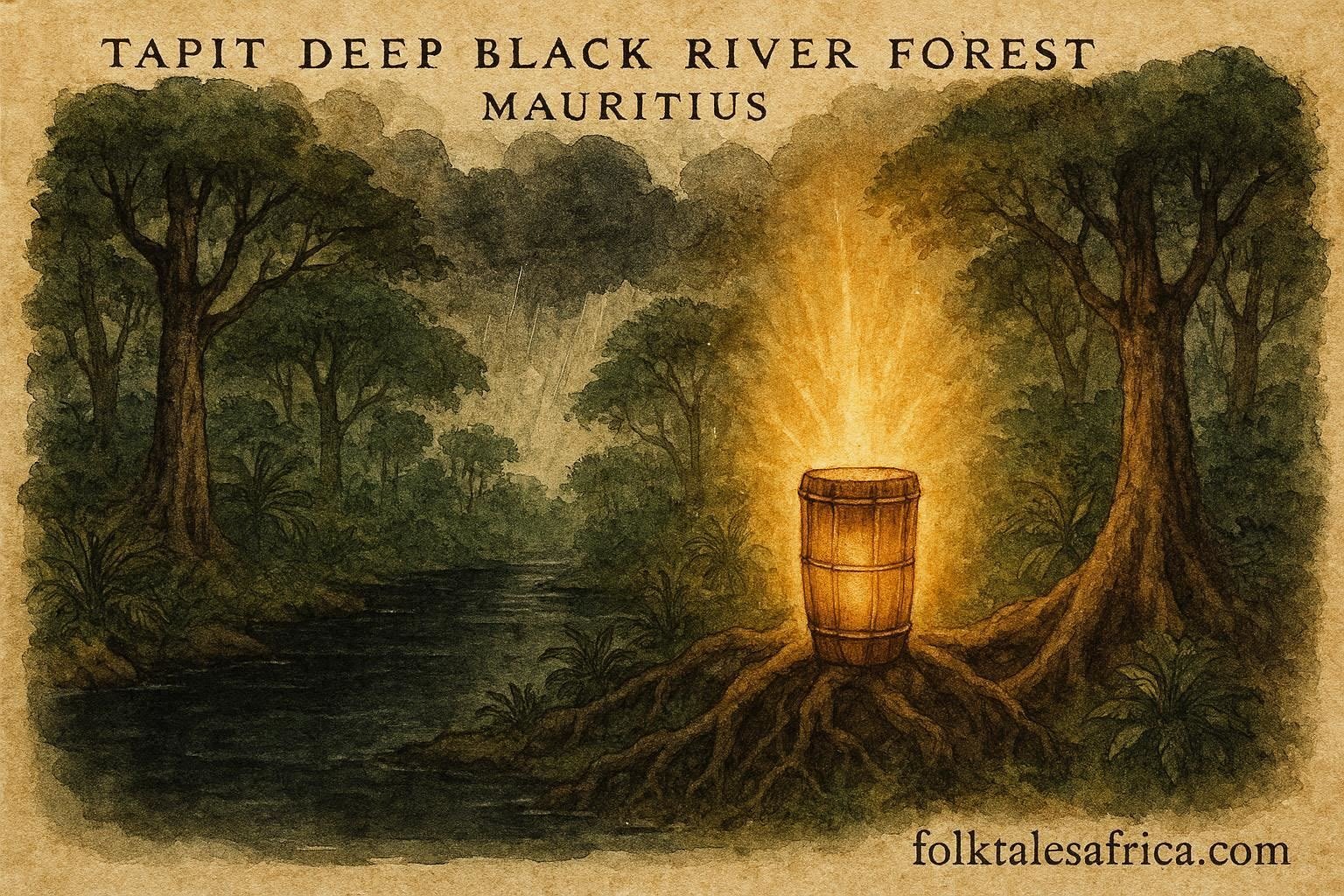
There, resting on a raised bed of roots and stone, lies the bamboo drum.
It is simple in appearance, crafted from pale bamboo polished by time rather than human hands. Yet there is something unmistakably sacred about it. The air around it feels still, as though even the forest pauses in its presence.
The traveler hesitates, understanding instinctively that this is not an object to be taken lightly. The stories are remembered, not as warnings of fear, but as reminders of responsibility.
With great care, the traveler approaches and places a hand upon the drum.
For a moment, nothing happens.
Then, softly, the forest responds.
A breeze stirs through the trees. Leaves shift gently overhead. The atmosphere changes, not dramatically, but with a subtle acknowledgment, as though the land itself is aware of intention.
The traveler does not strike the drum out of curiosity or ambition. Instead, it is touched with a single, respectful motion, an act meant not to command, but to ask.
A deep, resonant sound echoes through the forest.
It is not loud, but it carries far beyond what sound should be able to travel. The earth seems to listen.
Moments later, clouds begin to gather in the distance.
Rain follows, not sudden or violent, but steady and nourishing. It falls across the forest first, then spreads outward toward the villages beyond. Dry soil darkens. Streams begin to flow again. The land slowly returns to life.
The traveler understands then what the elders meant.
The drum is not a tool for control. It is a reflection of intention. It does not obey force, nor does it reward desire. It responds only to harmony, when human need aligns with respect for nature rather than domination over it.
After the rain, the forest becomes quiet again. The drum remains where it is, unchanged, as though it has fulfilled only a momentary role in a much larger balance.
The traveler does not attempt to take it. There is no need. The lesson has already been received.
From that time onward, the story of the bamboo drum becomes not a tale of possession, but of understanding. It teaches that nature does not exist to be controlled, even when the need is great. It responds only when approached with humility, care, and purity of purpose.
And so, the Bamboo Drum of Black River remains hidden within the forest, neither lost nor found, but simply present, waiting for the rare moment when intention and balance meet once again.
Continue your journey: Read more East African folktales
Moral Lesson
True power over nature is not gained through control or desire, but through respect, balance, and pure intention. Greed disrupts harmony, while humility restores it.
Knowledge Check
- What is the Bamboo Drum of Black River?
It is a magical drum in Mauritian folklore believed to control rain and storms. - Where is the bamboo drum said to be located?
It is hidden deep within the Black River forest region in Mauritius. - What powers does the drum have?
It can summon rain during droughts and stop destructive storms. - Who can successfully use the bamboo drum?
Only individuals with pure intentions and respect for nature can activate its power. - What happens to those who try to exploit it?
They are said to become lost in the forest and unable to find their way out. - What is the main lesson of the story?
It teaches responsibility, harmony with nature, and the dangers of greed.
Source: Mauritian Creole folklore with Malagasy and South Asian spiritual influences tied to nature reverence. Collected from oral traditions and referenced in mid–20th century cultural anthropology studies (1950s–1980s documentation).
Cultural Origin: Mauritius (Black River region folklore), likely pre-colonial oral tradition.